One plan, one building era
Hunters Creek is an unincorporated, master-planned community in south Orange County, next to the Osceola County line. Planning started in 1984, construction was announced in 1986, and most of it went up in the late 1980s and 1990s. It is laid out as 38 single-family and 10 multi-family neighborhoods around features such as the man-made Lake Calabay, under the Hunter’s Creek Community Association (Hunter’s Creek, Florida).
Census estimates for 2020–2024 match that history. The median home was built in 1996, only 2.1% of homes predate 1980, and roughly two-thirds (by our arithmetic from the published shares) were built between 1980 and 1999. Just under half, 49.8%, are detached houses; the rest are townhomes, condos and apartments. The median value is $450,100 (Census ACS via Census Reporter).
| Home type | Dryer vent | Fireplace | First thing to check |
|---|---|---|---|
| Townhome or condo | Often a longer run through walls, between floors or to the roof | Less common; factory-built where present | Drying time and the outside termination |
| Detached house, late 1980s–1990s | Usually an exterior wall, sometimes through the attic | Likely factory-built in a framed chase | Chase cover and storm collar |
| Detached house, 2000s | Wall or roof, depending on laundry location | Factory-built wood, gas or electric | Dryer run length and cap type |
Dryer vents where homes share walls
With half the homes attached, the dryer vent is the one system nearly every Hunters Creek household has. In a townhome or condo the duct often can’t go straight out the back, so it turns through a wall cavity or ceiling to reach an outside wall or the roof. Every turn adds resistance, and in homes of this age the original duct may have been joined with screws that catch lint, or connected with a foil hose that has since been crushed.
Dryer vent system, from dryer to termination
- 1Lint screen. Catches most lint inside the dryer. What gets past it collects in the duct.
- 2Transition duct. Short connector from the dryer to the wall. Easily crushed behind the machine.
- 3Duct run. Smooth 4-inch metal duct through walls, floors or the attic.
- 4Elbows. Every bend adds resistance and counts against the allowed duct length.
- 5Roof cap. Roof termination, common on two-story homes. Hard to see and to clean.
- 6Wall hood. Side-wall termination. Must open freely and has no screen.
- 7Backdraft damper. Flap that opens under airflow and closes to keep out air, rain and pests.
The reason to stay ahead of it is fire. NFPA estimated an average of 13,820 home structure fires a year involving clothes dryers in 2014–2018, and failure to clean was the leading factor (NFPA). A professional dryer vent cleaning clears the whole run. Where the duct has separated, been crushed or uses non-compliant material, dryer vent repair replaces that section. If you’ve moved into a unit and don’t know the vent’s history, a full vent inspection maps the run before anything is changed. A burning smell at the dryer is a reason to stop using it until the vent is checked, and dryer vent fire risk explains why.
Chase covers on the original houses
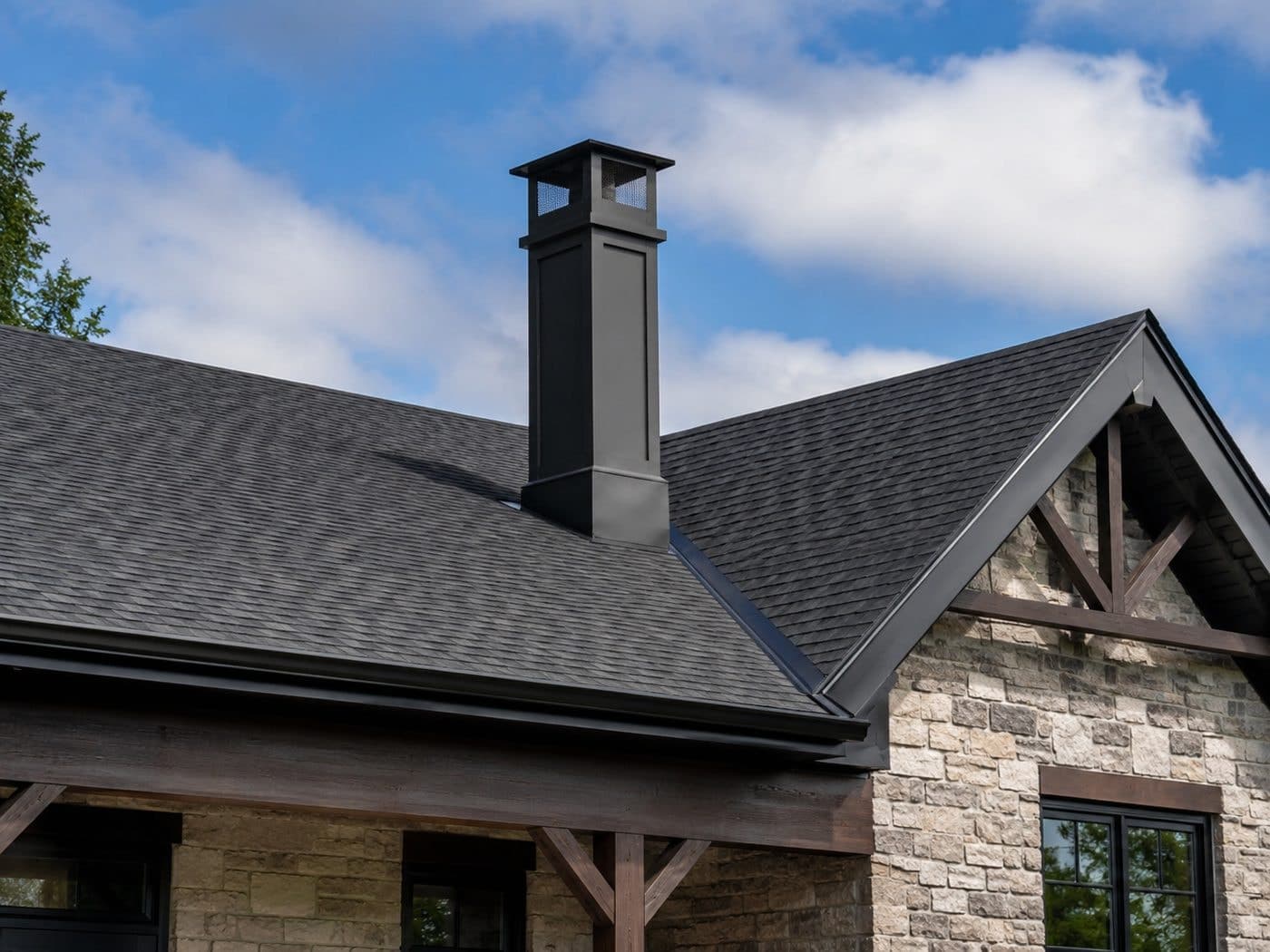
Most detached homes here that have a fireplace likely have a factory-built unit in a framed chase, given when they were built. On a house from the late 1980s or 1990s that has never had its chase cover replaced, the cover may be 30 years old or more. Plain galvanized covers eventually rust, and a flat one can sag and hold water.
How an old chase cover gives itself away
01Rust streaks down the chase
- What you may notice
- Orange or brown stains starting just below the top of the chase and running down the siding.
- How it’s confirmed
- Look for surface rust versus holes in the cover, and whether water pools on it.
02Water in the firebox
- What you may notice
- Rust flakes or damp spots on the firebox floor after heavy rain, without a ceiling stain.
- How it’s confirmed
- Check the storm collar seal around the flue pipe and the cover’s center hole.
03Soft siding near the top
- What you may notice
- Paint bubbling, trim pulling away, siding that gives when pressed.
- How it’s confirmed
- Probe the chase siding and framing below the cover for rot.
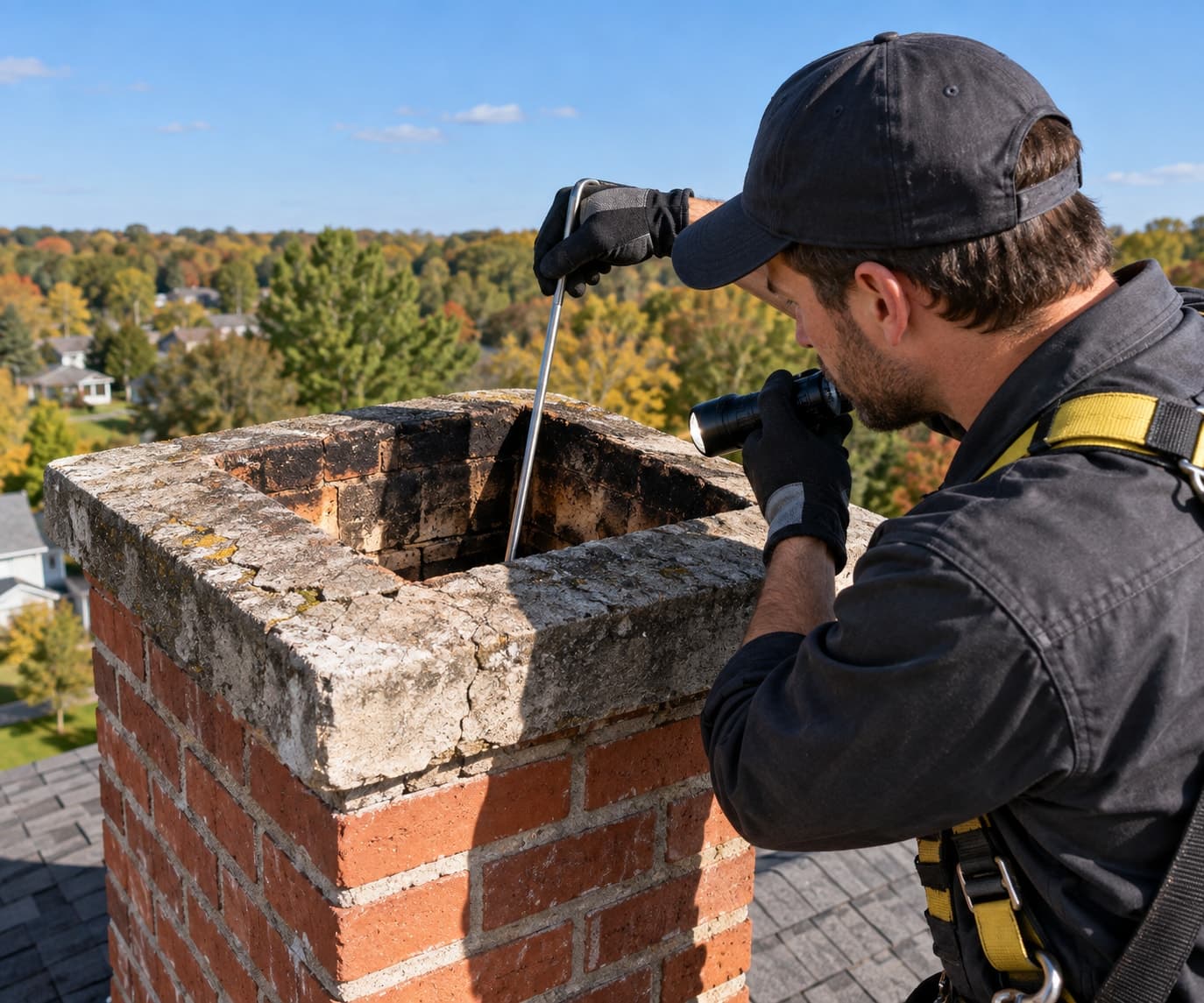
A cover with rust holes or a sagging center is replaced rather than patched; the chimney cap vs. chase cover guide explains why the two parts do different jobs. A yearly chimney inspection looks at the cover, the collar and the firebox together.
- Stains on a ceiling or wall near the fireplace after a storm: a leak diagnosis follows the water back to the cover, collar or siding before anything is replaced.
- A wood-burning unit used on cool nights: chimney sweeping clears soot and creosote from the metal flue.
- Cracked panels, a stuck damper or loose doors: repairs to the fireplace itself with parts listed for the model.
- A gas fireplace: yearly gas fireplace service covers the pilot, burner, glass and vent.
- A townhome dryer duct that ends on the roof: roof dryer vent cleaning includes the cap, where lint collects.
Working with the community association
The Hunter’s Creek Community Association has an Architectural Review Committee that oversees the community’s exterior guidelines (HCCA committees), and a neighborhood may also have its own association. Changes to how a home looks from outside generally go through a request first.
Before exterior chimney or vent work
Check your governing documents
Find out whether your neighborhood has its own association on top of the master association, and which one controls exterior changes.
Describe the change
A like-for-like chase cover or vent cap is a different request from a new cap style, a different color or relocating a vent.
Ask about timing
Review takes time, so ask how long before scheduling work that changes the roofline or siding.
In condos, confirm responsibility
The association may own the roof, walls and vent terminations, and may need to arrange work on them itself.
Backyard fire pits
Hunters Creek is in Orange County, where recreational fires must be at least 25 feet from any building or combustible structure, attended, with a hose ready, and are banned automatically when the county’s drought index reaches 500 (Orange County EPD). Association rules may add their own limits.
References (5)
Facts and figures on this page come from these references.