On this page
- The parts of chimney flashing
- Chimney crickets (saddles)
- Signs of failing chimney flashing
- Sealant vs a real flashing repair
- Flashing on tile, shingle and metal roofs
- Roofer or chimney company for flashing?
- Flashing and a new roof
- Factory-built chimneys have flashing too
- What affects the cost of flashing repair
- Crickets and saddles
Short answer: chimney flashing is two overlapping layers of metal. The lower layer is worked into the roof covering; the upper layer, the counterflashing, is set into the chimney and laps down over it. Most roof-line leaks come from one of those layers coming loose, rusting, or being replaced by a bead of sealant. A repair can be as small as resetting counterflashing, or as large as removing the roofing around the chimney and reflashing it completely.
The telltale sign is a stain on the ceiling or wall right next to the chimney, often worst after wind-driven rain. If you’re still working out what a stain like that means, the page on water stains around a chimney walks through the possibilities.
Masonry chimney and fireplace, cutaway
- 1Chimney cap. Metal lid with mesh sides over the flue opening. Keeps rain, debris and animals out.
- 2Crown. The concrete or mortar top of the masonry, sloped to shed water away from the flue.
- 3Flue liner. Clay tile or metal lining that carries smoke up and protects the masonry from heat.
- 4Flashing. Metal that seals the joint between the chimney and the roof.
- 5Brick & mortar. The chimney structure. Mortar joints and brick faces absorb water when they wear.
- 6Smoke chamber. The sloped transition that funnels smoke from the firebox into the flue.
- 7Damper. Metal plate at the throat (or a sealing lid on top) that closes the flue when not in use.
- 8Firebox. Where the fire burns. Firebrick laid in heat-resistant mortar.
- 9Hearth. Non-combustible floor extension in front of the fireplace opening.
The parts of chimney flashing
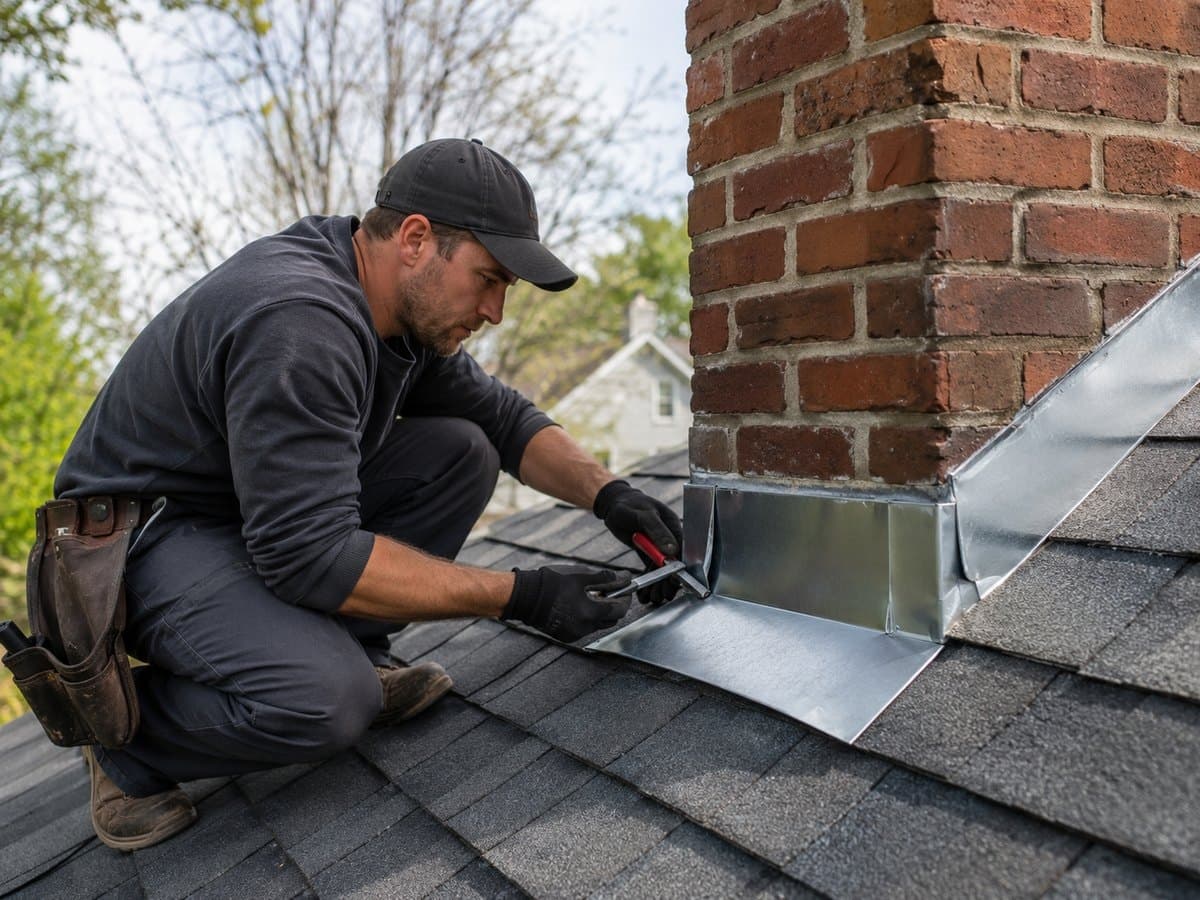
- Front (apron) flashing runs across the downhill face of the chimney and laps over the roofing below it.
- Step flashing is a series of L-shaped pieces along each side, one per course of shingles or tile, woven in so each piece sheds onto the course below.
- Counterflashing is set into the chimney, usually in a cut mortar joint called a reglet, and bent down over the step flashing. It covers the top edge of the step flashing so water can’t get behind it.
- Back flashing or a cricket handles the uphill side, where water running down the roof hits the chimney head-on.
The two-layer design is deliberate. The roof and the chimney move independently, so the step flashing moves with the roof while the counterflashing moves with the chimney, and the overlap between them keeps water out without either being fastened to the other. The Florida Building Code requires flashing at wall and roof intersections and around roof openings (FBC Residential R903.2.1); for shingle roofs, chimney flashing follows the shingle manufacturer’s instructions (R905.2.8.4), and for clay and concrete tile it calls for flashing and counterflashing at vertical surfaces (R905.3.8).
Chimney crickets (saddles)
A cricket, also called a saddle, is a small peaked roof built on the uphill side of a chimney. It splits the water coming down the slope and sends it around the chimney instead of letting it pool against the back wall, where leaves and debris collect too.
When the code calls for a cricket
Florida’s residential code requires a cricket on the ridge side of any chimney or penetration more than 30 inches wide measured perpendicular to the slope (R903.2.2). The chimney chapter says the same thing from the other direction: a cricket is required where the chimney’s dimension parallel to the ridgeline is greater than 30 inches and it doesn’t intersect the ridge, and the cricket must be flashed and counterflashed like the rest of the chimney (FBC Residential R1003.20). Older chimneys built before this was enforced sometimes don’t have one.
Signs of failing chimney flashing
What goes wrong with flashing, and how each problem is confirmed
01Counterflashing pulled out of the joint
- What you may notice
- Metal bowed away from the brick, sealant hanging loose, a visible gap at the top edge.
- How it’s confirmed
- We check whether the counterflashing is let into a reglet or only surface-mounted, and whether the mortar joint holding it has eroded.
02Flashing held on by sealant alone
- What you may notice
- A thick bead of caulk or tar where metal should overlap metal; leak comes back a season after each reseal.
- How it’s confirmed
- We look for missing counterflashing or step flashing replaced by sealant, and for layers of old sealant hiding open joints.
03Corroded or damaged step flashing
- What you may notice
- Rust stains on the roofing along the side of the chimney, pinholes, dented or torn pieces.
- How it’s confirmed
- Where the roofing allows, a course or two is lifted to see the step flashing underneath; attic framing below is checked for water tracks.
04No cricket, or a failed one, behind a wide chimney
- What you may notice
- Debris packed against the uphill side, stains in the attic below the back of the chimney, leaks in heavy rain.
- How it’s confirmed
- We measure the chimney across the slope and check the back flashing and any cricket for open seams and ponding.
05Tile disturbed around the chimney
- What you may notice
- Cracked, slipped or poorly cut tiles next to the chimney; old mortar or foam at the tile edges breaking up.
- How it’s confirmed
- We check how the tile was cut and sealed against the flashing and whether the pan or channel under it is intact.
06The water is coming from higher up
- What you may notice
- Flashing looks sound but the stain persists, or water also shows up in the firebox.
- How it’s confirmed
- The crown, cap and brick above the roof line are checked too, since water entering there can exit at the flashing.
Sealant vs a real flashing repair
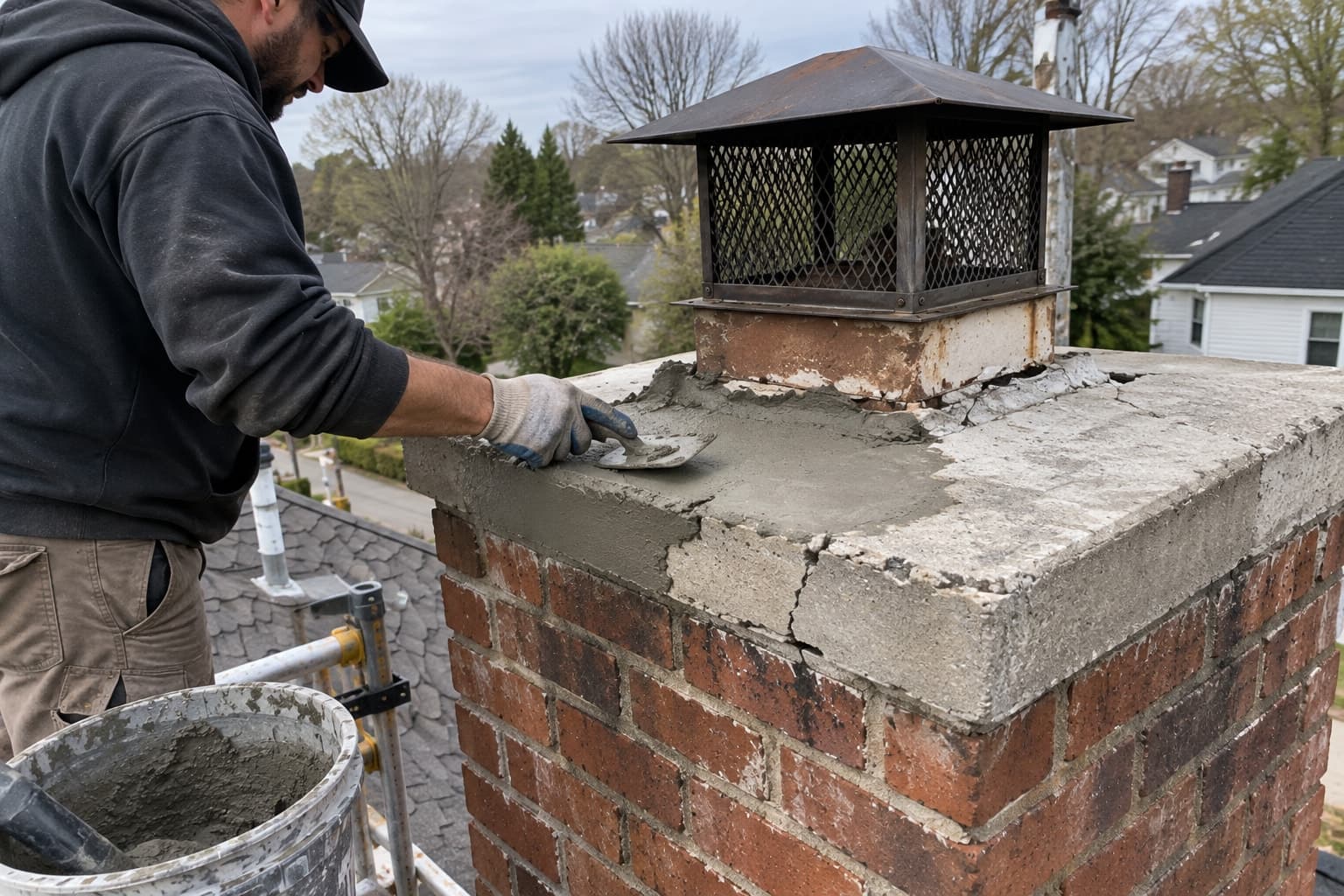
Sealant has a legitimate place: the top edge of counterflashing in a reglet is normally sealed, and that bead is a maintenance item that dries out over time. The problem is sealant used as the flashing, with a caulk joint standing in for overlapping metal.
| Feature | Resealing / caulking | Flashing repair or reflash |
|---|---|---|
| Good for | Renewing the sealant at the top of sound counterflashing | Missing, corroded, loose or badly lapped metal |
| How water is kept out | An adhesive bead that has to stay bonded to two materials | Overlapping metal that sheds water even if a sealant bead fails |
| Movement between roof and chimney | Stresses the bead until it cracks or peels | Absorbed by the two independent layers |
| Typical life | Depends on the product and exposure; needs periodic renewal | Tied to the metal and the roof covering around it |
| Risk | Hides the real defect; must be removed before a proper repair | Needs roofing disturbed, so it should be coordinated with a roofer when the roof is involved |
Good for
- Resealing / caulking
- Renewing the sealant at the top of sound counterflashing
- Flashing repair or reflash
- Missing, corroded, loose or badly lapped metal
How water is kept out
- Resealing / caulking
- An adhesive bead that has to stay bonded to two materials
- Flashing repair or reflash
- Overlapping metal that sheds water even if a sealant bead fails
Movement between roof and chimney
- Resealing / caulking
- Stresses the bead until it cracks or peels
- Flashing repair or reflash
- Absorbed by the two independent layers
Typical life
- Resealing / caulking
- Depends on the product and exposure; needs periodic renewal
- Flashing repair or reflash
- Tied to the metal and the roof covering around it
Risk
- Resealing / caulking
- Hides the real defect; must be removed before a proper repair
- Flashing repair or reflash
- Needs roofing disturbed, so it should be coordinated with a roofer when the roof is involved
Flashing on tile, shingle and metal roofs
Clay and concrete tile roofs are a common sight in Central Florida, and they change how flashing work is done. The roof covering decides how the lower layer is installed, how much of the roof has to be opened up, and who should be on the roof.
| Roof | How the chimney is flashed | What makes repairs tricky |
|---|---|---|
| Asphalt shingle | Step flashing woven with each shingle course, counterflashing over it, per the shingle maker’s instructions | Shingles near the chimney have to be lifted without tearing; brittle older shingles may need replacing |
| Clay or concrete tile | Flashing and counterflashing at the chimney, with tiles cut and fitted around it and often a pan or channel beneath | Tiles crack if walked on carelessly; cut tiles and their sealing have to be redone; best coordinated with a tile roofer |
| Metal (standing seam or panel) | Custom-bent flashing and trim matched to the panel profile, with room for the panels to expand | Fasteners through panels can leak; the roofer or panel manufacturer’s details usually apply |
Roofer or chimney company for flashing?
The honest answer is that the job often needs both. The lower layer lives in the roof covering, so on tile and metal especially, a roofer is the right person to open and close the roof around the chimney. The counterflashing, the reglet and the chimney above it are masonry work. What matters is that someone checks both before money is spent, so a roofer doesn’t reflash a chimney whose real leak is a cracked crown on top, and a chimney company doesn’t reseal counterflashing over rusted step flashing. When the roof side needs work, we say so and describe what the roofer should look at. If the source is still unclear, a top-down leak investigation sorts out which component is actually letting water in.
Flashing and a new roof
A reroof is the easiest time to get chimney flashing right, and also a common time for it to go wrong: old counterflashing gets bent back and reused, or the new roof is simply caulked to the chimney. Our guide on coordinating a reroof around a chimney goes through the order of work in detail. In brief:
Inspect the chimney before tear-off
Crown, cap, brick and counterflashing are checked while there’s still time to plan, so chimney repairs above the roof line can be done before the new roofing goes on.
Decide what gets reused
Sound, well-fastened counterflashing can sometimes stay. Rusted, torn or surface-mounted counterflashing should be replaced, not bent back into place.
Add a cricket if the chimney needs one
A wide chimney without a cricket is simplest to fix while the roof deck is open.
Roofing, then counterflashing
The roofer installs underlayment and the lower flashing with the new roof covering; counterflashing is then let into the chimney and lapped over it.
Factory-built chimneys have flashing too
A framed chase that passes through the roof is flashed like a wall, with step flashing along its sides and the siding or stucco acting as the upper layer. When a chase leaks at the roof line, the fix usually involves the siding, housewrap and trim as well, which is covered on our prefab chimney and chase repair page.
Wind can lift counterflashing and crack tile around a chimney without anything looking obviously wrong from the yard. If a stain appeared after a named storm, a post-storm chimney inspection checks the flashing along with the cap, crown and masonry. On older brick, eroded joints above the flashing can also let water in behind it, which is where a breathable chimney water repellent may help once the joints are repaired.
What affects the cost of flashing repair
Resealing a joint and reflashing a chimney through a tile roof are very different jobs. The main factors are listed below.
- Reseal or reset versus new counterflashing versus a full reflash
- Roof covering: shingle, tile or metal, and how much has to be removed and replaced
- Chimney width and whether a cricket is needed
- Roof pitch and height
- Metal chosen for the new flashing
- Condition of the mortar joints the counterflashing sits in
- Whether a roofer is needed for the roof side of the repair
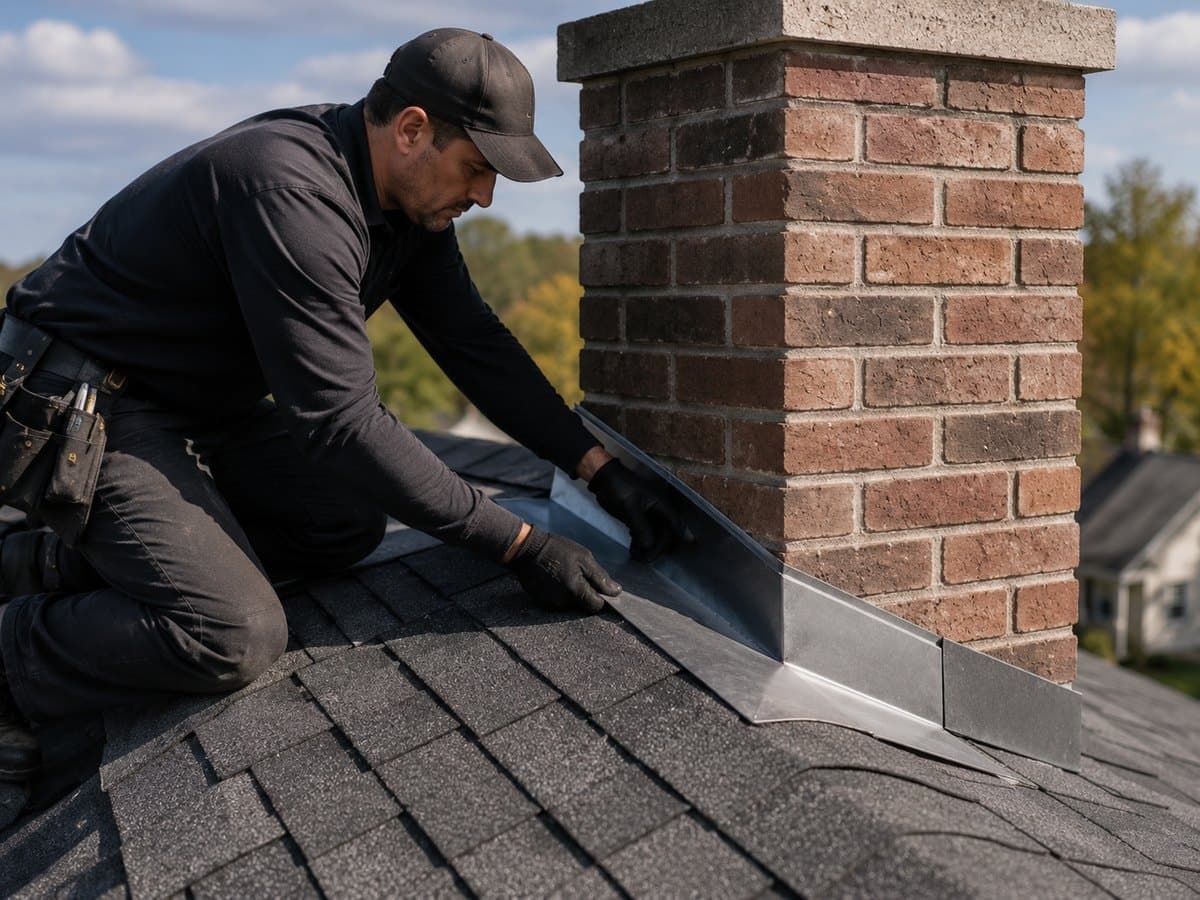
Crickets and saddles
On a chimney wider than about 30 inches sitting on a sloped roof, the upslope side collects water and debris in a way the flashing alone cannot handle. A cricket — also called a saddle — is a small peaked structure built behind the chimney to divert water around it.
Where one is missing on a wide chimney, no amount of resealing the flashing will fix the recurring leak, because the problem is water sitting against the masonry rather than the flashing failing. Where one exists, its own flashing and the valley it creates are worth checking, since debris collects there.
Flashing work frequently overlaps with roofing, and where a reroof is planned it is far cheaper to coordinate the two — reroofing around a chimney covers how that usually works.
References (2)
Facts and figures on this page come from these references.