On this page
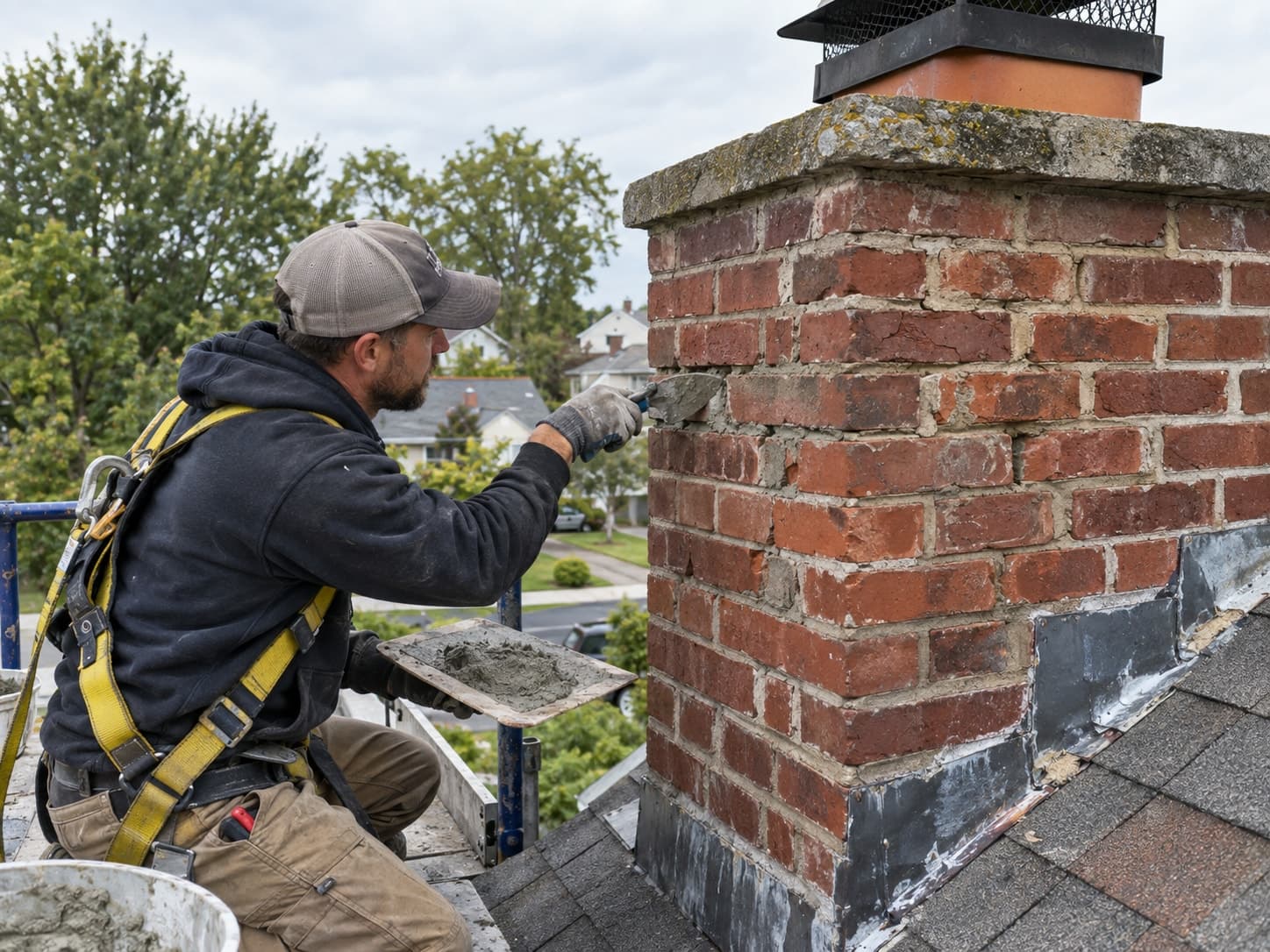
Mortar is designed to be the sacrificial part of a brick wall. It is softer than the brick, so movement and weather wear the joints instead of cracking the bricks. On a chimney, which takes rain from every side and heat from inside, joints eventually crumble, recede and open up. Water then moves into the masonry, rusts dampers, stains interior walls and, over time, loosens bricks.
“Tuckpointing” strictly means a decorative finish with a thin line of contrasting mortar. Today most people use the word for repointing: replacing failing mortar. That repair is what this page describes. Broken or spalled bricks and structural problems are covered under chimney masonry repair.
How water gets in through mortar joints
A chimney has far more mortar joint than most walls of the same size, and every joint is a path for water once it cracks or recedes. Rain that runs down the face gets drawn into open joints, soaks the brick from behind, and then has nowhere to go but inward: onto the flue tile, the smoke chamber, the damper and the framing beside the chimney. In Central Florida’s wet season, with heavy afternoon storms and rain driven sideways by wind, a chimney with open joints on its exposed faces can take in a surprising amount of water in one storm.
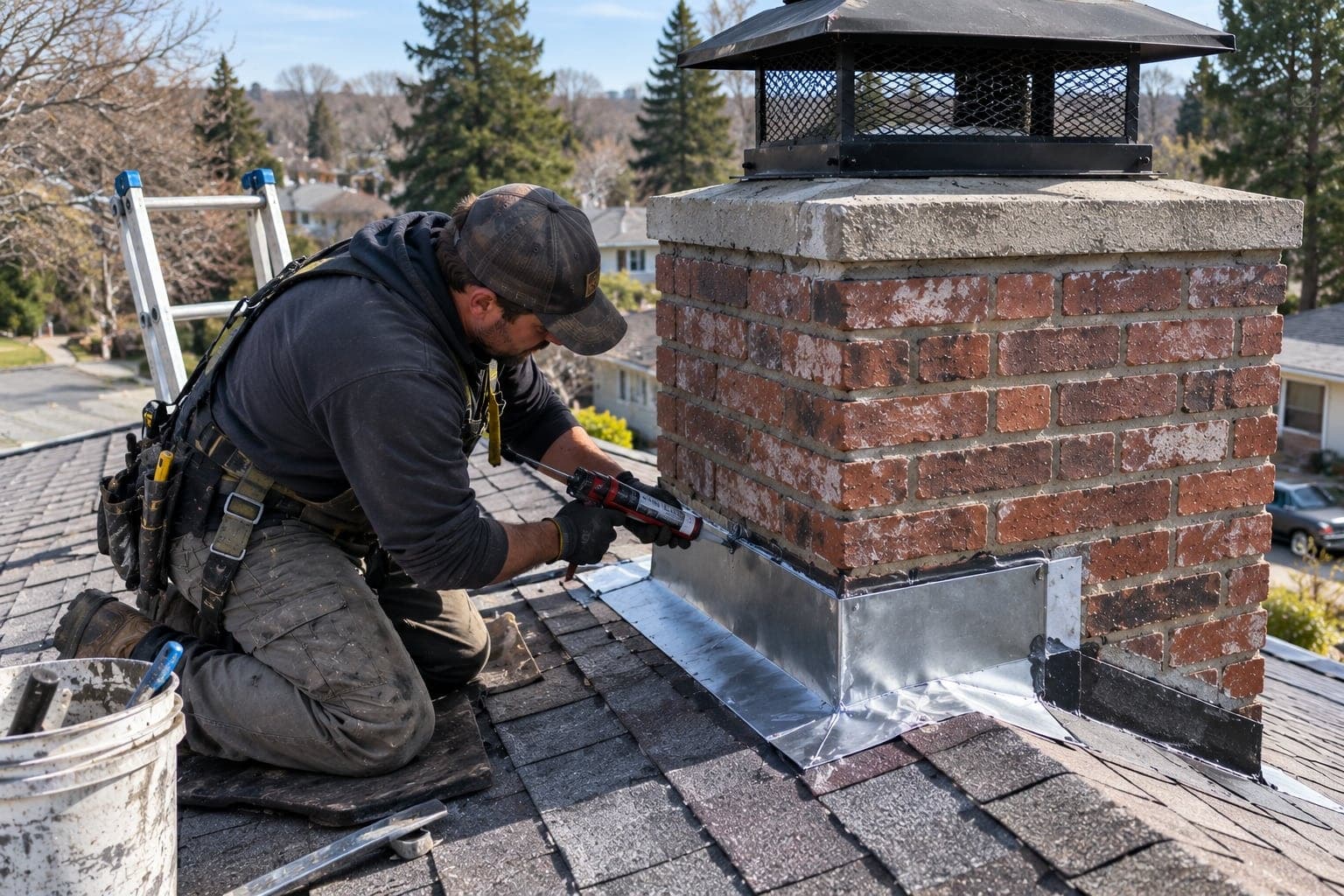
That’s why repointing is often part of a chimney leak repair: the flashing and crown may be fine, and the water is simply walking in through the joints.
Signs a chimney needs repointing
- Mortar that crumbles when scratched with a key
- Joints recessed well behind the face of the brick
- Gaps, holes or hairline cracks along the joints
- White staining (efflorescence) on the chimney, a sign of water moving through it
- Water stains inside near the chimney after heavy rain
- Loose bricks near the top of the chimney, where weather hits hardest
White streaks are often the first thing homeowners notice. Our guide to white stains on a chimney explains what efflorescence means and when it points to a mortar problem.
How repointing is done right
Assess the joints
We find where mortar has failed, test how deep, and check the crown, flashing and cap, since those often cause the water damage in the first place.
Rake out to sound mortar
Old mortar is removed to a consistent depth. The National Park Service guidance is roughly two to two-and-a-half times the joint’s width, and never by damaging the brick edges (NPS Preservation Brief 2).
Clean and dampen
Joints are cleared of dust and lightly dampened so the new mortar bonds instead of drying too fast in Florida heat.
Fill in layers
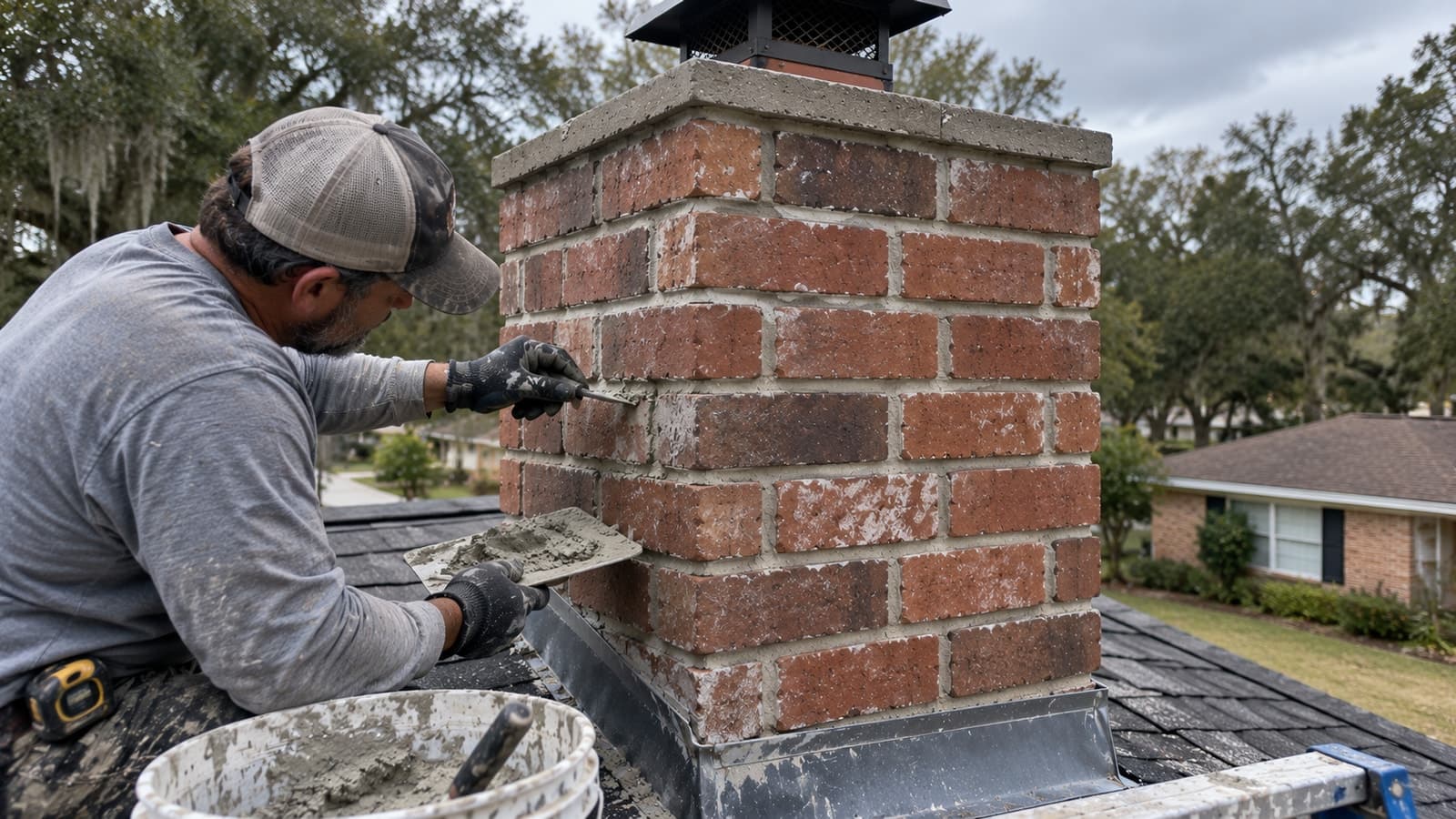
Deep joints are filled in layers, each allowed to firm up before the next, then tooled to match the existing joint profile.
Cure and clean
The new mortar is protected from drying out too quickly, and the brick face is cleaned of residue.
Tuckpointing, masonry repair or a rebuild?
| Condition | Right job |
|---|---|
| Joints crumbling, recessed or cracked; bricks sound and tight | Tuckpointing (this page) |
| Some bricks spalled, cracked or loose, joints mostly fine | Brick and masonry repair |
| Loose brick and failed joints through the top courses, or storm damage above the roof | Partial chimney rebuild |
| Joints fine but water still soaking into the brick | A breathable water repellent |
Choosing the right mortar
The most common repointing mistake is mortar that is harder than the brick. Hard, high-cement mortar doesn’t flex, and it traps moisture in the brick, which then spalls and cracks around the new joints. The NPS guidance is that repointing mortar should be softer and more permeable than the masonry units (NPS Preservation Brief 2). Older chimneys in historic neighborhoods such as Winter Park, Sanford and Mount Dora often need a softer, lime-rich mix. Color and joint profile are matched so the repair doesn’t stand out.
Protecting the repair
Repointing fixes the joints, but the chimney also needs a sound crown and flashing to stay dry. Once the new mortar has cured, a vapor-permeable water repellent can reduce how much rain the masonry absorbs; see breathable water repellents for brick. If the crown is cracked, chimney crown repair is usually done in the same visit.
Matching the mortar
The part that separates a repointing job that lasts from one that causes damage: the new mortar has to be no harder than the brick around it.
This is counter-intuitive. A stronger mix sounds better, but mortar is meant to be the sacrificial element — softer than the brick, so that movement and moisture are taken up by the joints rather than by the masonry. Repoint an older soft brick chimney with a hard modern mix and the brick faces start spalling instead, which is a far more expensive problem than the joints ever were.
What the mortar is matched on
- Compressive strength relative to the brick, which is the one that matters structurally
- Joint profile — concave, weathered, flush or raked — so the repair does not read as a patch
- Colour, which changes as the mix cures and is judged wet rather than dry
- Sand grading, which affects both texture and colour more than people expect
- Joint depth: cut back far enough to hold, typically around two and a half times the joint width
The National Park Service guidance on repointing historic masonry sets out the principle in detail, and it applies to any older brick rather than only to listed buildings.
Tuckpointing is carried out across Orlando, College Park, Winter Park, Maitland, Eatonville and the rest of the cities we serve, with free estimates. Older neighbourhoods here have the softer brick where mortar matching matters most.
References (2)
Facts and figures on this page come from these references.