On this page
- Which gas fireplace page fits your project?
- Types of gas fireplaces
- Choosing the location and vent route
- Replacing an old gas fireplace
- What’s included, and who does what
- How an installation runs
- After installation
- Linear and modern formats
- Venting and termination
- Blowers, remotes and controls
- Getting gas to the unit
Gas fireplaces suit the way many Central Florida homes use a fireplace: a handful of cool evenings a year, a quick start and no wood to store in the humidity. Modern direct-vent units are sealed from the room. They pull combustion air from outside and send exhaust out through the same vent, so they don’t use room air or pull conditioned air up a chimney.
Which gas fireplace page fits your project?
| Your situation | Where it’s covered |
|---|---|
| No fireplace yet, or a wall or room you want to add one to | This page: a new direct-vent gas fireplace |
| An old gas fireplace that is worn out, discontinued or not the look you want | This page: gas fireplace replacement |
| A masonry wood-burning fireplace you want to convert to gas | Insert installation, where a sealed gas insert goes into the existing firebox |
| A gas fireplace that works but hasn’t been maintained | Yearly gas fireplace service |
| A gas fireplace that won’t light, shuts off or soots | Repairing the existing unit |
| A new wood-burning or electric fireplace | Fireplace installation |
Types of gas fireplaces
| Type | Where it goes | Venting |
|---|---|---|
| Direct-vent fireplace | New wall or chase; traditional or modern linear designs | Co-axial vent through an exterior wall or the roof |
| See-through or multi-sided direct-vent | Between rooms, or as a feature wall | Co-axial vent; more framing and finish detail |
| Gas log set | In an existing wood-burning fireplace | Uses the open chimney; the damper must stay open |
| Vent-free units | Rooms without venting | No vent; combustion products and moisture stay in the room, so many owners avoid them |
For a Florida home, the vent-free trade-off is worth weighing carefully. A vent-free unit releases water vapor into rooms that are already humid, and it comes with run-time and room-size limits in its manual. Direct-vent units avoid both. The gas vs wood fireplace guide compares fuel choices more broadly.
Choosing the location and vent route
The vent route often decides where a gas fireplace can go. Each model’s installation manual lists the vent lengths, number of elbows, horizontal and vertical runs and termination positions it allows, and the installation has to stay inside those limits.
- Exterior walls allow a short horizontal vent straight out the back, which is the simplest route
- Interior walls usually need a vertical vent up through the ceiling and roof, if the model allows that run
- Termination clearances from windows, doors, soffits, corners, decks and walkways are set by the manual and checked before anything is cut
- Wind and weather: terminations on exposed walls and roofs are placed and fastened with Florida storms in mind
- Heat above the opening: TVs and mantels over a fireplace need the clearances the manual specifies, and some models are built for it
Replacing an old gas fireplace
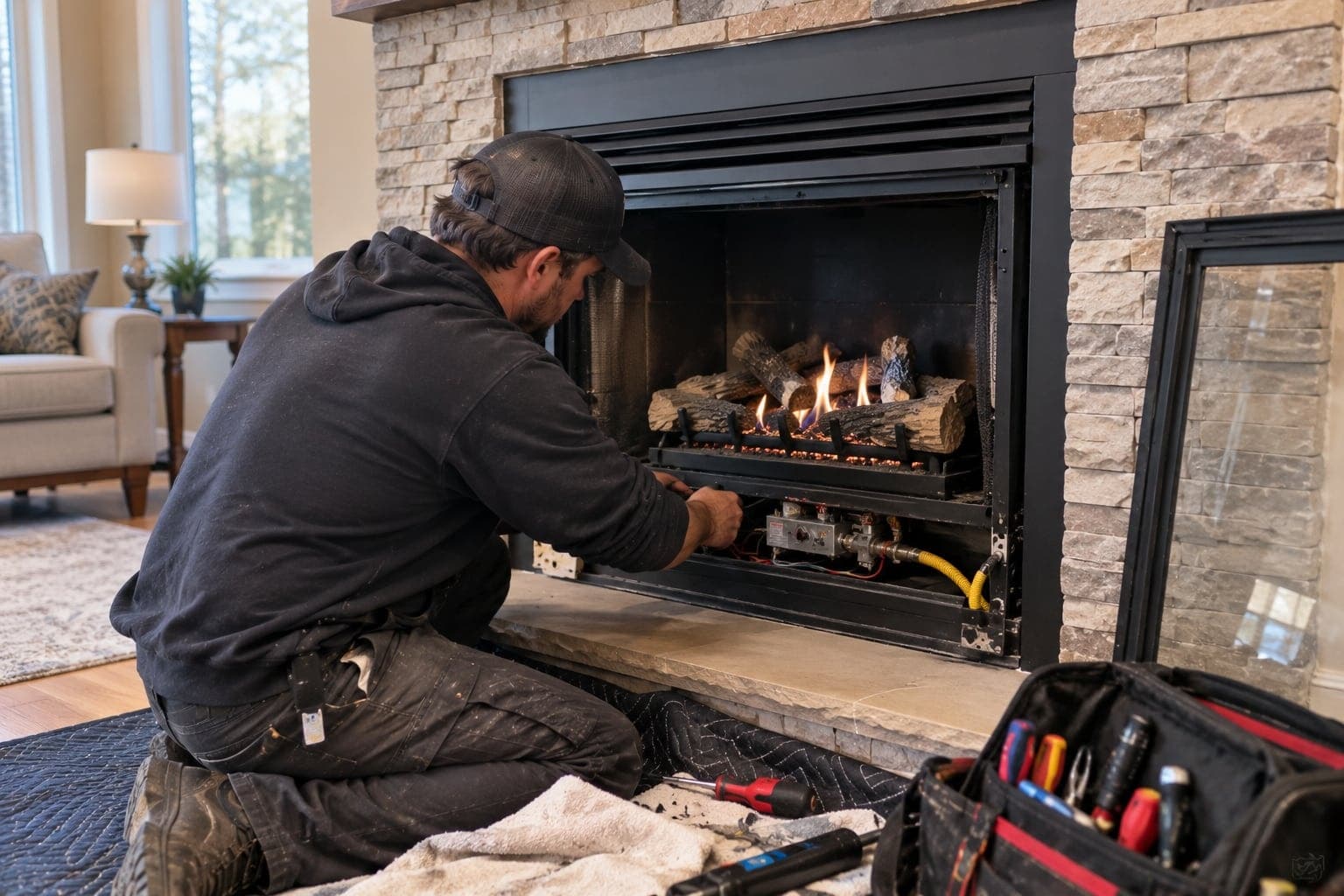
A gas fireplace that is original to the house can be decades old. When a unit has a rusted burner or firebox, controls that are no longer made, or glass and gaskets that can’t be sourced, replacement usually makes more sense than repair. A few things shape a replacement:
- Vent compatibility. Vent systems are generally specific to a manufacturer. Existing vent pipe is reused only where the new unit’s instructions allow it; otherwise the new unit gets the vent components it lists.
- The framed opening. A same-size replacement is simplest. A larger or linear unit means reframing and new finish work.
- Fuel. The new unit is ordered for natural gas or propane, whichever the home has.
- The existing gas connection. It is checked and, if it needs to change, altered as part of the gas-line scope.
If you aren’t sure whether your current fireplace is worth fixing, a diagnosis of the existing unit comes first. Wood-burning factory-built units follow a different path, covered under prefab fireplace replacement.
What’s included, and who does what
| Part of the job | Who handles it |
|---|---|
| Unit selection, sizing and the vent plan | Us, with you |
| Setting the unit and installing the listed venting and termination | Us, to the manufacturer’s instructions |
| Framing and finish to the unit’s clearances, with non-combustible materials where required | Us, or coordinated with your contractor on a remodel |
| Gas piping, the appliance gas connection and the leak or pressure test | Separate, permitted gas-line work |
| A new electrical outlet or circuit for igniters, blowers and remotes | A licensed electrician, where one is needed |
| Permits and inspections | As the local building department requires, pulled for the work being carried out |
How the gas supply is handled
Installing or altering gas piping in Florida is permitted and inspected work, regulated under F.S. 489.105 for natural gas and FDACS Chapter 527 for LP gas. We handle the fireplace, the venting and the supply, with the gas run as its own permitted stage — so it is one plan and one schedule rather than two trades blaming each other. What applies at your address is confirmed with the building department before work starts.
How an installation runs
Site visit
Location, wall or roof, vent route, gas availability and how you’ll use the fireplace.
Unit and plan
Models that fit, vent layout, framing, finish, and the gas and electrical scope for the other trades.
Permits and scheduling
Permit requirements confirmed for the address, and the gas contractor’s work scheduled around the install.
Install
Unit set, venting installed and sealed, framing and finish prepared.
Connect and start up
Gas connected and leak-tested, then the unit started up and the flame and controls checked.
Walkthrough
Operation, safety features and yearly service needs explained.
After installation
A new gas fireplace still needs yearly attention: cleaning the burner and pilot, checking the glass seal and vent, and confirming the safety controls work. That’s covered by annual gas fireplace maintenance, and how gas fireplaces work explains the controls you’ll be living with. Install carbon monoxide alarms near sleeping areas in any home with fuel-burning appliances (CPSC).
Linear and modern formats
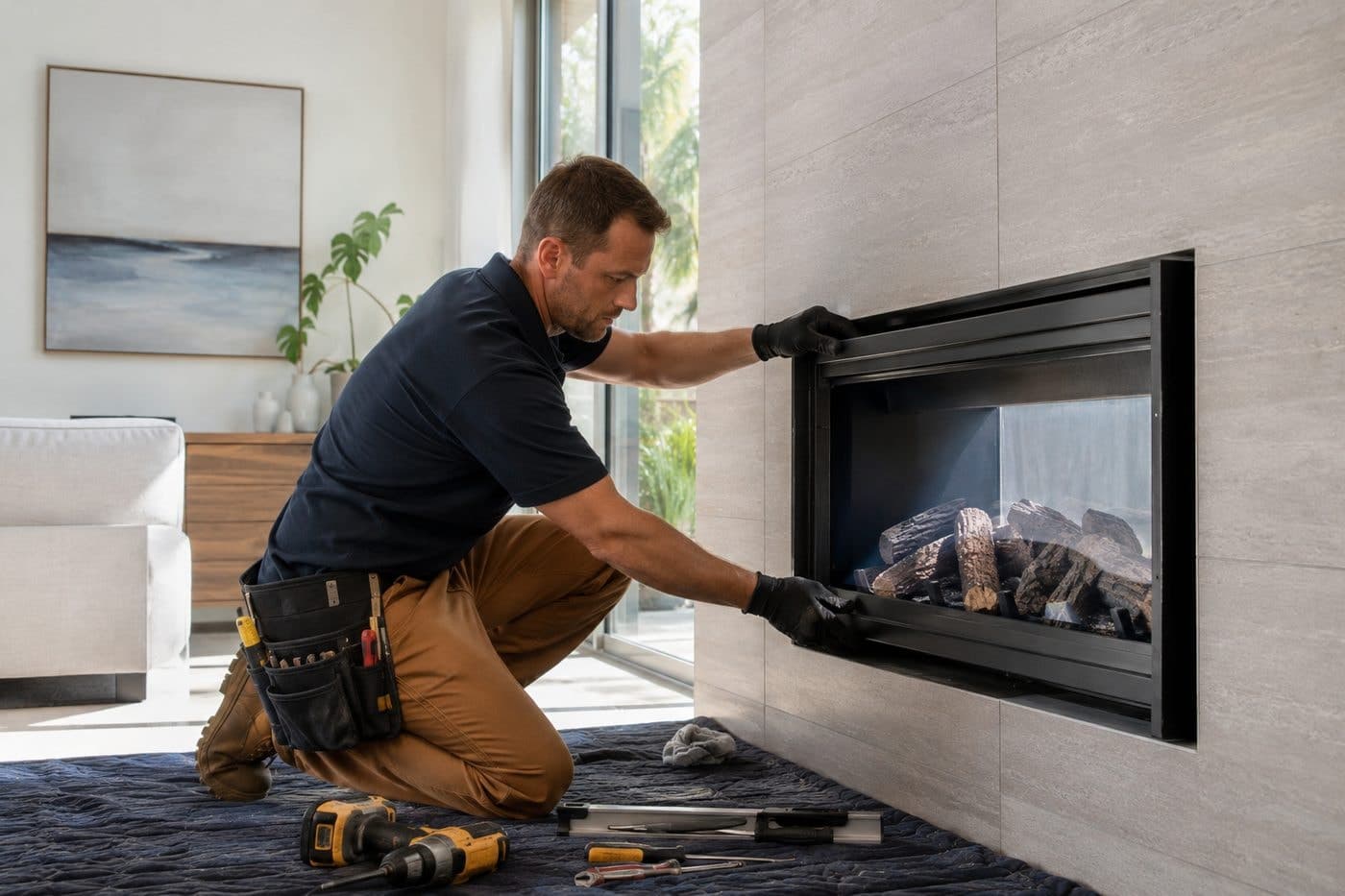
The wide, low glass opening set into a tiled or panelled wall has become the default look in new Orlando builds and in remodels around Lake Nona, Winter Park and Baldwin Park. These are direct-vent appliances, and the format changes the install rather than just the appearance.
| Format | What it looks like | What the install needs |
|---|---|---|
| Traditional front-facing | A square or arched opening, often with a mantel | The simplest vent route; usually straight back or up |
| Linear | A long, low glass panel, frequently with glass media rather than logs | A wider framed opening and a vent route planned around the unit's termination limits |
| See-through / two-sided | Open on both faces, between two rooms | Framing on both sides and careful clearance planning; heavier heat output into both rooms |
| Corner | Glass on two adjacent faces | Framing and vent routing are the constraint, not the unit |
| Freestanding stove-style | A gas stove sitting on a hearth pad | Least building work; the vent still has to reach a compliant termination |
A television above a gas fireplace is a question worth asking before the wall is built rather than after. Heat rising off the unit can shorten the life of a screen, and the answer is usually a mantel shelf, a recessed niche placed above the manufacturer's stated clearance, or a heat-management kit if the unit offers one. Clearances to a mantel and surround are covered in fireplace hearth and mantel clearances.
Venting and termination
A direct-vent appliance uses a coaxial pipe: the inner passage carries combustion products out, the outer one draws combustion air in. Because it is sealed from the room, it is not competing with the air handler for air — which matters in tight Central Florida houses.
What decides where a gas fireplace can go
- Maximum vent length and the number of elbows the model allows
- Whether the run terminates through a wall or up through the roof
- Clearance from the termination to windows, doors, soffits and the property line
- Height above grade and above anything that could be walked into
- Distance from the termination to an air-conditioning intake or a dryer vent
- Framing depth available in the wall, which is often the real limit
- Whether a chase or a false wall has to be built to carry the unit
The termination position is the most common reason a preferred wall does not work. It is settled at the survey stage, before anything is ordered, because moving it later means opening finished work.
Blowers, remotes and controls
Most units offer a blower kit, and it is worth deciding at the point of purchase: fitting one later can mean pulling the appliance out. A blower moves heat into the room instead of letting it collect at the top of the firebox, which is the difference between a fireplace that looks warm and one that is.
- Wall switch: simplest control. On a millivolt unit it works in a power cut, because the pilot generates its own current.
- Handheld remote: the common default. A receiver sits in the control cavity and is the part most likely to fail from heat over time.
- Wall-mounted thermostat remote: runs the fireplace to a room temperature rather than on and off.
- Smart-home integration: available on some models. Worth confirming before purchase rather than assuming.
- Battery backup: on an electronic ignition unit, this is what lets the fireplace light when the power is out — which in Central Florida is the week you most want it.
When a remote stops working later, the cause is usually batteries or a cooked receiver rather than the appliance. Gas fireplace repair covers the diagnosis, and there is a symptom page on a gas fireplace remote that will not work.
Getting gas to the unit
A new fireplace in a wall that has never had one needs a supply run to it, sized to the appliance's input rating. That is its own stage of the job and is covered on our page about sizing and running a gas supply, including why an undersized run produces a small, lazy flame that people spend months blaming on the appliance.
If you have not yet decided between a built-in unit, an insert and a log set, start with choosing a conversion route — the three differ enormously in cost and disruption, and the building usually narrows the choice more than preference does.
Estimates are free and cover the appliance, the vent route and the gas supply as separate lines, so you can see where the money actually goes. Installation is available across Orlando, Winter Park, Lake Nona, Windermere, Oviedo, Clermont and the rest of the Central Florida service area.
References (3)
Facts and figures on this page come from these references.