On this page
Why some homes vent the dryer through the roof
A dryer vent is supposed to reach the outdoors by a short, direct path. In a lot of Central Florida floor plans, that path goes up rather than sideways. The laundry room might be upstairs, in a hallway closet in the middle of the house, or off the garage with no easy outside wall. In those cases builders often run the duct up through the ceiling and attic to a cap on the roof.
We don’t have a count of how many Orlando-area homes vent this way, but it is common in two-story homes and in single-story plans with an interior laundry. The U.S. Fire Administration makes a related point: newer homes often put laundry in upstairs bedrooms, hallways and closets, and those locations may need longer ducts to reach outside.
Why roof dryer vents clog
A sidewall vent pushes lint a few feet sideways. A roof vent has to lift it vertically through the attic and out the top, usually after one or two elbows. As the air loses speed on that climb, lint drops out along the walls and gathers at the turns. The biggest single buildup is often at the top, where the exhaust meets the cap and slows down again.
The cap itself is the other half of the problem. Some roof caps were designed for bathroom fans or attic ventilation and include a screen or a fine grille. The Florida residential code requires a backdraft damper at the dryer exhaust termination and prohibits screens there (FBC-R 2023, M1502.3). On a roof, a screened cap can mat over with lint where no one sees it, and a damper flap that sticks under that lint stays half-closed on every load.
Code also requires the duct to terminate outside the building, so a dryer can’t discharge into the attic, a soffit or a ridge vent. When we find a roof vent that ends at an attic opening instead of a proper cap, we treat it as a duct repair, not a cleaning.
The ground-level signs of a clogged roof vent (lint on the shingles or tile, a cap flap that never lifts, a laundry room that gets hot) are covered on how to tell if a roof dryer vent is clogged.
How we clean a roof dryer vent
Airflow reading at the cap
With the dryer on a no-heat setting, we measure airflow at the roof termination so there is a before number to compare.
Inspect the transition and the ceiling connection
Behind the dryer we check the connector hose and, where visible, the point where the duct turns up into the ceiling or wall chase.
Brush from below with the vacuum running
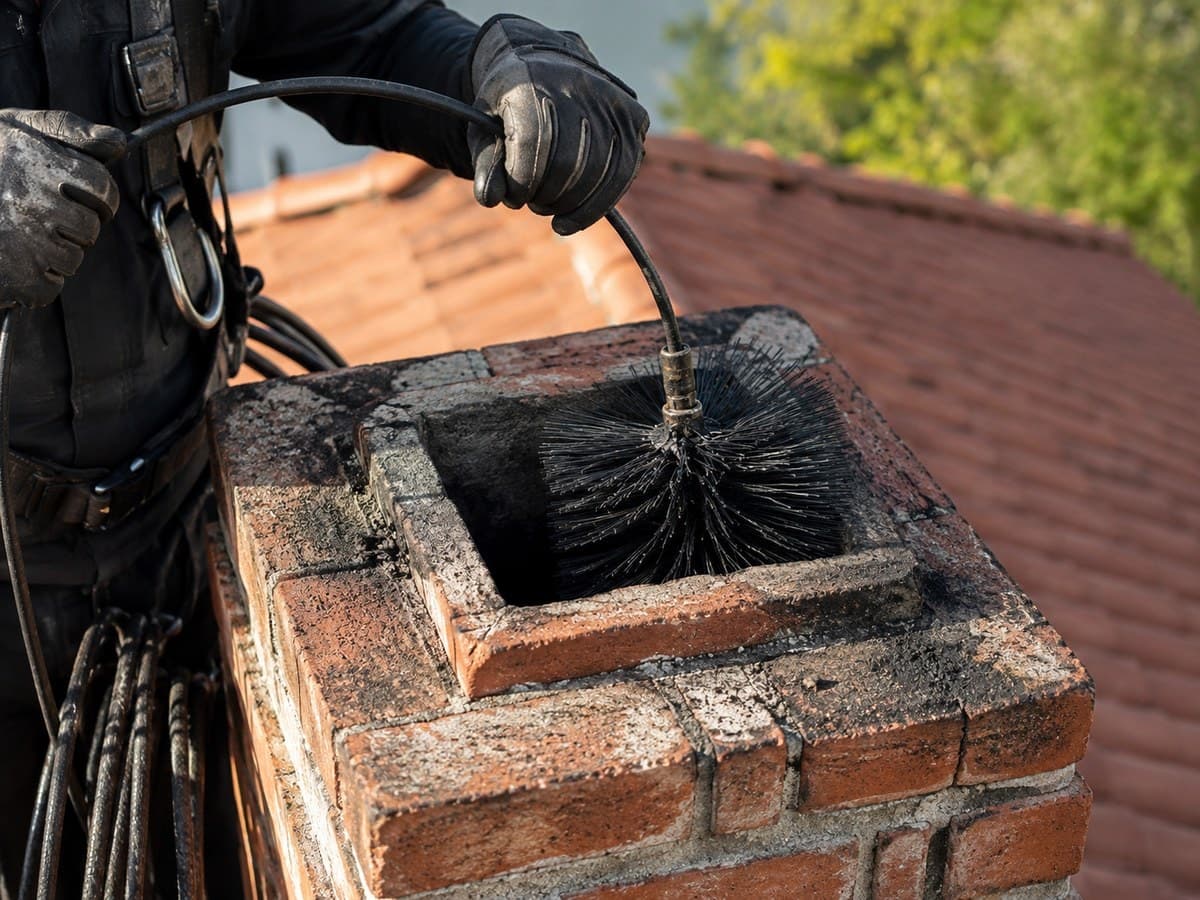
A rotary brush on flexible rods is run up the duct from the laundry end while a vacuum collects what comes loose, so the lint isn’t simply driven into the cap.
Open and clear the roof cap
On the roof, the cap is opened or removed where its design allows, packed lint and any nesting material are removed, and the top of the duct is brushed down.
Check the damper and the roof jack
We confirm the damper opens with airflow and closes when the dryer stops, and look at the flashing and sealant around the roof jack.
Re-test and report
A second airflow reading at the cap shows the result, and the condition of the cap, the flashing and anything that needs repair is explained before you decide on next steps.
Access and safety on tile vs shingle roofs
Roof work is where cleaning a dryer vent stops being a DIY job for most people. Pitch, height and the roofing material all change how the cap is reached.
| Feature | Tile roof | Shingle roof |
|---|---|---|
| Walking the roof | Concrete and clay tile can crack under a careless step. We place feet on the strongest part of the tile and avoid walking near the cap where possible. | Generally more forgiving underfoot, but granules scuff and shingles can be slick with dew or after an afternoon storm. |
| Around the cap | Caps usually sit on a tile-style flashing base; a cracked tile beside the cap is a leak path worth noting. | The flashing is usually tucked under the shingles above; lifted or nail-popped shingles near the cap are checked. |
| Weather | Wet tile is slippery; we don’t work a wet tile roof. | Wet or very hot shingles are also a reason to wait. |
Walking the roof
- Tile roof
- Concrete and clay tile can crack under a careless step. We place feet on the strongest part of the tile and avoid walking near the cap where possible.
- Shingle roof
- Generally more forgiving underfoot, but granules scuff and shingles can be slick with dew or after an afternoon storm.
Around the cap
- Tile roof
- Caps usually sit on a tile-style flashing base; a cracked tile beside the cap is a leak path worth noting.
- Shingle roof
- The flashing is usually tucked under the shingles above; lifted or nail-popped shingles near the cap are checked.
Weather
- Tile roof
- Wet tile is slippery; we don’t work a wet tile roof.
- Shingle roof
- Wet or very hot shingles are also a reason to wait.
Orlando’s wet season, roughly June through September according to the National Weather Service in Melbourne, brings frequent afternoon storms, so roof work is usually planned for the drier part of the day. Very steep or tall roofs may call for additional fall protection or a different access plan, and that is one of the factors in the cost.
Please don’t climb up to check it yourself
A clogged roof vent is a nuisance; a fall from a two-story roof is not. You can do the useful checks from the ground: see whether the cap has lint hanging from it, and with binoculars, whether the flap looks stuck.
When the roof can’t be reached safely
Roof access isn’t always possible on the day. A wet or storm-soaked roof, a very steep or tall roof, fragile or already-cracked tile around the cap, or association rules that restrict roof work can all rule it out. In that case the run is cleaned from the laundry end, you’re told plainly that the cap hasn’t been cleared, and the roof portion is rescheduled or planned with the right equipment. If the roof end is going to be hard to reach every time, that is a good reason to look at moving the termination to a wall.
Roof caps, dampers and bird nests
A good roof dryer cap has a damper that opens easily with dryer exhaust and closes by gravity or a light spring when the dryer stops, no screen, and enough open area not to choke the airflow. Common faults include flaps seized with lint, hinges broken so the flap hangs open, caps made for bath fans with an internal grille, and caps loose on their base after years of sun.
A flap that hangs open is an invitation. The USFA lists nests of small birds or other animals among the causes of blocked dryer exhaust, and a roof cap is a sheltered spot to build one. When we find a nest, we remove it along with the lint behind it. Adding mesh is not the fix, since screens are not allowed at the termination; the fix is a cap with a working damper, covered in more detail under dryer vent cover replacement.
Leaks at the roof jack
Any pipe through the roof is a possible leak point, and a dryer vent is no exception. Water can get in through cracked or dried-out sealant around the jack, flashing that was set on top of the shingles instead of under the course above, a cracked tile next to the cap, or a cap that has shifted on its base.
Signs include a water stain on the ceiling near the laundry room, rust or water marks on the duct in the attic, and water dripping from the dryer connection after heavy rain. Water inside the duct can also come from condensation, so both are checked before blaming the roof; water in a dryer vent explains how to tell them apart. Minor sealant work at the cap is part of what we check; flashing that needs to be rebuilt into the roofing is referred to a roofer.
When rerouting to a sidewall makes sense
Not every roof vent should stay a roof vent. If the run is over the code length once elbows are counted, if the vent keeps clogging between cleanings, or if the roof jack has become a recurring leak, moving the termination to an outside wall can be the better long-term answer. It depends on where the laundry is, what is in the wall between it and the outside, and whether the new run would actually be shorter and straighter.
We explain what a reroute would involve during the cleaning visit, and the options are laid out on the dryer vent rerouting page. For the basics of airflow testing and how often to clean, see the main dryer vent cleaning page.
What affects the cost
Roof vents generally take more time than sidewall vents. The main factors are roof height and pitch, tile versus shingle, how packed the duct and cap are, whether the cap needs replacing, and whether the run needs to be opened up for a disconnected or crushed section. You get the scope before work begins.
Tile and metal roofs
The reason roof-terminated vents cost more to service than wall vents is access, and in Central Florida the roof itself is frequently the complication.
Barrel and flat concrete tile is common across Orlando, and it breaks under foot in ways shingle does not. Walking a tile roof properly means knowing where the battens are and accepting that some tiles will still need replacing afterwards. Metal roofs are slippery and mark easily. Both are worth mentioning when you book, because they change the equipment and the time rather than just the price.
Weather sets the other limit. Roof work does not happen in a thunderstorm or on a wet roof, and during the wet season that regularly pushes an afternoon booking to the following morning.
References (3)
Facts and figures on this page come from these references.