On this page
- Two kinds of damper
- Common damper problems and what fixes them
- Repair or replace?
- Why a leaky damper costs more in Florida
- Dampers on factory-built fireplaces
- Dampers and gas logs
- How a damper repair visit works
- What affects the cost of damper work
- Top-sealing dampers
- Why this matters more in Florida than most places
- Dampers on gas appliances
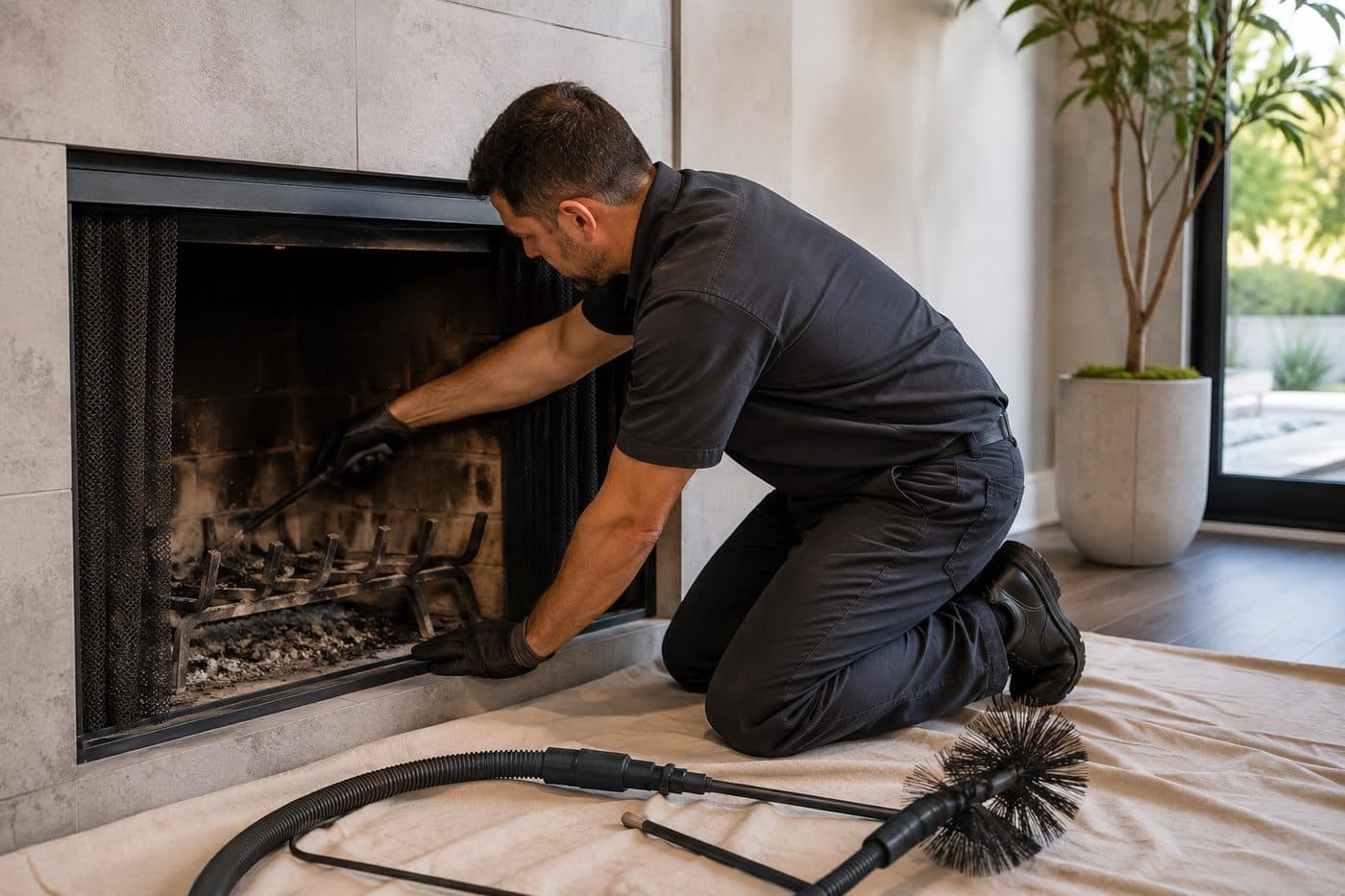
The damper is the metal plate that opens the fireplace to the flue when you light a fire and closes it off when you don’t. In most of the country its job is keeping winter heat in. Around Orlando, where a fireplace can sit idle for most of the year, it spends its life doing the opposite: holding back hot, humid outdoor air while the air conditioner runs.
If you’re still working out why your damper is jammed, the troubleshooting page for a damper that’s stuck open or shut walks through safe checks first. This page is about the fix: what can be repaired, what should be replaced, and how a throat damper compares with a top-sealing damper.
Two kinds of damper
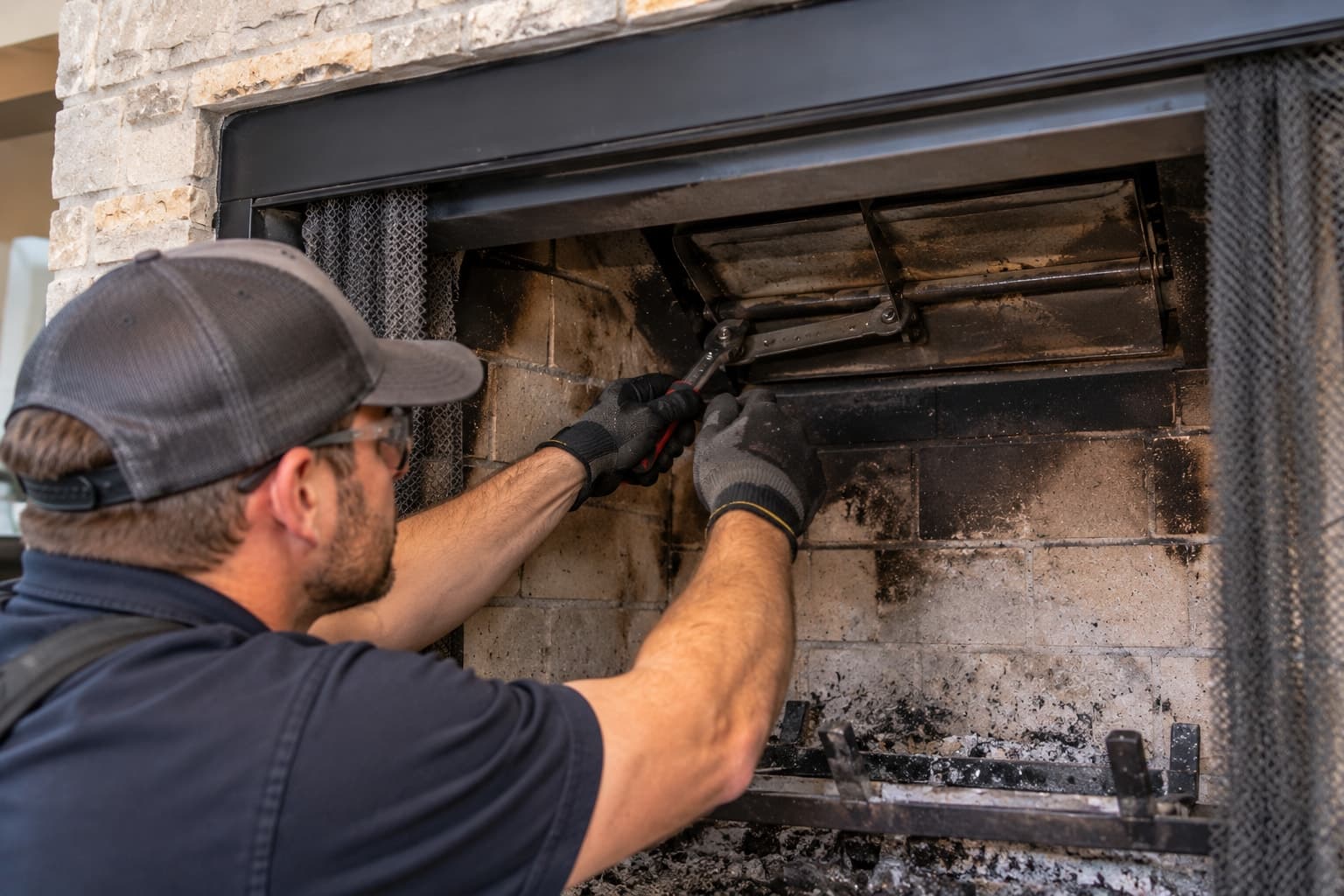
Masonry fireplaces are required to have a ferrous metal damper at least 8 inches above the top of the fireplace opening, operable from the room (FBC-Residential R1001.7.1). Most were built with a throat damper, a cast-iron or steel plate in a frame just above the firebox, worked by a handle, poker or rotary knob. The alternative is a top-sealing damper (also called a top-mount or chimney-top damper), which sits on the top of the flue and is opened and closed by a stainless cable that runs down to a bracket in the firebox.
| Feature | Throat damper | Top-sealing damper |
|---|---|---|
| Where it sits | Just above the firebox, below the smoke chamber | On top of the flue, above the crown |
| How it seals | Metal plate resting on a metal frame; no gasket | Lid closes onto a gasket, usually silicone |
| Air leakage when closed | Some air passes around the plate even when new, more once it warps or rusts | Much tighter seal while the gasket is in good condition |
| What it keeps out when closed | Room air from entering the flue (partially) | Rain, debris and outside air from the whole flue |
| Operated by | Handle, lever, poker or rotary knob | Cable and handle mounted inside the firebox |
| Main wear points | Rust, warping, seized pivots, broken handles | Gasket aging, cable or spring wear |
| Typical use | Repair or like-for-like replacement where the frame is sound | Replacing a failed throat damper, or added where AC loss and odor are the complaint |
Where it sits
- Throat damper
- Just above the firebox, below the smoke chamber
- Top-sealing damper
- On top of the flue, above the crown
How it seals
- Throat damper
- Metal plate resting on a metal frame; no gasket
- Top-sealing damper
- Lid closes onto a gasket, usually silicone
Air leakage when closed
- Throat damper
- Some air passes around the plate even when new, more once it warps or rusts
- Top-sealing damper
- Much tighter seal while the gasket is in good condition
What it keeps out when closed
- Throat damper
- Room air from entering the flue (partially)
- Top-sealing damper
- Rain, debris and outside air from the whole flue
Operated by
- Throat damper
- Handle, lever, poker or rotary knob
- Top-sealing damper
- Cable and handle mounted inside the firebox
Main wear points
- Throat damper
- Rust, warping, seized pivots, broken handles
- Top-sealing damper
- Gasket aging, cable or spring wear
Typical use
- Throat damper
- Repair or like-for-like replacement where the frame is sound
- Top-sealing damper
- Replacing a failed throat damper, or added where AC loss and odor are the complaint
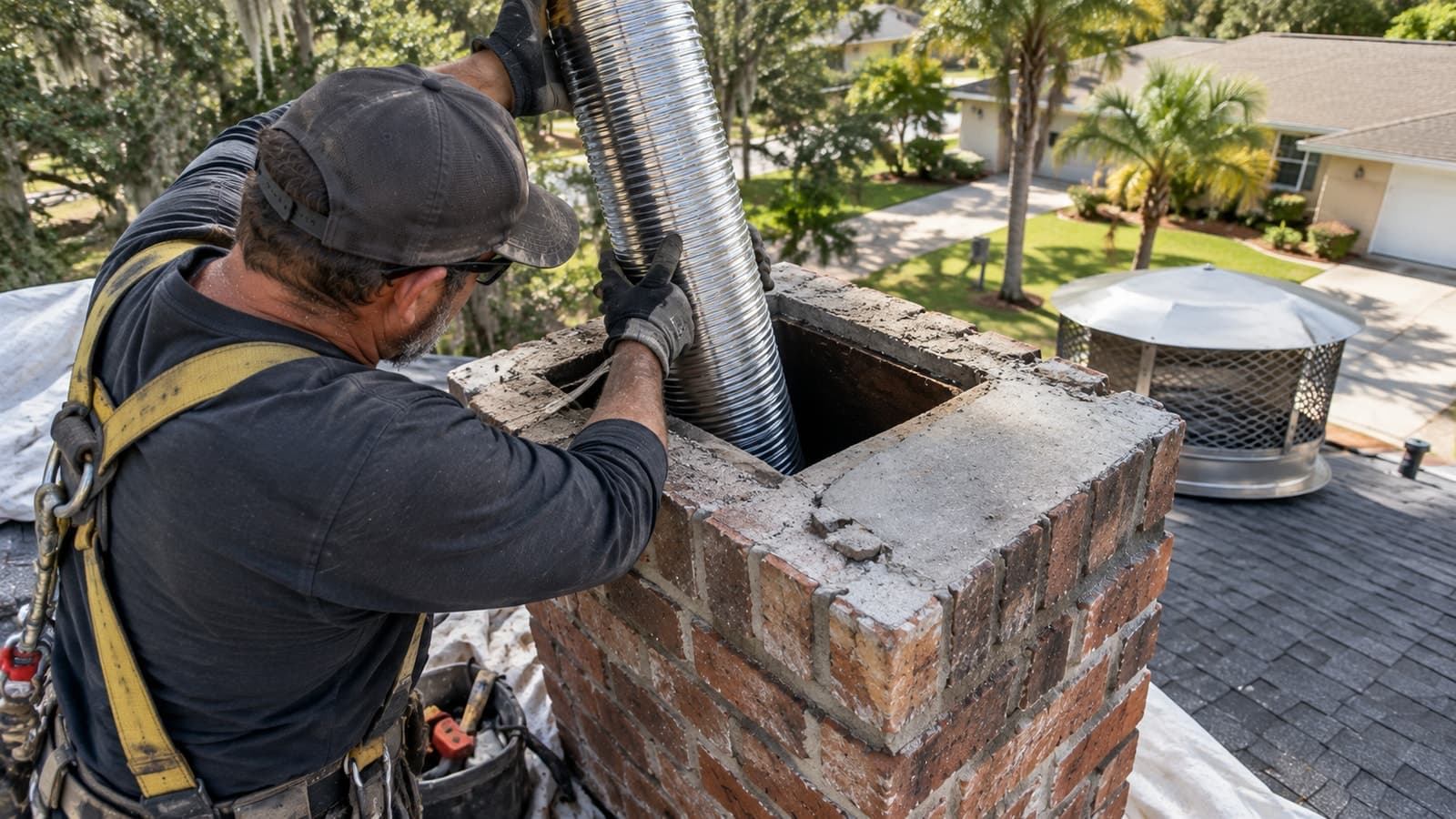
Because a top-sealing damper closes the flue at the top, it also acts as a lid on the chimney when the fire is out. Many designs incorporate a screened cap, which is why they overlap with chimney caps and animal guards. Whether one should replace the throat damper or be added alongside it depends on the fireplace and the throat damper’s condition.
Common damper problems and what fixes them
From symptom to repair
01Damper won’t open or is seized
- What you may notice
- Handle doesn’t move or moves only a little; smoke rolls into the room when a fire is lit.
- How it’s confirmed
- Plate, pivots and frame checked for rust, debris or a dropped plate; often freed, cleaned and lubricated with a high-temperature product.
02Damper won’t close fully
- What you may notice
- Daylight or a draft around the plate; the room feels warm or muggy near the fireplace in summer.
- How it’s confirmed
- Plate checked for warping and the frame for rust scale or debris that stops it seating.
03Rusted damper plate or frame
- What you may notice
- Rust flakes on the smoke shelf or firebox floor; a rough, orange plate when you look up.
- How it’s confirmed
- Metal thickness and holes assessed; surface rust can be cleaned, rust-through means replacement. The water source (cap, crown, leak) is checked too.
04Broken handle, chain or knob
- What you may notice
- Handle spins freely or comes away in your hand; a chain that has snapped or a rotary knob that won’t engage.
- How it’s confirmed
- Linkage inspected; handles, rods and some control parts can be replaced if the plate and frame are sound.
05Worn top-sealing gasket or cable
- What you may notice
- Top damper closes but odor or airflow returns; cable slack or the lid won’t latch.
- How it’s confirmed
- Gasket, spring and cable checked from the roof and firebox; gaskets and cables are replaceable parts on many models.
Repair or replace?
| Condition | Likely fix |
|---|---|
| Stiff but intact; light surface rust | Clean, free the pivots and lubricate with a product rated for fireplace heat |
| Broken handle, rod or chain; plate and frame sound | Replace the operating parts |
| Plate warped, but the frame is sound | Replacement plate if one fits the frame; otherwise a new damper |
| Plate or frame rusted through, or frame cracked | Replace the throat damper where practical, or install a top-sealing damper |
| Damper works, but air and humidity still get through | Top-sealing damper, often with glass doors at the front |
| Factory-built fireplace damper damaged | Manufacturer’s listed part for that model only |
Replacing a throat damper in a masonry fireplace can be awkward: the old frame is often mortared into the brick, and the replacement has to fit the throat opening. Where a direct replacement isn’t practical, a top-sealing damper is the usual alternative, provided the flue top and crown are in condition to take one.
Why a leaky damper costs more in Florida
An open or poorly sealing damper connects your living room to the outdoors through a tall chimney. When the house is cooled and slightly depressurized by exhaust fans and the air handler, warm, humid outdoor air can be drawn down the flue, carrying the smell of soot and damp masonry with it. Conditioned air can also leak out the other way. Neither shows up as a single dramatic symptom; it shows up as a muggy corner, a fireplace that smells on sticky afternoons, or an AC that never quite catches up.
This is where a top-sealing damper earns its keep: it closes the whole flue with a gasket, so moist air and rain stay above the roof. Well-fitted fireplace glass doors add a second seal at the room side. For the full picture of how humidity affects idle fireplaces, see the guide to humidity, chimneys and fireplaces in Florida, and if odor is your main complaint, start with why a fireplace smells in humid weather.
Always open the damper before a fire
A top-sealing damper is closed from inside the firebox, and it’s easy to forget it’s shut because you can’t see it. Make opening it part of lighting every fire, and check that it’s open by looking up with a flashlight before you strike a match.
Dampers on factory-built fireplaces
Factory-built (prefab) fireplaces have a damper built into the unit, and it is part of the tested, listed assembly. Repairs are limited to the parts the manufacturer lists for that model, which is why the rating plate or model label matters. Aftermarket damper plates and top dampers that aren’t approved for the system shouldn’t be installed. If the damper area has rusted through because water has been getting into the unit, the fix begins at the top of the chase; see factory-built chimney and chase repair.
Dampers and gas logs
Vented gas log sets rely on the flue to carry combustion gases outside. Florida’s fuel gas code requires decorative gas appliances for wood-burning fireplaces to be listed and installed according to the manufacturer’s instructions (FBC-Fuel Gas 602.1), and those instructions set a minimum permanent damper opening. Instructions written to the ANSI Z21.60 standard for these logs say the damper must be fixed in a way that keeps that minimum opening at all times (Rumford, summarizing ANSI Z21.60), typically with a damper clamp or stop. Follow the instructions for your specific set; a damper closed over lit vented logs sends combustion gases into the room.
Gas work is a separate trade
We can repair or replace the damper itself, and the gas side is covered too — gas fireplace service for the burner, pilot and valve, gas log installation for the log set, and running a new gas supply where that has to change. A damper on a vented gas appliance is usually locked open, which is checked at the same visit.
How a damper repair visit works
Identify the fireplace and damper
Masonry or factory-built, throat or top-sealing, and the model where there is a label.
Check the plate, frame and linkage
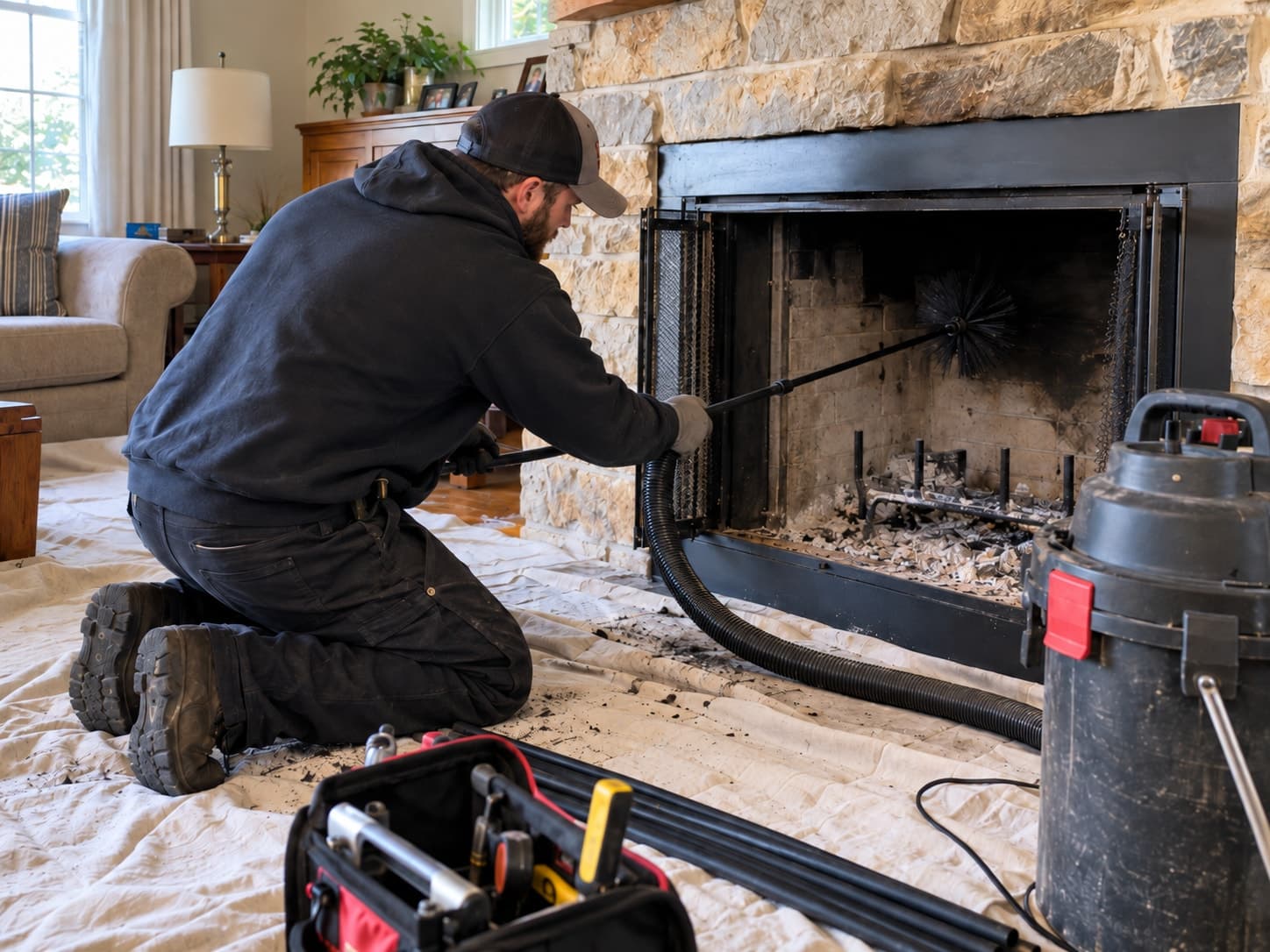
The damper is operated, then the plate, pivots, frame, handle and any cable are inspected for rust, warping and wear.
Look above it
The smoke chamber, flue and cap are checked, because rust on a damper usually means water is getting in from above.
Explain the options
Repair, like-for-like replacement or a top-sealing damper, with what each involves for your fireplace.
Test the result
The damper is cycled open and closed several times and its seal is checked before the job is closed out.
What affects the cost of damper work
The scope follows the fix. These factors decide it:
- Repair of the existing damper versus replacement
- Throat damper versus top-sealing damper
- Flue size and shape, which set the damper size
- Condition of the flue top and crown for a top-mount unit
- Roof height, pitch and roof covering
- Listed parts availability for factory-built fireplaces
- Any water damage found in the smoke chamber or firebox
Top-sealing dampers
A traditional throat damper sits just above the firebox and is a cast-iron plate resting in a cast-iron frame. It was designed to control a fire, not to seal a chimney. Even a new one in good condition leaks, and most of the ones in Central Florida homes are decades old, warped by heat and rusted by humidity.
A top-sealing damper is a different device. It mounts at the top of the flue, closes onto a silicone or rubber gasket, and is operated by a stainless cable that runs down the flue to a handle in the firebox. Closed, it seals the chimney rather than merely obstructing it.
| Feature | Throat damper | Top-sealing damper |
|---|---|---|
| Position | Just above the firebox | At the top of the flue |
| Seal | Metal on metal — always leaks to some degree | Closes onto a gasket |
| What it keeps out | Very little when the fireplace is idle | Humid air, rain, debris, insects and animals |
| Doubles as | Nothing else | A rain cap and an animal screen when open |
| Conditioned air | Cool air escapes up the flue all summer | The flue is sealed while the fireplace is idle |
| Fitted from | Inside the firebox | The roof, so access matters |
| Suits | A fireplace used regularly in a cold climate | A Central Florida fireplace that sits idle most of the year |
Position
- Throat damper
- Just above the firebox
- Top-sealing damper
- At the top of the flue
Seal
- Throat damper
- Metal on metal — always leaks to some degree
- Top-sealing damper
- Closes onto a gasket
What it keeps out
- Throat damper
- Very little when the fireplace is idle
- Top-sealing damper
- Humid air, rain, debris, insects and animals
Doubles as
- Throat damper
- Nothing else
- Top-sealing damper
- A rain cap and an animal screen when open
Conditioned air
- Throat damper
- Cool air escapes up the flue all summer
- Top-sealing damper
- The flue is sealed while the fireplace is idle
Fitted from
- Throat damper
- Inside the firebox
- Top-sealing damper
- The roof, so access matters
Suits
- Throat damper
- A fireplace used regularly in a cold climate
- Top-sealing damper
- A Central Florida fireplace that sits idle most of the year
Our guide comparing top-sealing and throat dampers goes into the trade-offs in more detail.
Why this matters more in Florida than most places
The usual argument for a top-sealing damper is stopping heated air escaping in winter. In Orlando the argument runs the other way round, and it is arguably stronger.
- Conditioned air escapes upward. An open or leaking damper is an uncapped hole from an air-conditioned room to the outside, for the nine months of the year you are paying to cool that room.
- Humid air comes down. Orlando's average relative humidity sits around 74%. Damp air moving down a flue that holds soot and creosote deposits is what produces the campfire smell people notice in July.
- Rain is kept out at the top, not the bottom. A top-sealing damper closes the flue at its highest point, so water never enters the chimney in the first place.
- It screens the flue. Closed it excludes animals entirely, and open it still acts as a cap and screen — which in practice means one device instead of three.
Where recurring odour is the main complaint, the damper is usually part of the answer rather than the whole of it. Chimney odor removal covers the deposits that produce the smell in the first place.
Dampers on gas appliances
One important exception. A vented gas log set needs the damper held permanently open, usually with a damper clamp or stop, so the flue can never be closed while the burner is running. A top-sealing damper can still be used on that installation, but it has to be set up and labelled correctly.
A sealed direct-vent gas appliance does not use the old flue at all, so the damper question becomes moot — though the disused chimney above it still needs capping so it does not turn into a rainwater channel. The gas side is covered under gas log installation and gas fireplace service.
Damper repair, throat damper replacement and top-sealing damper installation are available across Orlando, Winter Park, Maitland, Kissimmee, Oviedo and the rest of the Orlando service area. Estimates are free, and the existing damper is assessed before a replacement is recommended — plenty of them only need cleaning and freeing off.
References (3)
Facts and figures on this page come from these references.