On this page
Three different jobs get called the same thing, and the price and disruption are nothing alike. This page is the first one.
| What you get | What changes | Where it is covered |
|---|---|---|
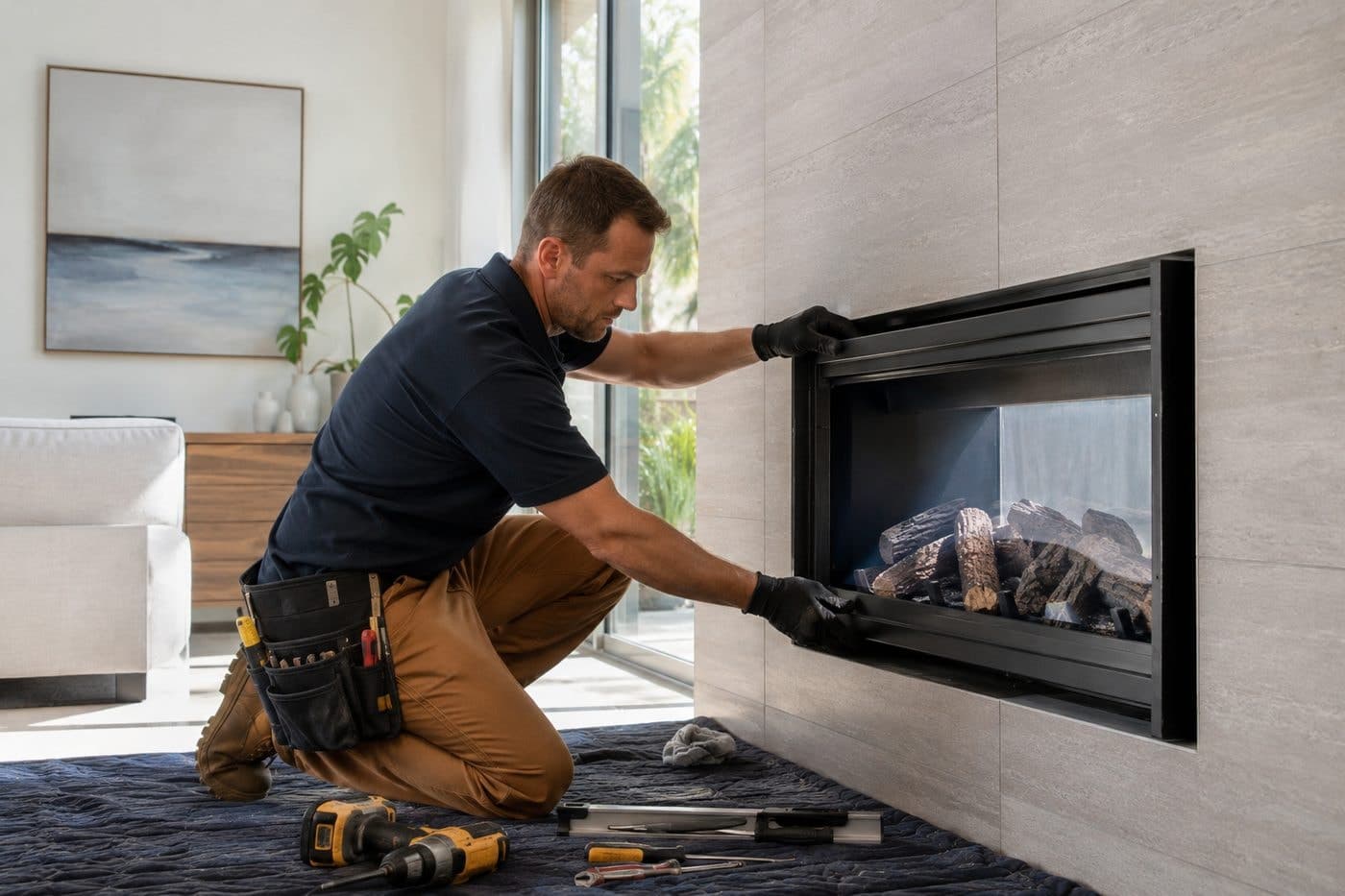
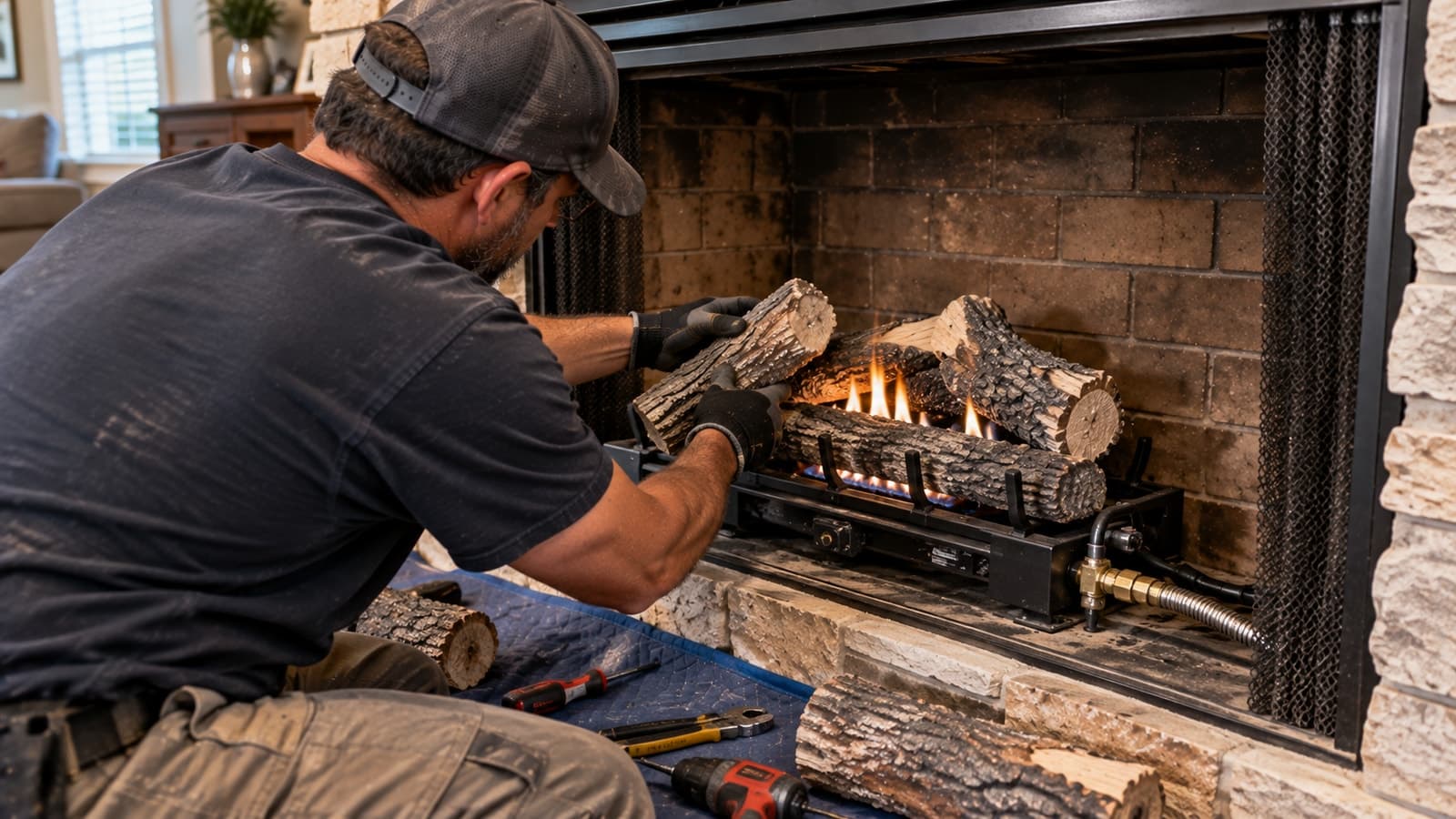
| A log set | A burner, pan and ceramic logs go into the firebox you already have. The chimney stays as it is. | This page |
| A gas insert | A sealed unit slides into the fireplace opening and a liner runs up the flue. More heat, more work. | Fitting a gas insert |
| A built-in gas fireplace | The old firebox comes out and a new appliance with its own vent goes in. | Installing a built-in gas fireplace |
If you are still deciding between them, our page on choosing between the three routes walks through which one suits which house.
Vented and vent-free log sets
This is the decision that shapes everything else, and the two products behave very differently despite looking similar in a showroom.
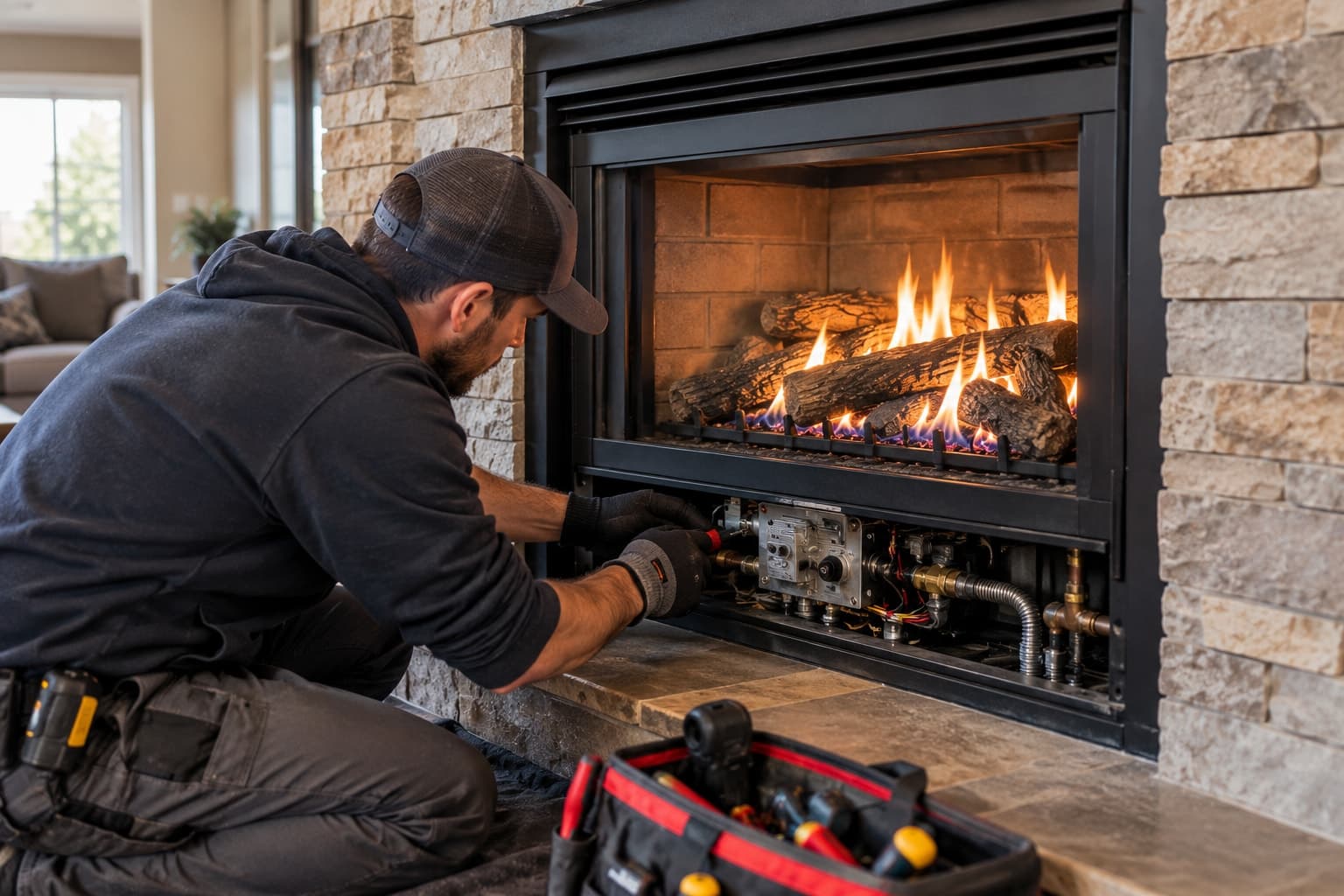
| Feature | Vented log set | Vent-free log set |
|---|---|---|
| Damper | Stays open while it runs, usually locked open | Designed to run with the damper closed |
| Flame look | Tall, yellow, closest to a wood fire | Shorter and bluer, tuned to burn clean |
| Heat into the room | Most of it goes up the flue | Nearly all of it stays in the room |
| Combustion products | Vented outside | Released into the room, which is why output and run time are limited |
| Chimney condition | The flue must be sound and clear | Still needs a safe, sealed firebox |
| Best for | Look and ambience in a working fireplace | Rooms where the chimney cannot be used |
Damper
- Vented log set
- Stays open while it runs, usually locked open
- Vent-free log set
- Designed to run with the damper closed
Flame look
- Vented log set
- Tall, yellow, closest to a wood fire
- Vent-free log set
- Shorter and bluer, tuned to burn clean
Heat into the room
- Vented log set
- Most of it goes up the flue
- Vent-free log set
- Nearly all of it stays in the room
Combustion products
- Vented log set
- Vented outside
- Vent-free log set
- Released into the room, which is why output and run time are limited
Chimney condition
- Vented log set
- The flue must be sound and clear
- Vent-free log set
- Still needs a safe, sealed firebox
Best for
- Vented log set
- Look and ambience in a working fireplace
- Vent-free log set
- Rooms where the chimney cannot be used
Vent-free is not a way round a broken chimney
A vent-free set still needs a sound firebox, a working carbon monoxide alarm and adequate room volume, and some jurisdictions and HOAs restrict them. Local code is confirmed before a vent-free set is quoted. If the chimney is the problem, fixing the chimney is usually the better answer.
In Central Florida the vented option is the more common choice, because most people want a gas fireplace for the look on a handful of cool evenings rather than for heat. A vented set in a sound chimney gives the closest thing to a wood fire without the wood.
What has to fit
A log set is sized to the firebox, not to the room. Getting it wrong is the main reason a set looks cramped, sits at the wrong angle or sends soot onto the back wall.
Measured before anything is ordered
- Firebox width at the front and at the back — most fireboxes taper
- Firebox depth and height at the opening
- Damper opening and whether it can be locked open for a vented set
- Flue size and condition, because a vented set depends on the chimney drawing
- Whether the firebox is masonry firebrick or a factory-built unit with refractory panels
- Existing gas supply: line position, size and whether a shut-off valve is present and reachable
- Fuel type — natural gas or propane, which are not interchangeable without the right orifice
- Hearth extension and any combustible mantel or surround clearances
Factory-built fireboxes need an extra check. Many are listed for a specific range of gas appliances and some are not listed for a log set at all. Fitting one into a unit that was never approved for it is how a warranty and a safe clearance both disappear at once, so the rating plate is read before anything is ordered.
Replacing a worn log set
Ceramic logs do not last forever. They sit directly in the flame path, and Florida's humidity is unkind to the steel underneath them during the long months a fireplace sits idle.
Signs the set is due for replacement
01Logs crumbling or broken
- What you may notice
- Pieces missing, cracks through a log, or ceramic debris in the pan.
- How it’s confirmed
- Broken logs change where the flame sits. That is what starts sooting, so a damaged set is replaced rather than rearranged.
02Heavy sooting on the logs or the back wall
- What you may notice
- Black deposits building up faster than they used to, or soot on the surround.
- How it’s confirmed
- Usually log placement, a partly blocked burner or the wrong fuel orifice. All three are checked before a new set is recommended.
03A rusted pan or burner
- What you may notice
- Rust flakes in the firebox, an uneven flame, or ports that will not light along the whole burner.
- How it’s confirmed
- Humidity and standing water from a chimney leak corrode the burner from below. The leak gets fixed too, or the new burner goes the same way.
04Flames lifting off the burner
- What you may notice
- Flame floating above the ports, or roaring rather than burning quietly.
- How it’s confirmed
- Points at gas pressure or an orifice mismatch, often after a propane-to-natural-gas change. It is corrected before a new set goes in.
05A yellow, sooty flame on a vent-free set
- What you may notice
- Soot appearing on a set that is supposed to burn clean.
- How it’s confirmed
- Stop using it and have it checked. On a vent-free appliance this is a combustion problem in the room you are sitting in.
Gas supply and connection
Some fireplaces already have a capped gas stub in the firebox from a previous set or from the original build. Others have nothing, and the line has to be run and connected before a log set can go anywhere. That work is covered on our page about getting gas to the fireplace.
Either way there should be a shut-off valve you can reach without lying in the firebox. If the existing valve is buried behind the logs or seized, it gets dealt with as part of the job rather than left for the next person.
Natural gas and propane need different orifices and different pressures. A set moved between the two — or a house that switched supply — will not run correctly until the conversion parts are fitted, and running it in the meantime is what produces soot and a lazy yellow flame.
Controls: match, pilot or remote
| Control | How it works | Worth knowing |
|---|---|---|
| Match-lit | A manual key valve in the wall or floor; you light the burner with a long match. | Simplest and cheapest. No pilot burning all season. |
| Standing pilot with a safety valve | A small pilot stays lit and a knob or switch opens the main burner. | Lights instantly. Uses a little gas continuously. |
| Millivolt with a wall switch | The pilot generates its own current through a thermopile, so the switch works in a power cut. | The thermopile is the usual failure point after a few seasons. |
| Electronic ignition with a remote | A module sparks the pilot on demand, with a handset or thermostat. | No standing pilot. Needs power and a battery backup. |
Remotes and receivers are the part most likely to go wrong later, usually from flat batteries or a receiver cooked by heat in the control cavity. When a handset stops working, gas fireplace repair covers the diagnosis.
Installation day
Check the fireplace first
Firebox, damper, smoke chamber and flue. A vented set depends on the chimney drawing properly, so a flue that has not been looked at recently is checked before the set goes in, not after.
Clean the firebox
Old ash, soot and debris come out. On a conversion from wood, that means a full sweep so the flue is not carrying years of creosote above a burner that will now run for hours.
Set the pan and burner
Positioned and levelled, connected to the supply, and the connection leak-checked before anything is lit.
Place the logs to the manufacturer's layout
This is not decorative. Log position determines where the flame goes, and a log sitting in the wrong place is the most common cause of soot on a new set.
Light and watch it run
Flame pattern, pilot stability and — on a vented set — that the chimney is actually taking the products of combustion away.
Show you the controls
Where the shut-off is, how to light it, what to do if the pilot goes out, and what the set should look like when it is running normally.
A log set needs looking at once a year like any other gas appliance — burner ports, pilot, log position and the state of the flue. That is covered under gas fireplace service.
Gas logs in Greater Orlando homes
A lot of Central Florida fireplaces get used a handful of times a year, which is exactly the case a log set suits: no firewood to store in a humid garage, no ash to clear, and nothing to do at the end of the evening but turn it off.
The local complication is the idle season. A fireplace that sits unused from March to December collects humidity, and a burner that has been damp for nine months does not always light cleanly in January. Booking service in autumn rather than on the first cold front is the practical answer.
We fit and replace log sets across Orlando, Winter Park, Kissimmee, Oviedo, Clermont and the rest of the Central Florida service area. Estimates are free and the set is quoted after the firebox has been measured, not before.
References (2)
Facts and figures on this page come from these references.