On this page
- Why the home inspection didn’t check the flue
- Why a Level 2 is the standard for a sale
- What buyers, sellers and agents each get
- Timing around your inspection period
- Findings that come up in Central Florida homes
- If the fireplace is “decorative” or never used
- What this inspection is not
- Working to a closing date
- Why 'further evaluation recommended' happens
- A camera scan is usually the deciding evidence
- Insurance and older chimneys
Why the home inspection didn’t check the flue
Florida’s Standards of Practice for licensed home inspectors are set out in Chapter 61-30 of the Florida Administrative Code. Under Rule 61-30.808, the inspector looks at the visible parts of the fireplace, including the lintel, hearth, surround and clearance to combustibles. The inspector is not required to inspect the flue or the chimney interior, or to evaluate draft (Rule chapter 61-30 at FLRules; plain-language summary of 61-30.806 and 61-30.808).
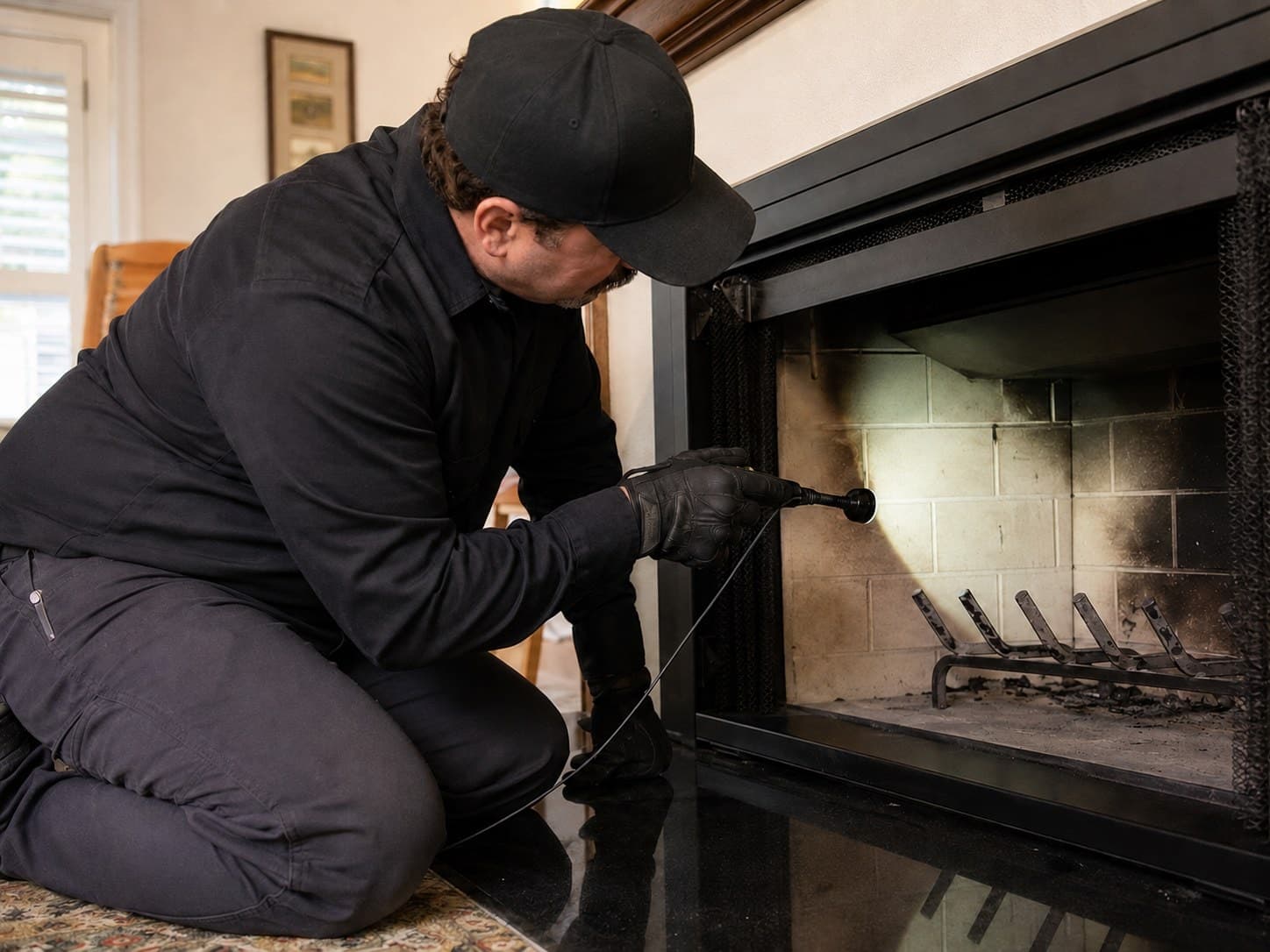
That isn’t a shortcut by your inspector. Seeing inside a flue takes specialized equipment, roof access and chimney-specific knowledge. That’s why so many reports include a line like “recommend further evaluation by a qualified chimney professional.” We explain the gap in more detail in why your home inspection didn’t check the chimney flue.
Why a Level 2 is the standard for a sale
NFPA 211 sets out three inspection levels. Industry summaries of CSIA and NFPA guidance call for a Level 2 inspection when a property is sold or transferred (Highs Chimney). The reasoning is simple: a new owner has no history for the chimney. They don’t know how it was used, whether it was maintained, or whether it came through past storms undamaged.
Under CSIA’s procedure, a Level 2 adds two things a basic check doesn’t have: a video scan (or a similar inspection) of the full flue and a look at the chimney wherever it passes through accessible attic or crawl-space areas. The full breakdown of levels is on our chimney and fireplace inspection page.
What a real-estate Level 2 covers
- Firebox, damper, smoke chamber and hearth
- A full-length evaluation of the flue, bottom to top
- Crown or chase cover, cap and flashing from the roof, where it can be reached safely
- Chase framing, siding or stucco on factory-built chimneys
- Accessible attic areas the chimney passes through
- Gas fireplace vent and termination, if the home has one
- The fireplace’s rating label and model on factory-built units
What buyers, sellers and agents each get
Buyers
You find out whether the fireplace is safe to use and what it will need, while you can still act on it. Findings are sorted into safety concerns, repairs to plan for and maintenance items, which makes them easier to use in a repair request. If the home has a factory-built fireplace, we record the manufacturer and model from the label where it’s legible. That matters later if parts or a replacement are ever needed.
Sellers
A pre-listing inspection shows you what a buyer’s inspection would find, before you’re under contract and working to a deadline. You can repair items on your own schedule, collect quotes, or price the home with the issue in mind. Talk with your agent about what your findings mean for disclosure.
Agents
You get findings a client can read without a chimney background: what we found, where it is, why it matters and what it would take to resolve. We coordinate access the same way other inspectors do, and we note clearly anything we couldn’t reach so there are no surprises later.
Timing around your inspection period
Most purchase contracts give the buyer a limited inspection window. The chimney inspection often gets booked last, after the general inspector flags the fireplace. By then the window may be half gone. A few things help:
- Book as soon as the contract is signed, or as soon as the home inspection report mentions the fireplace. Don’t wait for the full report to be finalized.
- Arrange access to the roof, attic and fireplace. Tell us if the home is vacant or occupied, and whether there’s a gate code or a lockbox.
- Keep utilities on. A gas fireplace can’t be fully checked with the gas or power off.
- Leave room for follow-up. If the Level 2 points to a concealed problem, a Level 3 or a repair quote takes additional time. That’s the main reason to start early.
When you call, we’ll give you an honest answer about when we can be there and when the findings will be ready. We won’t promise a turnaround we can’t meet.
Findings that come up in Central Florida homes
In this climate, water is behind many chimney problems. Orlando averages about 51.5 inches of rain a year (CurrentResults, NCEI normals), and a chimney that has been neglected for a few wet seasons shows it. Typical findings include:
- Rusted or sagging chase covers on factory-built chimneys, often with rust streaks down the chase
- Soft or stained framing inside the chase where water has been getting in
- Cracked or eroded refractory panels in factory-built fireboxes
- Missing, damaged or non-matching caps
- Cracked crowns, open mortar joints and damaged flue tiles on older masonry chimneys
- Nests and debris in flues that haven’t been used in years
- Gas fireplace vent terminations that are loose, damaged or blocked
The 4-point insurance inspection doesn’t cover the chimney
A Florida 4-point inspection looks at the roof, electrical, plumbing and HVAC systems. Chimneys and fireplaces aren’t part of it (Slide Insurance; CFBI), so passing one tells you nothing about the flue. More in does a 4-point inspection include the chimney?
If the fireplace is “decorative” or never used
Listings sometimes describe a fireplace as decorative, or the sellers mention they never lit it. That doesn’t mean the chimney can be skipped. The chimney still goes through the roof and takes the same rain and wind as one that gets used. A rusted chase cover or failed flashing on an unused chimney can let water into the framing for years without anyone noticing.
It also matters for what comes next. If you plan to use the fireplace, you need to know it’s safe. If you don’t, you still want to know whether it needs a new chase cover, a cap or a leak repair, and whether sealing it off or removing it is worth considering. Either way, the inspection tells you what you’re buying.
What this inspection is not
It’s an evaluation of the chimney and fireplace as we found them on the day of the inspection. It isn’t a warranty, an appraisal or a statement about insurance. It also doesn’t replace the general home inspection, which covers the rest of the house. If something is wrong, the findings say what it is and what it would take to fix. Whether to repair, renegotiate or walk away is your decision.
Working to a closing date
Almost every call about a real-estate chimney inspection has a date attached to it, and that date is the thing that actually shapes the booking. Tell us what it is when you call, not afterwards.
| Point in the deal | What is being asked | What the inspection needs to settle |
|---|---|---|
| Inspection period, buyer's side | Should I ask for this to be fixed, or credited? | What is wrong, how serious, and whether it can be used before repair |
| Inspection period, seller's side | How bad is the item the buyer's inspector flagged? | Whether the flagged item is real, and what the actual scope is |
| Repair negotiation | What is a fair scope for this? | A defined repair rather than an open-ended 'further evaluation' |
| Before listing | What will an inspector find? | Problems identified before a buyer's inspector turns them into leverage |
| Post-inspection re-check | Was the agreed work actually done? | Confirmation the repair matches what was agreed |
Bookings tied to a contract get scheduled around the deadline rather than in queue order, and same-day attendance is offered where a slot genuinely exists. The one thing that can move is roof access in a thunderstorm, which is worth building a day of slack around during the wet season.
Why 'further evaluation recommended' happens
A general home inspector is not a chimney specialist and their standards of practice do not require them to climb a chimney or evaluate the inside of a flue. When they see something they cannot assess, they write that it needs further evaluation — which is correct, and also unhelpful if you are trying to price a repair.
That phrase is what most of these bookings are answering. The job is turning it into a specific finding with a specific scope, so the deal can move.
Whether a four-point inspection covers the chimney at all is a separate and frequently misunderstood question, covered in does a 4-point inspection include the chimney.
A camera scan is usually the deciding evidence
In a transaction the disagreement is rarely about what anyone can see. It is about the part of the flue nobody can see, where cracked tiles and separated liner sections live.
A video scan turns that from two opinions into one set of evidence both sides are looking at. It is also what stops the opposite outcome: plenty of scans show a sound flue, which saves a seller from conceding on a repair that was never needed. How it works is on the camera inspection page.
Sooted flues have to be swept first
A camera cannot see through soot. On a chimney that has been used and not cleaned, the sweep comes first and the scan follows on the same visit. Worth knowing when you are planning a tight inspection window, because it is one visit but a longer one.
Insurance and older chimneys
Florida insurers have become noticeably more particular about older roofs and the things attached to them. A chimney with visible masonry deterioration, missing flashing or an obviously failed crown can become a question at the point of binding cover on an older house.
That is worth knowing at the inspection stage rather than after a closing date is set. Where storm damage rather than age is the issue, storm damage chimney inspection covers the claim side of it.
Home-sale inspections are carried out across Orlando, Winter Park, Baldwin Park, Lake Nona, Windermere, Oviedo, Kissimmee, Clermont and the rest of the areas we serve. Estimates are free. Agents and buyers frequently search for a chimney inspection near me during an inspection period — calling with the closing date is faster than a form when the clock is running.
References (7)
Facts and figures on this page come from these references.
- 1Florida Administrative Code, Chapter 61-30 (Home Inspectors)
- 2CFBI: Summary of Florida home inspection Standards of Practice (61-30.806, 61-30.808)
- 3Highs Chimney: Level 1 and Level 2 chimney inspections (summary of CSIA/NFPA guidance)
- 4NFPA 211: Standard for Chimneys, Fireplaces, Vents, and Solid Fuel-Burning Appliances
- 5Slide Insurance: What is a 4-point inspection?
- 6CFBI: 4-point insurance inspection
- 7CurrentResults: Orlando weather averages (NCEI normals)