On this page
- Masonry repair, crown work or a rebuild?
- What damaged chimney masonry looks like
- Tuckpointing vs repointing
- Why the mortar has to match older brick
- How Central Florida weather wears chimney masonry
- Keeping masonry repairs from coming back
- What affects the cost of chimney masonry repair
- Spalling in a humid climate
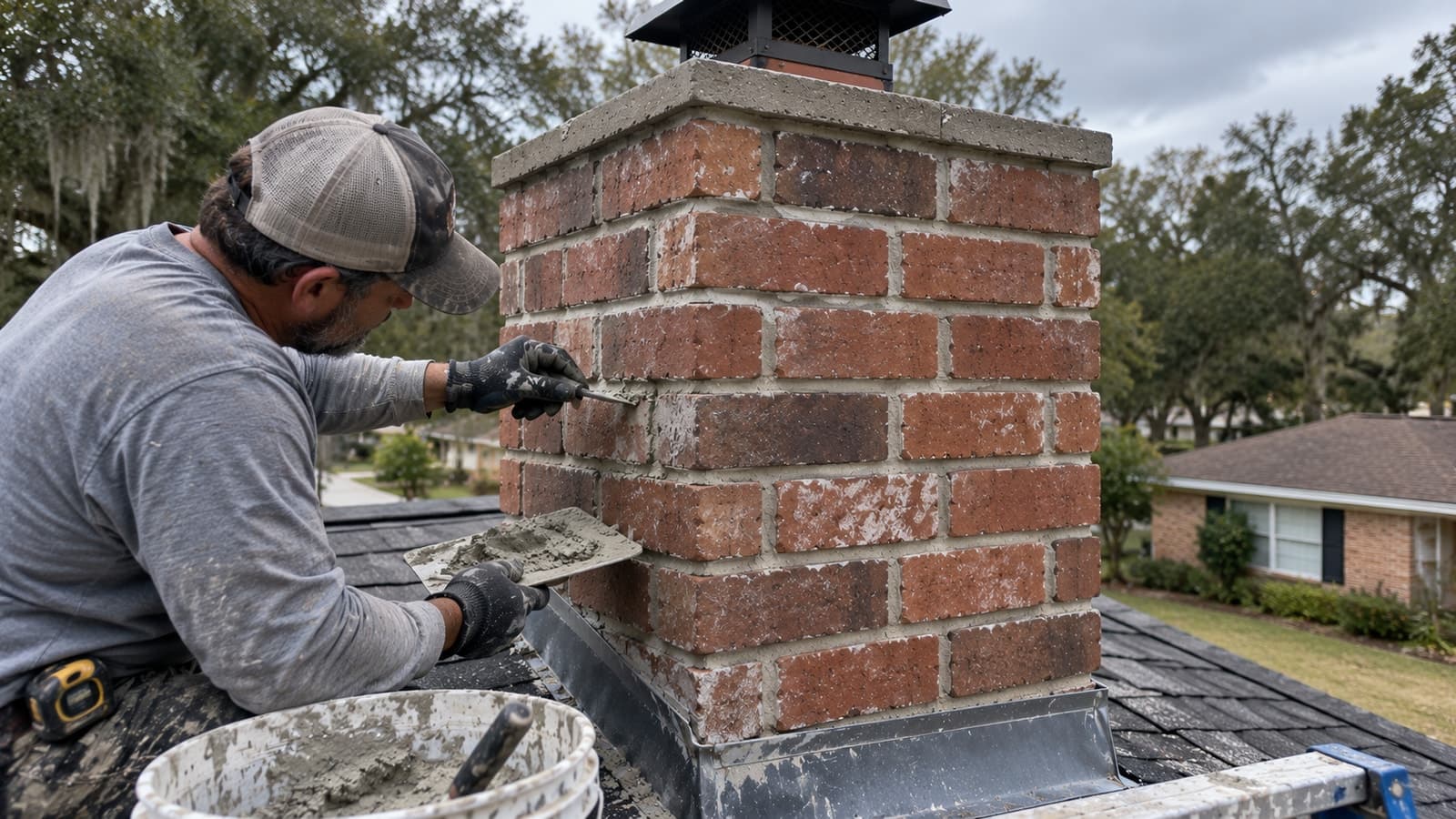
Short answer: chimney masonry repair covers the brick and the mortar between them. The most common jobs are repointing (raking out eroded mortar and packing new mortar into the joints), replacing individual bricks that have cracked or lost their faces, and resetting loose courses near the top. When the damage is deep or widespread, or the top of the chimney is loose or out of plumb, repair gives way to a rebuild.
Masonry repair, crown work or a rebuild?
These three get lumped together as “chimney repair,” but they’re different jobs aimed at different parts of the chimney.
| Job | What it addresses | Typical signs |
|---|---|---|
| Masonry repair (this page) | Mortar joints and individual bricks in walls that are still straight and solid | Sandy or recessed joints, a few cracked or flaking bricks, hairline step cracks |
| Crown repair or replacement | The concrete or mortar slab on top of the chimney | Cracks across the top, pieces on the roof, a gap at the flue tile |
| Chimney rebuild | Taking down and relaying a section of chimney, usually above the roof line | Loose bricks you can move by hand, a lean, widespread spalling, joints eroded deep into the wall |
What damaged chimney masonry looks like
Common masonry problems and how each is assessed
01Eroded or crumbling mortar joints
- What you may notice
- Joints recessed behind the brick face, sand in the gutter or on the roof, mortar that scratches out with a key.
- How it’s confirmed
- We check joint depth and hardness on every side, since the weather-facing side usually erodes first, and note how far down the stack the erosion runs.
02Spalling brick
- What you may notice
- Brick faces flaking, popping off in layers or leaving rough, pitted surfaces; fragments at the base of the chimney.
- How it’s confirmed
- We look at whether spalling is scattered or concentrated, and at the mortar and any coatings around it, because hard mortar and trapped moisture are common causes.
03Cracked bricks and step cracks
- What you may notice
- Cracks through individual bricks, or a stair-step crack following the joints.
- How it’s confirmed
- We check whether cracks are active (fresh edges, widening) and whether they line up with movement at the base or the roof line, which can point to a structural issue.
04White staining (efflorescence)
- What you may notice
- White or gray chalky deposits on the brick, often below the crown or above the roof line.
- How it’s confirmed
- Staining is treated as a sign of water movement: we trace it back to the crown, joints or flashing rather than just cleaning it off.
05Loose top courses
- What you may notice
- Bricks that shift under light hand pressure, gaps under the crown, mortar missing entirely at the top.
- How it’s confirmed
- If more than a few bricks are loose, or the loose area continues below the crown, the conversation turns to a rebuild of that section.
Tuckpointing vs repointing
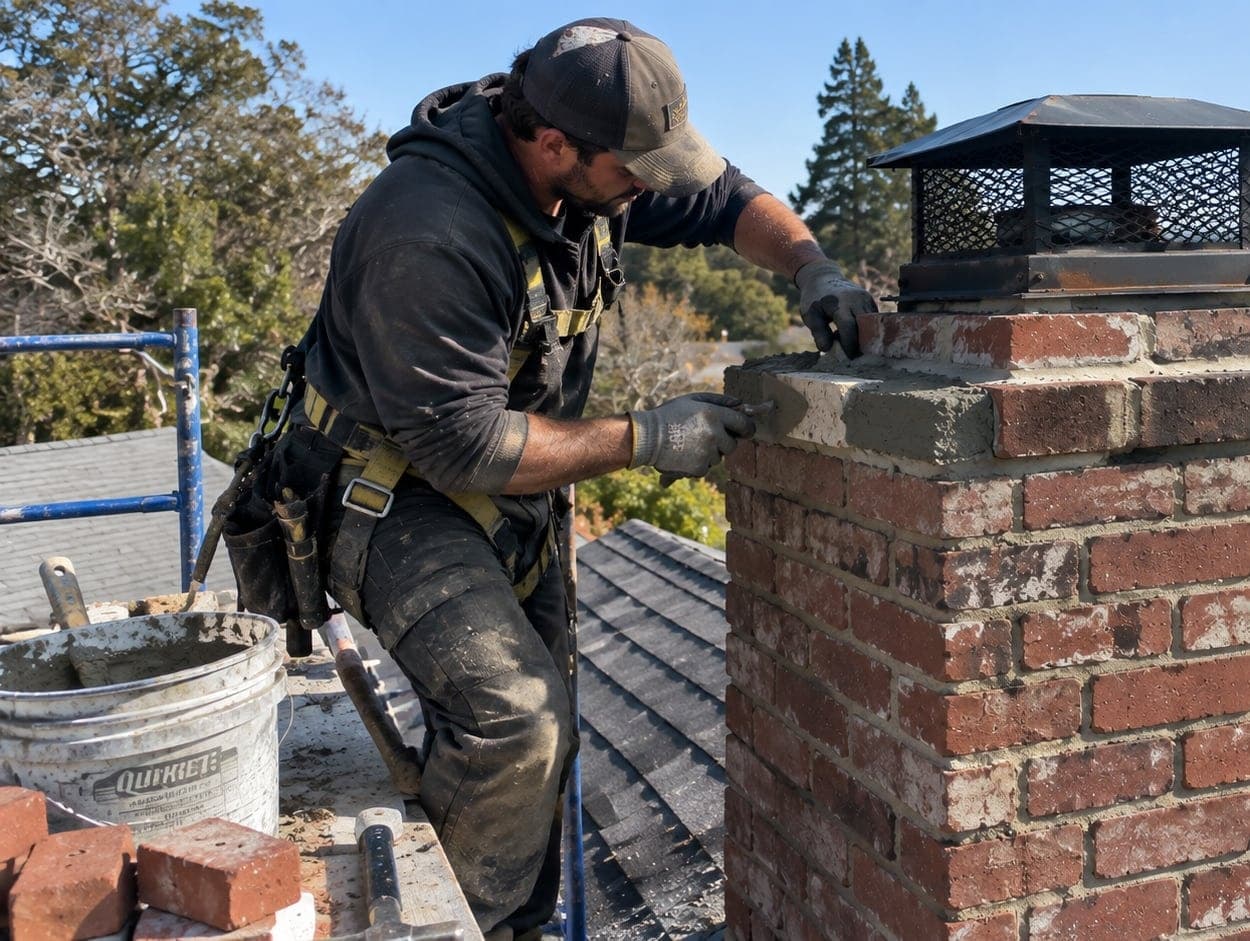
Homeowners and contractors use both words for the same job: removing deteriorated mortar and replacing it. Strictly, repointing is the repair itself, and tuckpointing is a decorative finish: a thin raised line of mortar or lime putty applied over flush joints. The National Park Service calls the everyday use of “tuck pointing” for repointing “somewhat inaccurate.” On a chimney, what you almost always need is repointing with a joint profile that matches the rest of the brickwork.
How a chimney is repointed
Assess the existing mortar and brick
The hardness, color and texture of the original mortar and the brick are compared, so the new mortar can be matched to them rather than chosen by habit.
Rake out the joints
Deteriorated mortar is removed to a consistent depth. The National Park Service recommends a minimum depth of 2 to 2½ times the joint width, plus any loose mortar beyond that, so the new mortar has something to bond to.
Clean and dampen the joints
Dust and debris are cleared and the joints are lightly dampened so the dry brick doesn’t pull water out of the new mortar too quickly.
Fill in layers
Deep joints are filled in several compacted layers rather than all at once, then tooled to match the profile of the original joints.
Cure and clean up
The new mortar is protected from drying too fast, and any smears are removed once it is firm, without harsh acids on new joints.
Why the mortar has to match older brick
Mortar is supposed to be the weaker, more permeable part of a masonry wall. When the wall moves with heat or settlement, or when moisture needs to escape, the mortar is meant to take that stress and wear, and it can be replaced. The National Park Service’s Preservation Brief 2 on repointing puts it plainly: new mortar should be softer and more vapor-permeable than the brick, and no harder or less permeable than the historic mortar.
Hard mortar can break soft brick
If a joint is packed with mortar that is harder and denser than the brick around it, the brick becomes the weak link. Movement cracks the brick instead of the joint, and moisture that can’t escape through the mortar leaves through the brick faces, depositing salts that can pop the surface off. Preservation Brief 2 shows exactly this damage from hard portland-cement mortar used on soft brick. Once a brick face has spalled, it can’t be repointed back; the brick has to be replaced.
Matching doesn’t automatically mean a pure lime mortar, either. The same brief notes that many buildings from the first half of the 20th century were originally built with portland-cement mortar. A chimney from the 1950s or 1960s may have a harder original mortar than one from the 1920s. That’s why the existing brick and mortar are assessed first and the mix is chosen for that chimney.
| Feature | Compatible repair mortar | Mismatched repair mortar |
|---|---|---|
| Strength | Softer than the brick, no harder than the original mortar | Harder than the brick or the surrounding joints |
| Moisture | Lets the wall dry through the joints | Forces moisture out through the brick faces |
| Where stress goes | Into the mortar, which can be repointed again later | Into the brick, which cracks or spalls |
| Appearance | Color, sand and joint profile matched to the original | Obvious patches; can look smeared or too gray |
Strength
- Compatible repair mortar
- Softer than the brick, no harder than the original mortar
- Mismatched repair mortar
- Harder than the brick or the surrounding joints
Moisture
- Compatible repair mortar
- Lets the wall dry through the joints
- Mismatched repair mortar
- Forces moisture out through the brick faces
Where stress goes
- Compatible repair mortar
- Into the mortar, which can be repointed again later
- Mismatched repair mortar
- Into the brick, which cracks or spalls
Appearance
- Compatible repair mortar
- Color, sand and joint profile matched to the original
- Mismatched repair mortar
- Obvious patches; can look smeared or too gray
How Central Florida weather wears chimney masonry
Up north, freeze-thaw cycles are the big brick killer. Here they barely register. What wears Central Florida chimneys is water and heat: heavy summer downpours and wind-driven rain soak the exposed faces, high humidity keeps the masonry from drying out, and strong sun heats the brick every afternoon. The results are washed-out mortar near the top, white efflorescence where water carries salts to the surface, rusted dampers and steel, and spalling on soft older brick that was repointed or sealed with materials too hard or too tight for it.
- The top courses fail first, because they take rain from every side and sit above the flashing.
- The face that takes the most weather usually shows the most wear.
- Joints around the flashing crack as the roof and the chimney move at different rates.
- Brick below a cracked crown stays wet the longest, which is why crown repair is often part of the job.
Older brick chimneys are most common in homes built before 1970. The City of Orlando has six local historic districts, and exterior modifications in them need a Certificate of Appropriateness (City of Orlando). Whether a given chimney job counts as a modification (repointing with matched mortar is different from replacing brick or changing the chimney’s appearance) is a question for the City’s historic preservation staff; ask before exterior work is scheduled. The Orlando neighborhood guide covers where older chimneys are concentrated.
Keeping masonry repairs from coming back
Mortar erodes because water moves through it. Repointing without fixing the source means repeating the job. The usual culprits are above the damage: a crown with no overhang dumping water down the brick faces, a missing cap, or failed flashing at the roof line. Once the joints and bricks are sound, a vapor-permeable masonry water repellent is an option for brick that still absorbs a lot of rain, though many repaired chimneys don’t need one.
What affects the cost of chimney masonry repair
Masonry work is priced by extent and access. The factors below are the main ones.
- How many joints need repointing, and how deep they’ve eroded
- Number of bricks to replace, and whether matching brick can be found
- Mortar matching for older or historic brick
- Chimney height above the roof and roof pitch
- Crown or flashing repairs found at the same time
- Any historic district review needed before exterior work
Spalling in a humid climate
Spalling is brick faces flaking, crumbling or popping off, and people assume it is a freeze-thaw problem. Central Florida averages about one freezing night a year, and chimneys here spall anyway.
The mechanism here is moisture and salts rather than ice. Brick that stays wet draws dissolved salts to the surface as it dries, and those salts crystallise just under the face and push it off. That is also what the white powdery deposit — efflorescence — is telling you. It is a moisture signal, not a cosmetic one.
Which means fixing the spalled brick without fixing the water gets you a repair that spalls again. The crown, cap, flashing and, where appropriate, a vapour-permeable water repellent are part of the same job.
References (2)
Facts and figures on this page come from these references.