On this page
Smoke comes into the room for one underlying reason: the chimney is not pulling air up faster than the fire is producing smoke. That single symptom has about eight distinct causes, and they need completely different repairs. Guessing is how people end up paying for a new damper when the problem was a bird's nest.
If you want the background on why it happens rather than the service that fixes it, why does my fireplace smoke covers the physics and the things you can check yourself.
The causes, in the order they are checked
This order is deliberate. It runs from the cheapest and most common to the most involved, so nobody pays for structural work before the simple explanations have been eliminated.
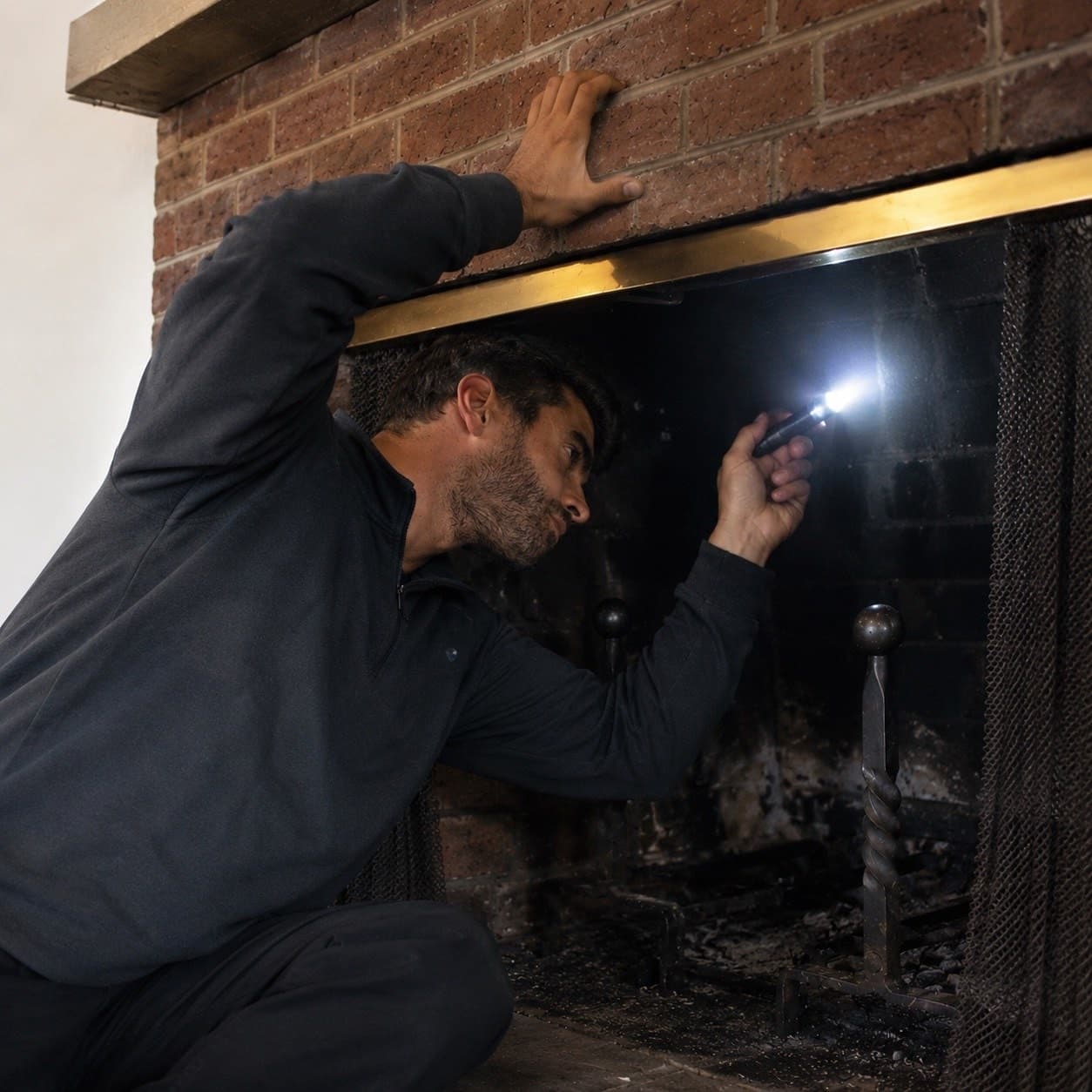
Draft faults and how each is confirmed
011. The damper is not fully open
- What you may notice
- Smoke from the moment the fire is lit, every single time.
- How it’s confirmed
- Looked at directly rather than taken on trust. Warped blades, a seized frame or a snapped handle all leave a damper that feels open and is not.
022. Something is blocking the flue
- What you may notice
- It used to work and now it does not. Common after a summer the fireplace sat unused.
- How it’s confirmed
- Checked from below and from the roof where access allows, and confirmed with a camera where the view runs out. Nests, leaves and fallen flue tiles are the usual finds.
033. Heavy soot and creosote narrowing the flue
- What you may notice
- Gradual worsening across seasons, with black flakes appearing in the firebox.
- How it’s confirmed
- Deposits reduce the flue's cross-section and the chimney's ability to pull. Measured against what the flue should be, then cleaned.
044. A rough or badly shaped smoke chamber
- What you may notice
- Smoke rolls out at the top of the opening, especially when a fire is first lit.
- How it’s confirmed
- Corbelled brick left rough, or shoulders that are too steep on one side, break up the airflow. Parging smooths it into a proper funnel.
055. The opening is too large for the flue
- What you may notice
- It has smoked since the day the house was built and no repair has ever fixed it.
- How it’s confirmed
- The firebox opening and the flue's cross-section are measured and compared. An opening that is too big for the flue cannot be fixed by cleaning — it is corrected by reducing the opening.
066. The chimney is too short, or wind is pushing down
- What you may notice
- It draws fine in calm weather and smokes when the wind is up or from one direction.
- How it’s confirmed
- Height above the roofline and the distance to nearby roof surfaces and trees are checked. A taller flue or a wind-directional cap is the usual answer.
077. The house is under negative pressure
- What you may notice
- Smoke pulls in when the air handler, range hood or dryer runs, and stops when a window is cracked open.
- How it’s confirmed
- Tested by running the appliances and watching what happens. Very common in tight modern Orlando homes, and the fix is make-up air rather than chimney work.
088. Cold-flue stall on the first light
- What you may notice
- The first few minutes smoke, then it settles and behaves perfectly.
- How it’s confirmed
- A column of cool, dense air in the flue has to be reversed before it will draw. A technique fix rather than a repair, and the cheapest outcome of the visit.
How the diagnosis is done
Ask what actually happens
Always, sometimes, only on windy days, only at first light, only when the dryer is running. The pattern narrows the cause faster than any test.
Inspect the whole path
Firebox, throat, damper, smoke chamber, flue and the top of the chimney. Draft problems are frequently a combination rather than a single fault.
Measure the ratio
Firebox opening against flue cross-section. This is the number that decides whether the fireplace was ever going to work, and it is routinely never checked.
Look up the flue with a camera where needed
A partial blockage or a collapsed section halfway up looks identical from the firebox to a chimney that is perfectly clear.
Test the draft
A smoke test shows which way air is moving in the flue before a fire is lit, and whether it reverses when the air handler starts.
Check the house, not only the chimney
Range hood, dryer, bathroom fans and the air handler are run to see whether the fireplace is losing a competition for air.
The cheapest test you can run yourself
Crack a window in the same room, wait a minute, then light the fire. If the smoking stops, the chimney is fine and the house is starving it of air. That points at make-up air and appliance interaction, not at masonry work — and it is worth knowing before you book anything.
What the repairs actually are
| Cause found | The repair | Page |
|---|---|---|
| Damper seized, warped or missing | Repair, or replace with a top-sealing damper | Chimney damper repair |
| Nest, debris or fallen tile in the flue | Clear the obstruction, then cap the top | Chimney blockage removal |
| Heavy soot or glazed creosote | Full sweep, or rotary and chemical treatment for glaze | Creosote removal |
| Rough or misshapen smoke chamber | Parge and reshape into a smooth funnel | Smoke chamber repair |
| Opening too large for the flue | Reduce the opening height with a smoke guard or a raised lintel detail | This page |
| Chimney too short or wind-affected | Extend the flue, or fit a wind-directional cap | Chimney cap installation |
| Flue oversized or damaged | Reline to the correct size for the appliance | Chimney liner installation |
| House under negative pressure | Make-up air, and changing which appliances run together | This page |
Reducing the opening
A working rule of thumb is that a fireplace opening should be somewhere around ten times the flue's cross-sectional area. Get much beyond that and the flue physically cannot move the volume of smoke the opening produces, no matter how clean it is.
This is the diagnosis behind most fireplaces that have smoked since the day they were built. Owners assume it is dirt, have it swept repeatedly, and it never improves — because cleaning was never going to change the geometry.
The fix is to reduce the opening rather than enlarge the flue. A smoke guard is a metal strip across the top of the opening that lowers it by a few inches; it is reversible and is the sensible first attempt. Where more correction is needed, the opening can be permanently reduced with a raised hearth detail or by rebuilding the lintel line. Either way it is tested before it is made permanent.
Gas fireplaces that smell or soot
A vented gas appliance has the same dependence on the chimney, but the symptoms look different. Instead of visible smoke you get soot on the glass, a smell of combustion in the room, or black marks above the opening.
Those point at a venting problem and should be treated seriously rather than cleaned off. The diagnosis overlaps with this page, but the appliance side is covered under gas fireplace repair and gas fireplace service. If you smell gas rather than combustion, leave the building and call 911 and the gas utility first.
Why this is common in Central Florida
Draft depends on the temperature difference between the flue and the outside air. A chimney works because hot gas is lighter than the cold air outside it, and that difference is what pulls. On a 68°F Orlando evening that difference is small, so Central Florida fireplaces start with weaker draft than the same fireplace would have in January in Ohio.
Add to that a housing stock built tight for air conditioning, with powerful air handlers and range hoods, and you have the local pattern: a chimney that is adequate in principle, competing for air with the rest of the house, in a climate that barely gives it a temperature difference to work with. Small faults that would be masked in a cold climate show up here as smoke in the room.
There is more on how the climate affects chimneys in Florida humidity and your chimney.
Draft diagnosis is available across Orlando, Winter Park, Maitland, Kissimmee, Oviedo and the wider Central Florida service area. Estimates are free, and a visit that ends with “your chimney is fine, the air handler is the problem” is a legitimate result rather than a wasted call.
References (2)
Facts and figures on this page come from these references.