On this page
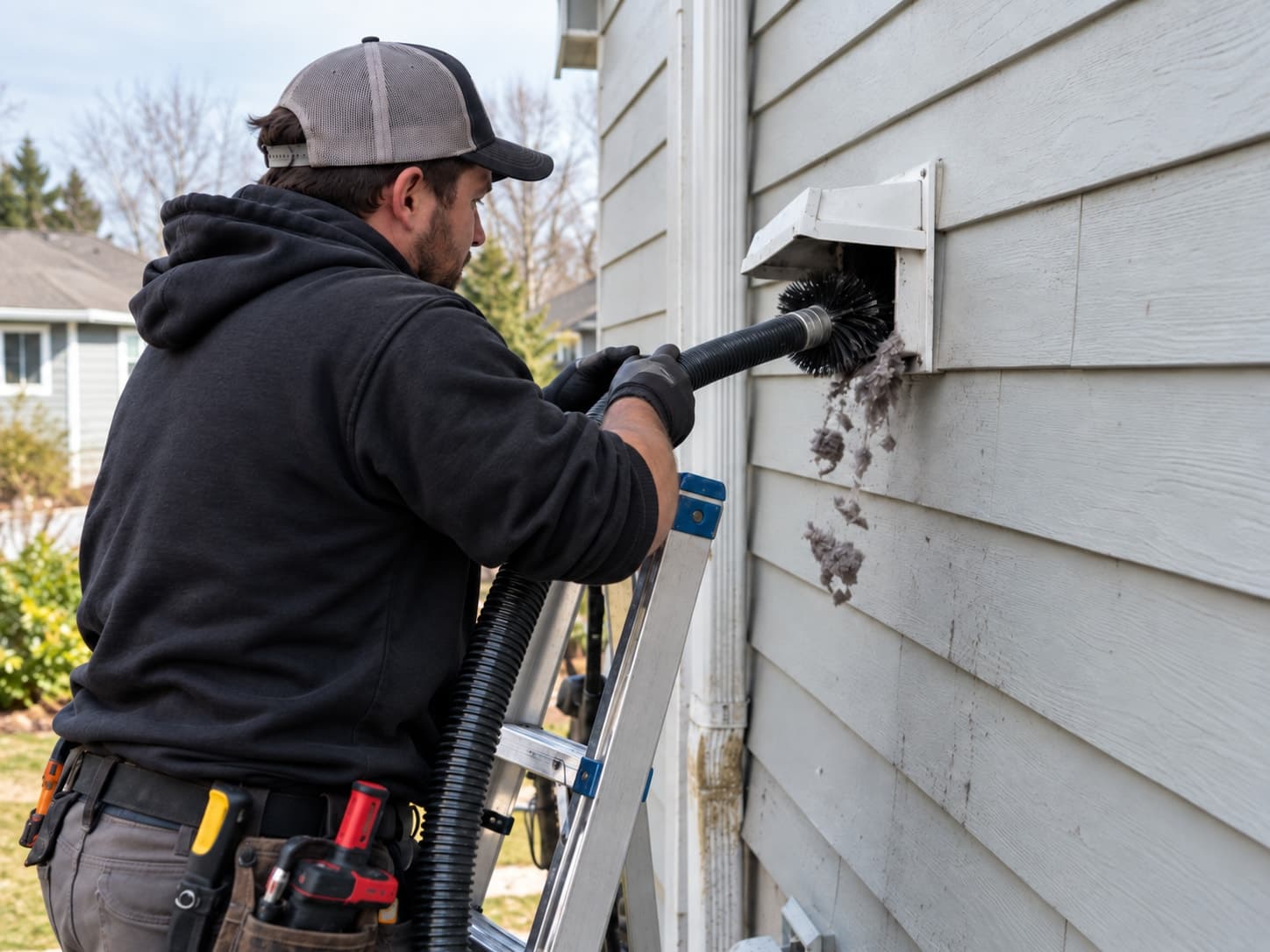
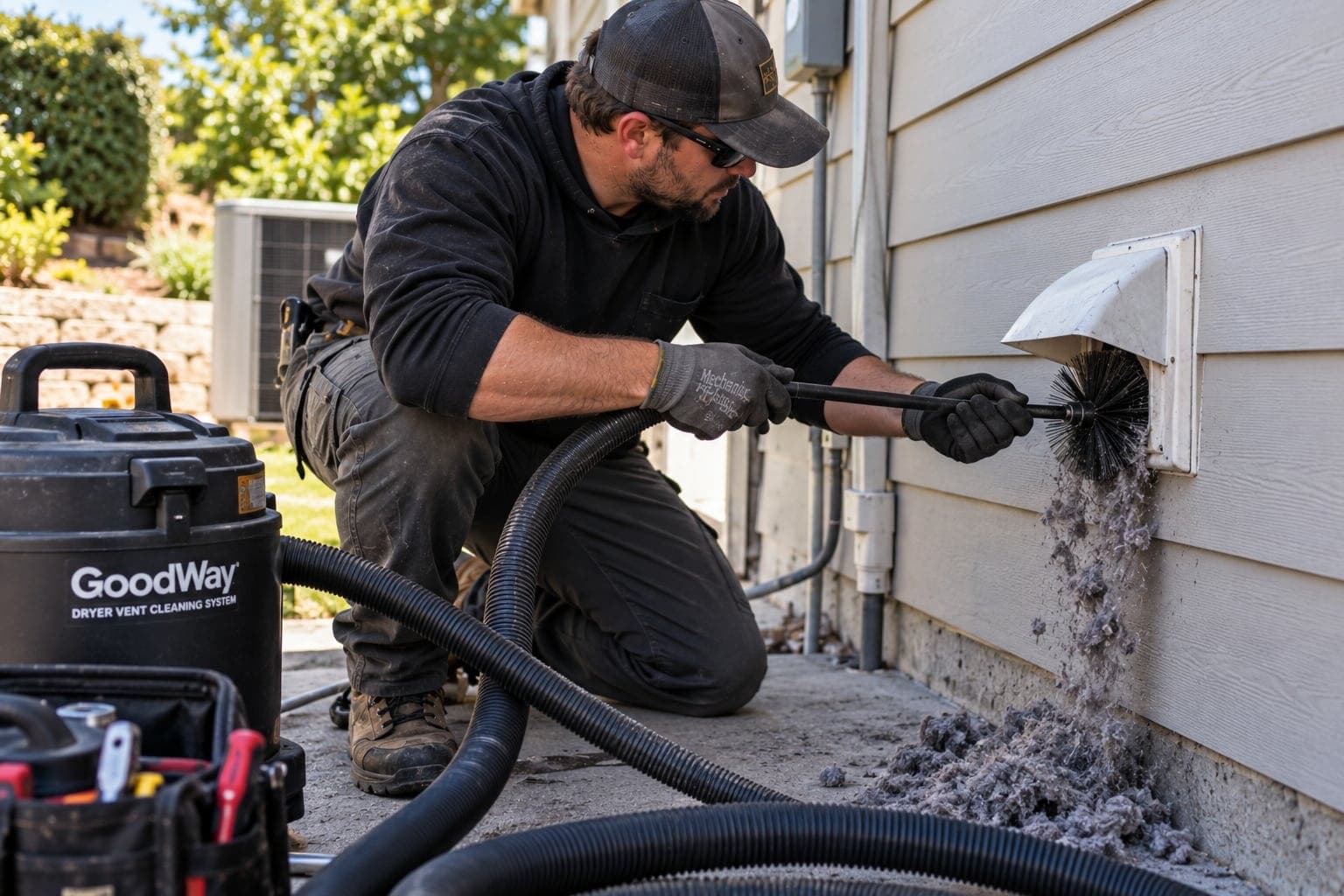
The lint screen in your dryer catches most of the lint, but not all of it. The rest travels with hot, wet air into the duct, and some of it sticks every time. Given enough loads, that lint packs into mats at elbows, fills the hose behind the dryer and stuffs the space behind the outside flap. Lint removal goes after those deposits specifically, from the dryer to the outside.
Failure to clean is the leading factor in dryer fires, according to the U.S. Fire Administration (USFA). Lint is highly flammable, and a packed duct makes the dryer run hotter.
Lint removal or a routine vent cleaning?
The two overlap: both use the same brushes and vacuums, and both end with a clear duct. The difference is the starting point, and it changes how the visit is approached.
| Feature | Heavy lint removal | Routine dryer vent cleaning |
|---|---|---|
| Typical starting point | Years without cleaning, a duct packed solid, or lint showing up outside the vent | A vent cleaned in the last year or two, with slowing dry times |
| Focus | Finding every deposit, including the lint-trap slot and any lint that has escaped the duct | Keeping a sound vent clear on a regular schedule |
| Work involved | Several brushing passes from both ends, hose often replaced, cap opened and cleared | A full-length brushing and vacuuming, cap cleared, airflow compared |
| Follow-up | Finding why so much lint built up, and whether escaped lint needs cleanup | Setting the next cleaning interval |
Typical starting point
- Heavy lint removal
- Years without cleaning, a duct packed solid, or lint showing up outside the vent
- Routine dryer vent cleaning
- A vent cleaned in the last year or two, with slowing dry times
Focus
- Heavy lint removal
- Finding every deposit, including the lint-trap slot and any lint that has escaped the duct
- Routine dryer vent cleaning
- Keeping a sound vent clear on a regular schedule
Work involved
- Heavy lint removal
- Several brushing passes from both ends, hose often replaced, cap opened and cleared
- Routine dryer vent cleaning
- A full-length brushing and vacuuming, cap cleared, airflow compared
Follow-up
- Heavy lint removal
- Finding why so much lint built up, and whether escaped lint needs cleanup
- Routine dryer vent cleaning
- Setting the next cleaning interval
If your vent has been looked after and just needs its regular service, book a standard dryer vent cleaning. If almost no air comes out at all, the vent may be fully obstructed rather than just lint-heavy; see clearing a blocked dryer vent.
Where lint builds up
| Location | Why lint collects there | How it’s removed |
|---|---|---|
| Lint-trap slot (below the screen) | Fine lint slips past the screen and packs into the slot | Long, narrow brushes and vacuum attachments |
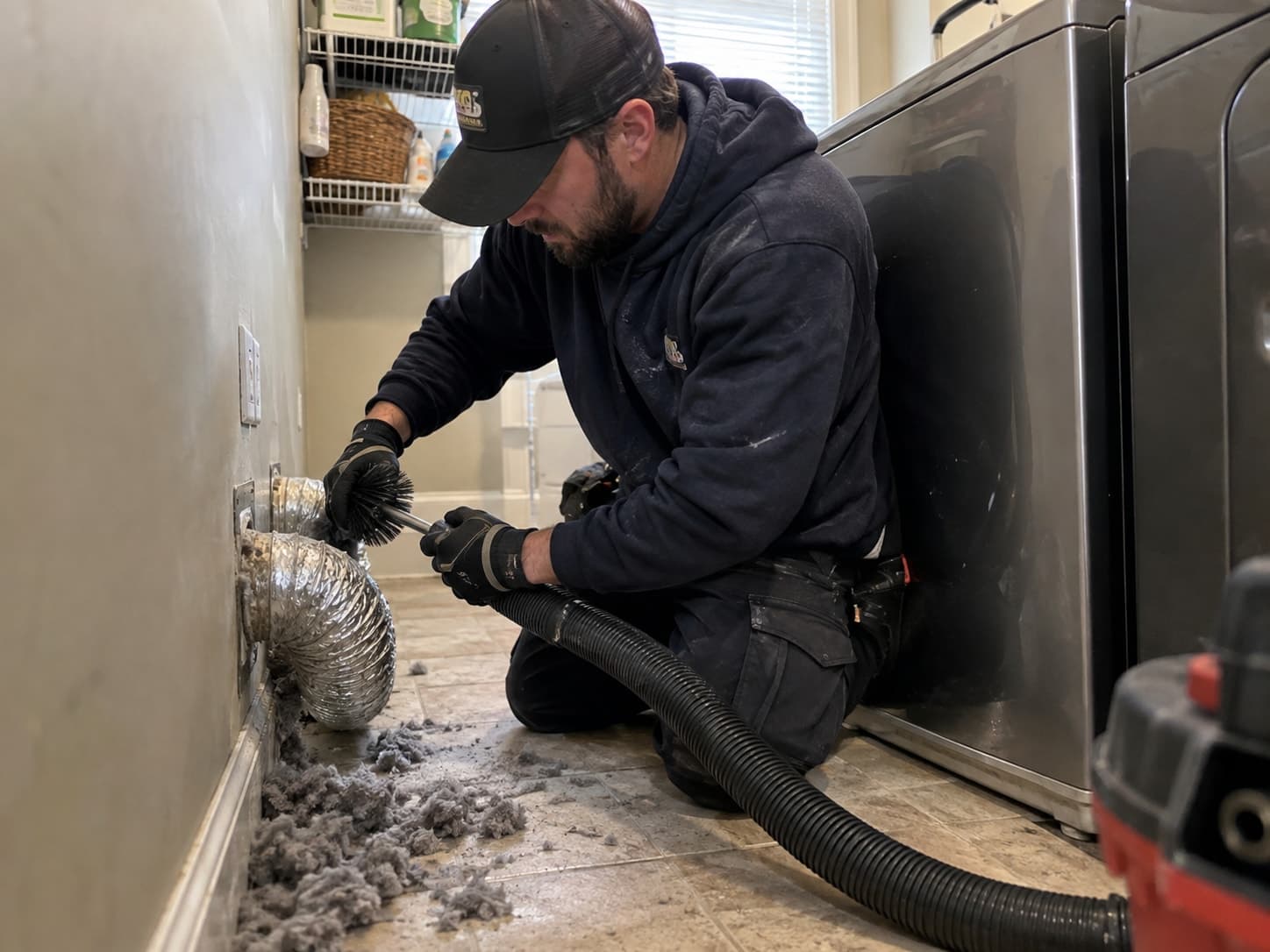
| Dryer exhaust outlet | Lint that passes the slot settles where the drum air leaves the cabinet | Vacuumed from the back with the hose off |
| Transition hose behind the dryer | Kinks, sags and ridged foil catch lint | Disconnected, cleaned or replaced with a listed hose |
| Elbows and long runs | Air slows at every turn and drops lint | Rotary brushing in both directions with vacuum or air |
| Attic and roof runs | Air cools as it rises; lint and moisture settle | Cleaned from the roof cap and from inside |
| Exterior or roof cap | Flaps and screens trap lint as air exits | Cap opened and cleared; any screen removed |
Lint deep inside the dryer cabinet, around the drum, heater or blower wheel, is appliance territory. It is pointed out if we see it, and an appliance technician handles it.
Screens on the exterior cap are a common cause of repeat lint buildup. Florida’s residential code doesn’t allow screens at a dryer exhaust termination, because they trap lint (FBC-R M1502). If yours has one, swapping it for a damper hood fixes it.
Lint where it shouldn’t be
Lint outside the duct is a clue, not just a mess. Where it shows up usually tells you where the vent is failing:
- Behind the dryer or around the door seal: a loose or torn transition hose, or a restricted vent pushing lint back out of the dryer.
- On attic insulation along the duct route: a joint that has separated, which needs reconnecting and sealing as well as cleanup.
- Around the outside hood or on the roof near the cap: a stuffed cap or a flap that sticks, forcing lint out in clumps.
Drying problems aren’t always the vent. Our guide to a dryer taking too long to dry helps separate vent problems from dryer problems.
How heavy lint is removed
Measure airflow
Airflow at the exterior or roof cap is checked before any cleaning.
Pull the dryer out
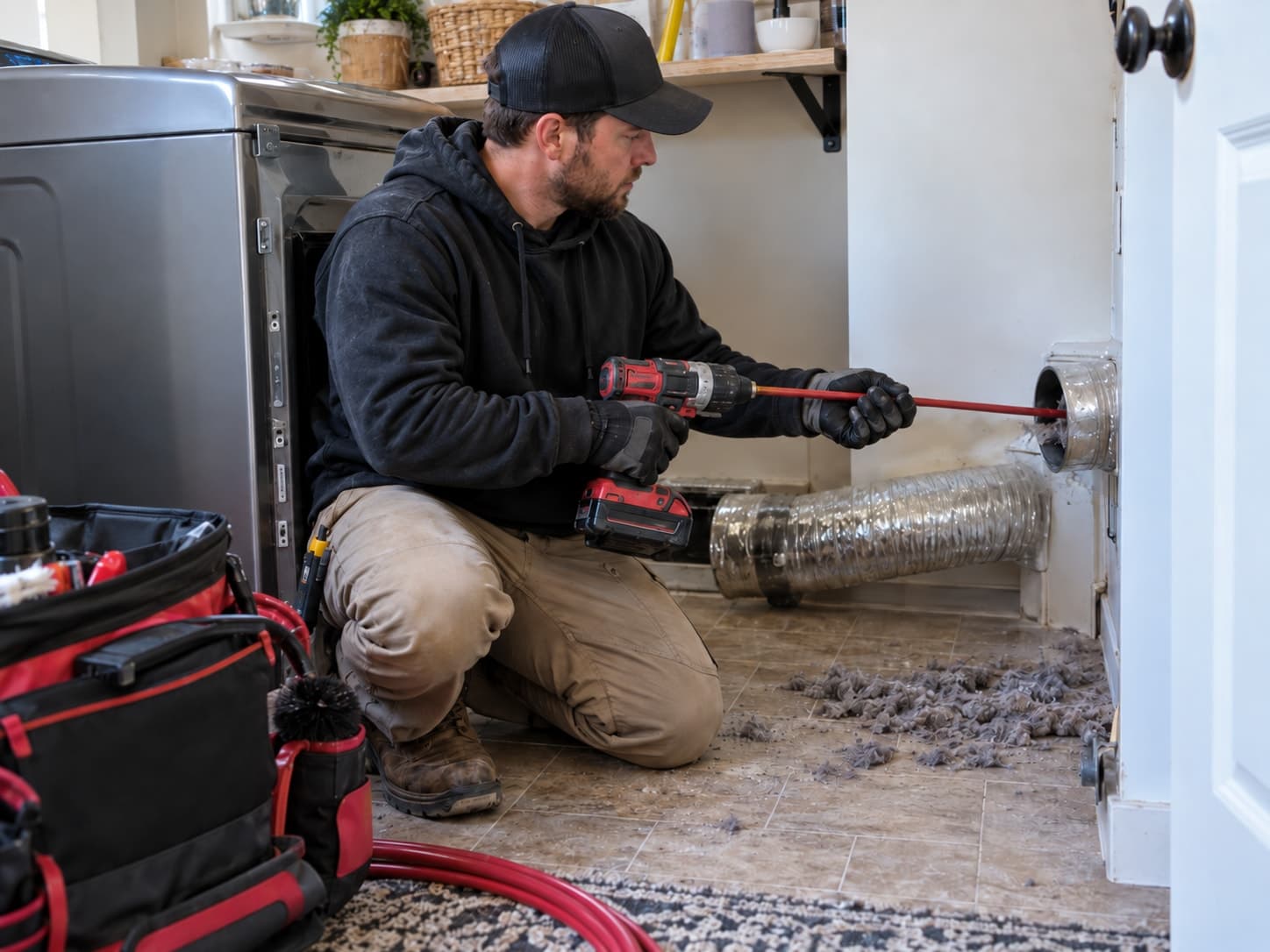
The transition hose is disconnected, and the lint-trap slot and exhaust outlet are cleared.
Break up packed lint
Rotary brushes work the full length in several passes, from both ends where possible, with lint pulled out by vacuum.
Clear the cap
Flap, damper and any illegal screen cleared or removed.
Reconnect and re-test
The transition hose is reconnected or replaced without kinks, and airflow is measured again.
If you smell burning
Stop the dryer and unplug it if it’s safe to do so. A burning smell can mean lint is overheating. See dryer burning smell, and call 911 if you see smoke or flames.
Long runs are where lint actually collects
A short, straight duct out through the wall behind the dryer rarely gives trouble. The runs that clog are the long ones, and Central Florida housing is full of them: townhomes with an interior laundry, two-storey homes with a ground-floor laundry venting through the roof, and additions where the laundry ended up a long way from an outside wall.
Code puts a limit on how long a dryer duct can be, and every elbow counts against that limit as several extra feet of equivalent length. A run that is close to or past the limit is one that will keep clogging no matter how often it is cleaned.
| Run type | Typical behaviour | What it needs |
|---|---|---|
| Short wall vent behind the dryer | Rarely a problem | Routine cleaning |
| Long horizontal run to an exterior wall | Lint settles on the bottom of the duct along its length | Full-length brushing, not just from the ends |
| Ground-floor laundry venting through the roof | Lint falls back down the vertical section between cycles | Cleaning from the roof as well as from the dryer |
| Run with several elbows | Lint packs at each bend | Brushing plus a check on whether the route is viable at all |
| Run at or over the code length | Clogs again within months of every cleaning | Rerouting or a booster fan, not more cleaning |
Where a run keeps clogging, cleaning it more often is treating the symptom. Dryer vent rerouting covers shortening the route, and Florida dryer vent code sets out the length limits that apply.
Booster fans
Where a duct genuinely cannot be shortened, a booster fan is the recognised solution: an inline fan that adds the push the dryer cannot provide over the distance.
They need cleaning too, and that is the part that gets missed. Lint builds on the impeller and in the housing, and a booster fan choked with lint is both useless and a heat source sitting inside a duct full of fuel. Where one is fitted, it is opened and cleaned as part of the visit.
A fan that has stopped working is a common cause of a dryer that suddenly takes twice as long with no visible blockage — see dryer vent booster fan not working and the guide to dryer vent booster fans.
The parts right behind the dryer
A surprising share of lint problems are in the four feet nobody can see, because the dryer has to be pulled out to look.
What is usually wrong back there
01A crushed transition hose
- What you may notice
- The dryer has been pushed back tight against the wall.
- How it’s confirmed
- Flexible hose folds and kinks when the appliance is pushed in. A kinked hose collects lint at the fold and restricts airflow badly.
02A recessed dryer box that has never been cleaned
- What you may notice
- A metal box let into the wall behind the dryer.
- How it’s confirmed
- The box is there so the dryer can sit closer to the wall without crushing the hose. It collects lint in the bottom and is easy to clean once you know it is there.
03A periscope fitting packed with lint
- What you may notice
- A flat rectangular duct behind the dryer instead of a round hose.
- How it’s confirmed
- Periscopes save space but have a small cross-section that blocks quickly. Cleaned or replaced.
04Foil flex hose used for the transition
- What you may notice
- Thin silver flexible hose with a wire spiral.
- How it’s confirmed
- The ribbed interior catches lint at every corrugation. Rigid or semi-rigid metal is the correct material.
05A disconnected duct inside the wall
- What you may notice
- Lint appearing in the room, or the laundry getting humid during a cycle.
- How it’s confirmed
- The duct has come apart inside the cavity and is venting into the wall. This causes real damage and needs fixing, not cleaning.
Where the whole run is blocked rather than restricted, that is dryer vent blockage removal — and if the dryer is producing a burning smell or cutting out on its thermal switch, stop using it and treat it as urgent.
Lint removal on long and awkward runs is available across Orlando, Winter Park, Altamonte Springs, Kissimmee, Oviedo, Clermont and the rest of the Central Florida service area, with same-day slots where the schedule allows and free estimates on anything the visit turns up.
References (2)
Facts and figures on this page come from these references.