On this page
Electric fireplaces are a common choice in condos, apartments and homes without a chimney. They’re simple to live with, but they are still appliances with moving parts, lights, heating elements and electronics. When one stops working, the fix is usually a specific part, and the model’s manual and parts list decide what that part is.
An electric fireplace works in a completely different way from a gas one. There’s no burner, pilot, valve or vent; the “flame” is light and motion, and the heat comes from an electric element and a fan. If your fireplace burns gas, see repairs for gas fireplaces instead.
Types of electric fireplaces we work on
| Type | How it’s installed | Repair notes |
|---|---|---|
| Wall-mount | Hung on the wall and plugged into an outlet | Usually taken down to reach the heater and control board |
| Electric insert | Set into an existing fireplace opening | Slid out for access; the outlet is often inside the firebox |
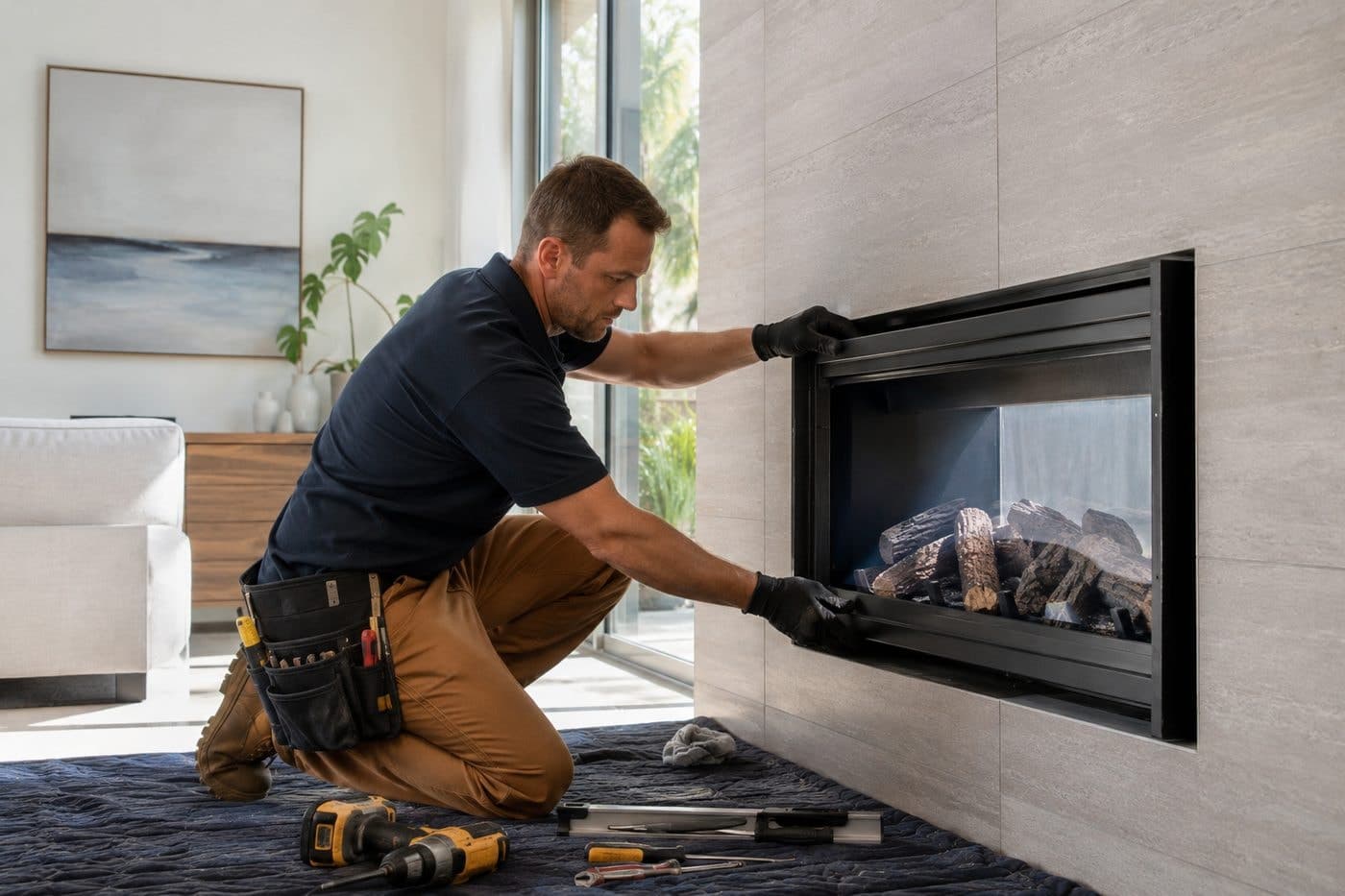
| Built-in or linear | Framed into a wall or media wall, sometimes hardwired | Access depends on how it was framed; hardwired units are isolated at the breaker first |
| Media console or mantel unit | Firebox cartridge inside furniture | The cartridge is removed as one piece |
Common electric fireplace problems
| Symptom | Usual causes |
|---|---|
| No power at all | Tripped breaker or GFCI, unplugged or loose connection, blown internal fuse, failed main switch |
| Flame effect not showing or frozen | Failed LED strip or bulbs, stalled flicker motor, broken flame rod or reflector |
| Flame works but no heat | Heater set off or too low, thermal cutoff tripped, failed heating element or fan motor |
| Heater shuts off after a few minutes | Overheat protection tripping from blocked vents, dust buildup or a failing fan |
| Remote or app not responding | Batteries, receiver pairing, or a failed control board |
| Clicking, humming or rattling | Fan motor wear, a loose part, or a flicker motor rubbing |
For the checks behind each of these, step by step, see why an electric fireplace stops working.
Heater and blower repairs
Most electric fireplaces heat with a resistance element and a small blower that pushes warm air out through a grille. The unit protects itself with a thermal cutoff that shuts the heater off if the air can’t get out. Dust packed in the intake, a fan motor that has slowed with age, or a grille blocked by décor all trip it, which is why a heater that runs for a few minutes and quits is so common. A thermostat set below room temperature has the same effect, which catches people out on mild Florida evenings. Failed elements, fan motors and thermostat sensors are replaced with the maker’s parts.
Flame effect and lighting
The flame picture comes from LEDs or bulbs, a reflector, and often a small motor turning a twisted rod or mirror to make the light flicker. When the light works but the flame is frozen, the motor or its coupling has usually failed. When part of the picture is dark, an LED strip or a connection to it has failed. Some models also have separate ember-bed and downlight circuits that fail independently.
Remotes, apps and control boards
The control board ties the power switch, remote receiver, thermostat, heater and lighting together. Power surges, heat and age can all take a toll on a board. Before a board is replaced, the remote batteries, pairing and any Wi-Fi or app connection are ruled out, since those are the cheaper causes.
Checks you can do first
- Confirm the outlet works with another device, and reset any tripped GFCI or breaker
- Replace the remote batteries and re-pair the remote following the manual
- Unplug the unit for a few minutes to reset the controls
- Vacuum dust from the heater intake and outlet grilles with the unit off and cool
- Make sure nothing blocks the heater outlet, including furniture or décor
Don’t open the unit while it’s plugged in
Electric fireplaces run on household voltage. Unplug the unit, or switch off the circuit for hardwired models, before removing any panels. Wiring changes on hardwired units and new circuits are work for a licensed electrician, not part of this repair service.
How a repair visit works
Identify the model
Make, model and serial from the label, so the right manual and parts are used.
Diagnose
Power supply, controls, flame system and heater tested in turn.
Source parts
Manufacturer parts are ordered where needed; some models have limited parts availability, which you’ll hear about up front.
Repair
Failed components replaced and the unit reassembled.
Test
Flame, heat, remote and safety cutoffs checked in operation.
Repair or replace?
Many electric fireplaces are affordable enough that an expensive board or motor can make replacement the better value, especially on older or discontinued models. We tell you when that’s the case. If you’d rather put a sealed insert into an existing fireplace opening, insert installation covers electric, gas and wood options, and installing a new fireplace covers the rest. For every other kind of fireplace, start at the fireplace repair overview.
Two systems in one box
Nearly every electric fireplace fault makes sense once you know the unit contains two largely independent systems: a heater, and a flame effect. They fail separately, which is why the symptom is so often “one works and the other does not”.
| Feature | Flame effect | Heater |
|---|---|---|
| What it is | An LED or lamp array plus a motor turning a reflector or rotisserie | A resistance element with a fan behind it |
| Typical fault | Motor seized or lamps failed, so the flame stops moving or goes dark | Element failed or thermal cut-out tripped, so the fan blows cold |
| Runs without the other | Yes — flame with no heat is normal on most units in summer | Yes, though few people run heat without flame |
| Usual cause here | Dust on the motor bearing after a long idle period | Overheating from a blocked intake, which trips the cut-out |
| Serviceable? | Often, where the module is still available | Sometimes; elements and thermal switches are model-specific |
What it is
- Flame effect
- An LED or lamp array plus a motor turning a reflector or rotisserie
- Heater
- A resistance element with a fan behind it
Typical fault
- Flame effect
- Motor seized or lamps failed, so the flame stops moving or goes dark
- Heater
- Element failed or thermal cut-out tripped, so the fan blows cold
Runs without the other
- Flame effect
- Yes — flame with no heat is normal on most units in summer
- Heater
- Yes, though few people run heat without flame
Usual cause here
- Flame effect
- Dust on the motor bearing after a long idle period
- Heater
- Overheating from a blocked intake, which trips the cut-out
Serviceable?
- Flame effect
- Often, where the module is still available
- Heater
- Sometimes; elements and thermal switches are model-specific
A unit doing nothing at all is more often the supply than the appliance: a tripped breaker, a GFCI outlet that has tripped, or a remote receiver that has lost its pairing. Those are worth checking before anything is booked. The symptom page on an electric fireplace that will not work walks through the checks in order.
Fitting an electric unit
Electric is the route people take when there is no gas and no viable vent path, and in Central Florida that covers a lot of situations: condos, interior walls, rentals, and associations whose rules rule out a fuel-burning appliance.
What an installation involves
- A dedicated circuit in most cases, because a heater on a shared circuit trips breakers
- Measuring the opening, since electric inserts come in fixed sizes
- Deciding between an insert into an existing firebox, a wall-mounted unit or a built-in
- Sealing off the flue where a working fireplace is being retired
- Keeping the chimney capped and weather-tight even though it is no longer used
- Somewhere to put the remote receiver where heat will not reach it
Retiring a chimney does not mean ignoring it
An electric unit fitted into an old firebox leaves a chimney sitting above it, still out in the weather. Without a cap and a sound crown it becomes a rainwater channel into the wall, and nobody notices until the damage shows inside. The flue gets sealed at the appliance and capped at the top.
Where you are weighing electric against gas, our page on changing a fireplace over compares the routes. Dimplex is the make most often found in Orlando-area homes, and our page on identifying your fireplace make covers finding the model number before you call.
Electric fireplace work is available across Orlando, Winter Park, Lake Nona, Altamonte Springs, Kissimmee and the rest of the Orlando service area, with free estimates. Bring the model number: on electric units it decides almost entirely whether a part exists.