On this page
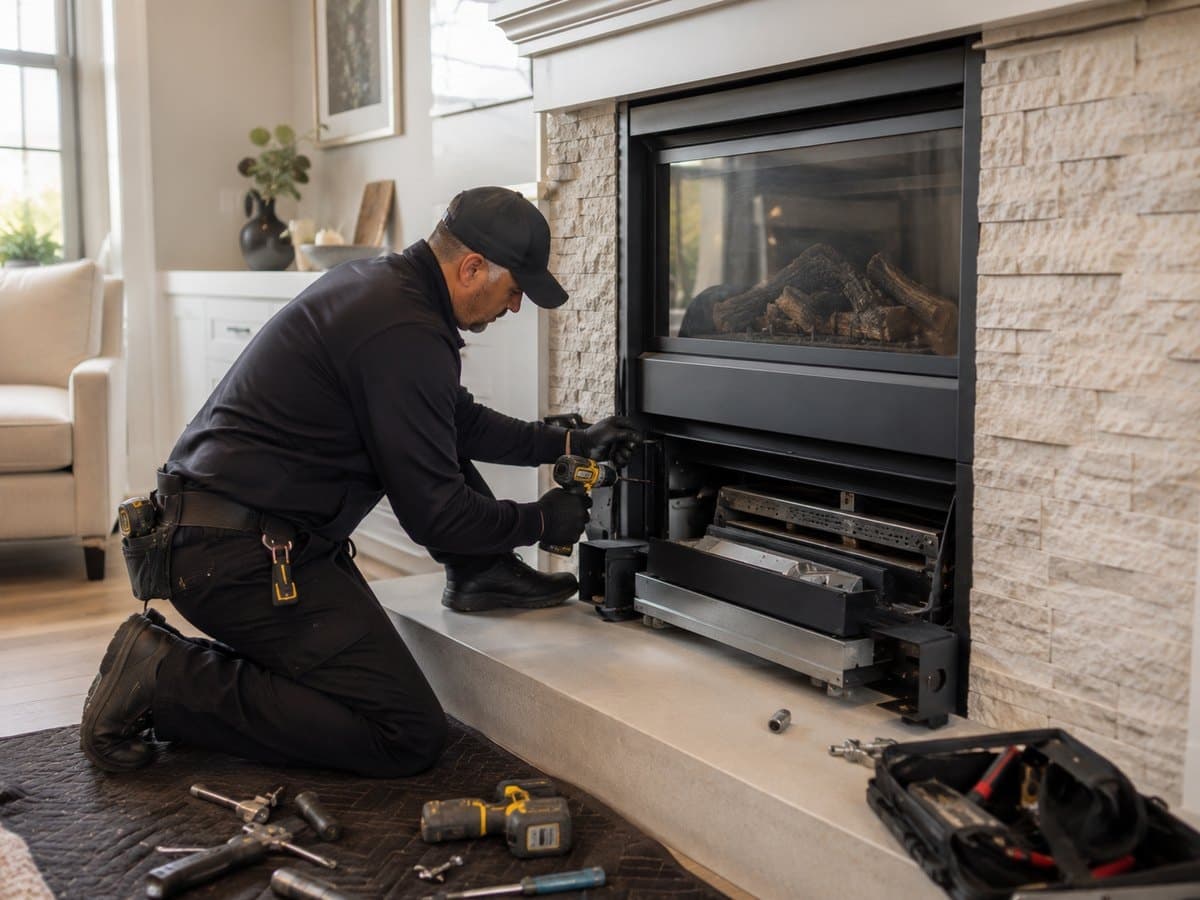
Open fireplaces send most of their heat up the chimney and pull conditioned air out of the house with it. An insert closes the opening with a sealed firebox and glass door, and vents through its own liner. For many Orlando homeowners the main appeal isn’t heat. It’s turning a drafty, rarely used opening into something that looks good and starts easily.
This page is about putting an insert into a fireplace you already have. Building a new fireplace from scratch is fireplace installation, and adding a stand-alone gas fireplace to a wall is direct-vent gas fireplace installation.
Types of inserts
| Insert | Venting | Worth knowing |
|---|---|---|
| Wood-burning insert | Stainless liner connected to the insert | Choose an EPA-certified model; it burns cleaner and makes less creosote (EPA Burn Wise) |
| Direct-vent gas insert | Two-pipe co-linear or co-axial liner through the chimney | Sealed combustion; the gas supply is run as separate, permitted work if one isn’t already there |
| Electric insert | None | Needs a suitable outlet in or near the firebox; mostly for looks and light heat |
Insert, gas logs or a different fireplace?
| Feature | Fireplace insert | Gas log set |
|---|---|---|
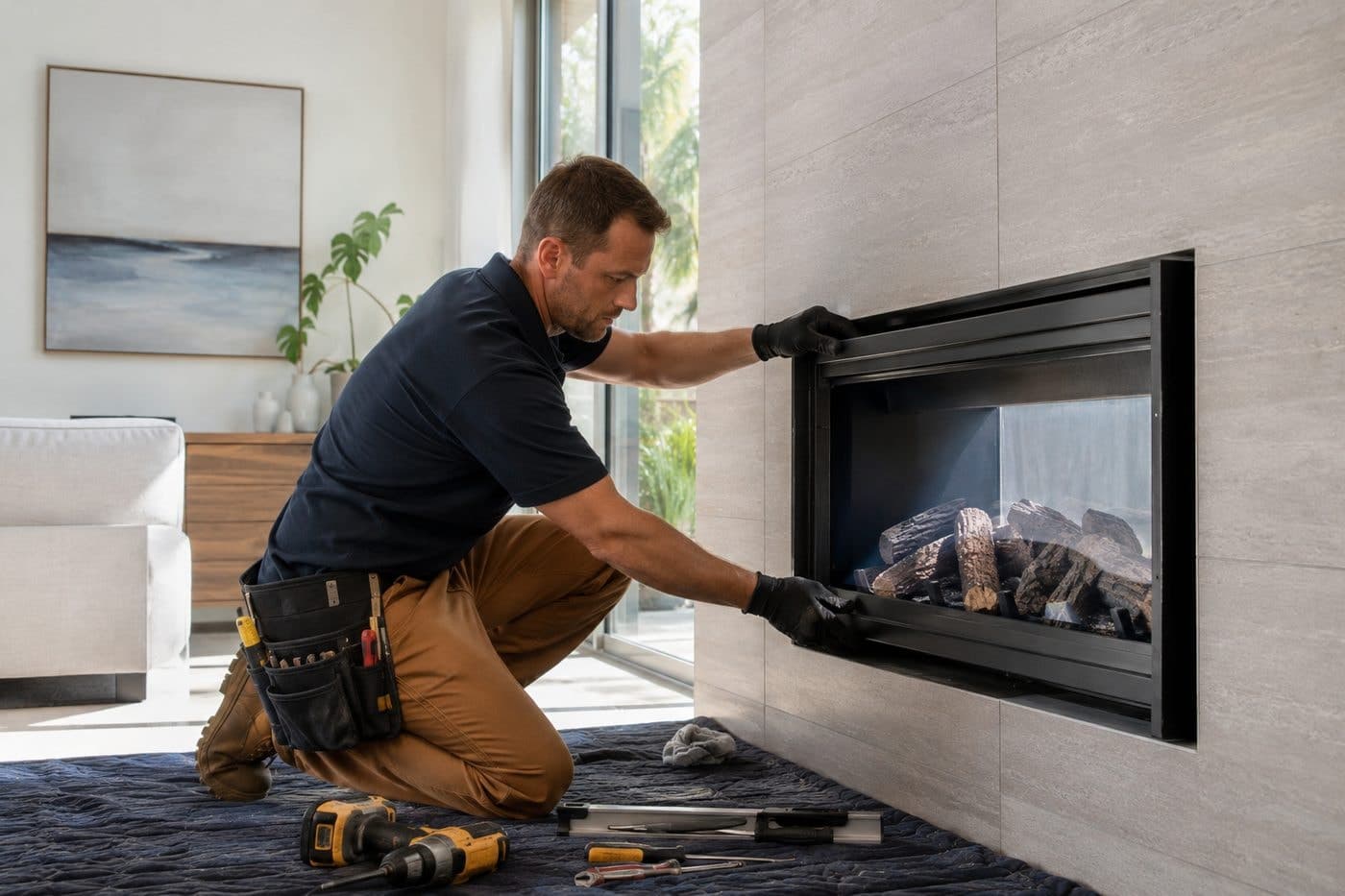
| What it is | A sealed firebox with a glass front that fits inside the old opening | A burner and ceramic logs set in the open firebox |
| Chimney | Vents through a new liner sized to the insert | Uses the existing flue; the damper stays open |
| Heat and air loss | Seals the opening, so far less conditioned air is lost | Mostly decorative; the open damper keeps pulling air |
| Fuel options | Wood, gas or electric | Gas only |
What it is
- Fireplace insert
- A sealed firebox with a glass front that fits inside the old opening
- Gas log set
- A burner and ceramic logs set in the open firebox
Chimney
- Fireplace insert
- Vents through a new liner sized to the insert
- Gas log set
- Uses the existing flue; the damper stays open
Heat and air loss
- Fireplace insert
- Seals the opening, so far less conditioned air is lost
- Gas log set
- Mostly decorative; the open damper keeps pulling air
Fuel options
- Fireplace insert
- Wood, gas or electric
- Gas log set
- Gas only
The fireplace inserts guide goes further into types, liners and fit.
Can your fireplace take an insert?
Not every fireplace can take an insert, and not every insert fits a fireplace that can. A fireplace that can’t safely take one is better off repaired or replaced than fitted with the wrong appliance.
- Masonry fireplaces are the usual candidates: the firebox is measured front, back, depth and height to find inserts that fit.
- The chimney has to be sound, since the liner runs through it. A fireplace and chimney inspection comes first.
- Factory-built fireplaces can only take inserts the fireplace manufacturer has approved for that model. Many can’t take one at all, and replacement may make more sense; see prefab fireplace replacement.
- The hearth in front of the insert must meet the insert’s floor protection requirements.
- Mantels and trim above and beside the opening must meet the insert’s clearances to combustibles.
What gets measured
- Opening width at the front and back, height, and firebox depth
- The damper, smoke shelf and throat, which may need space made for the liner
- Flue size and chimney height, for the liner and the insert’s draft requirements
- Hearth depth and height in front of the opening
- The surround, to size a panel that closes the gap between insert and opening
Why the liner matters
An insert’s flue outlet is much smaller than the old fireplace flue. Venting into the large original flue leads to poor draft, condensation and heavy creosote. NFPA 211 requires inserts to connect to the flue, and most manufacturers call for a full-length liner sized to the insert (NFPA 211). That liner is installed as part of the job; see chimney liner installation.
Replacing an old insert
Older inserts were sometimes pushed into the fireplace and vented straight into the big masonry flue with no liner, or with a short pipe that stops just above the damper. That arrangement is behind a lot of smoky, sooty inserts. Replacing an old insert means pulling it, inspecting the chimney, installing a full-length liner if there isn’t one, and fitting a new insert sized to the firebox. If the old insert is sound and only the liner connection is wrong, fixing the venting may be enough, and you’ll hear that option too.
Gas and power for inserts
A gas insert needs a gas supply at the firebox. If the fireplace already has a gas line for logs, it is checked and adapted as needed; if not, a new line is run as separate, permitted work. The insert and its liner are installed here, and any gas-line work the job needs is quoted and scheduled as its own stage. Electric inserts need a suitable outlet, and a new outlet or circuit is work for a licensed electrician.
How an installation goes
Inspect and measure
Chimney and firebox inspected, firebox measured, and the hearth and surround checked.
Choose the insert
Wood, gas or electric models that fit, with the trade-offs explained.
Prepare the fireplace
Firebox and flue cleaned; damper removed or secured open where the liner needs the space.
Install liner and insert
Liner run from the top and connected to the insert; insert set, leveled and secured.
Finish and test
Surround panel fitted, gas or power connected by the appropriate trade, and a test burn.
Once it’s in, a wood insert needs its liner and smoke path cleaned regularly; see cleaning an insert and its liner. A gas insert gets annual gas service like any gas fireplace.
Why an insert needs its own liner
This is the part that surprises people when the estimate arrives, so it is worth being plain about. An insert is a sealed appliance dropped into an opening that was built for an open fire, and the flue above it is far too big for what the insert produces.
Running a sealed appliance into an oversized masonry flue means the exhaust cools too much on the way up. The draft weakens, and on a wood insert the cooled gases condense creosote on the flue walls at a rate an open fire never would. So the insert gets its own correctly sized liner running the full height of the chimney.
That liner is a real part of the cost and a real part of the day's work. It is also what makes the insert perform, so it is not somewhere to economise. Chimney liner installation covers sizing and insulation in detail.
Insert or log set?
These two get compared constantly and they answer different questions. In a climate where a fireplace runs a dozen evenings a year, the honest answer is that most people are buying the look rather than the heat.
| Item | Gas insert | Gas log set |
|---|---|---|
| What goes in | A sealed appliance filling the fireplace opening | A burner, pan and ceramic logs in the open firebox |
| Chimney work | A liner the full height of the flue | Flue must be sound and clear; damper locked open on a vented set |
| Heat into the room | High — the unit is sealed and designed to radiate | Low — most of it goes up the chimney |
| Look | Glass front, visible appliance | Open firebox, closest to a real wood fire |
| Install time | Typically more than a day with the liner | Often a single day |
| Relative cost | Considerably higher | The lowest-cost gas route |
| Suits | Wanting the room genuinely warm | Wanting flames on a handful of cool evenings |
The log set route is covered on gas log installation, and if you have not chosen between them yet, our page on choosing a conversion route lays out all the options including electric.
Measuring the firebox
Inserts come in fixed sizes and fireboxes do not. Getting this wrong is the main reason an insert either will not fit or looks wrong once it is in.
Measured before an insert is specified
- Opening width and height at the face
- Firebox depth, and the width at the back — most fireboxes taper significantly
- Height from the hearth to the top of the opening
- Damper frame position, which frequently limits how far back a unit can sit
- Flue size and whether it will take the liner the insert needs
- Hearth extension depth in front of the opening
- Surround dimensions, since the trim has to cover the gap around the unit
- Power availability for a blower, ignition or an electric unit
Where gas has to be brought to the fireplace, that is a separate stage covered under running a new gas supply. Size the supply for the insert rather than for a log set, because an undersized line will starve the appliance and produce a small flame nobody can explain.
Inserts are fitted across Orlando, Winter Park, Windermere, Lake Nona, Oviedo, Clermont and the rest of the Central Florida service area, with free estimates that itemise the unit, the liner and any gas work separately so you can see what drives the number.
References (2)
Facts and figures on this page come from these references.