On this page
- Know which kind of gas fireplace you have
- Symptoms and what usually causes them
- The parts that fail, and what repairing them involves
- What a gas fireplace diagnosis involves
- Venting and termination checks
- Gas piping and who handles it
- Repair, service or a new unit?
- What affects the cost of a gas fireplace repair
- Parts, models and what is still available
Smell gas? Leave first, then call
If you notice a strong gas odor (a rotten-egg smell), don’t try to light the fireplace, don’t switch lights or appliances on or off, and don’t use your phone inside. Get everyone out, then call your gas utility or 911 from outside. Don’t go back in until they say it is safe. More on this in what to do if your fireplace smells like gas.
A gas fireplace is a gas appliance: a valve, a pilot or electronic ignition, a burner and a vent system all working together. When one part fails, the symptom usually points to a short list of causes. This page explains those causes so you know what you are dealing with. It is not a repair guide. Relighting the pilot by following the lighting instructions on your unit is normal operation; taking apart the valve, pilot assembly, burner or venting is work for a qualified technician.
Know which kind of gas fireplace you have
How a gas fireplace is vented changes what can go wrong and how it is checked. Your owner’s manual or the rating plate (usually behind the lower grille) will say which type you have.
| Type | How it works | What that means for repairs |
|---|---|---|
| Direct-vent | Sealed glass front. A two-layer (coaxial) vent brings outside air in and takes exhaust out through a wall or roof termination. | The glass and its gasket are part of the seal. Blocked or damaged terminations cause shutdowns and flame problems. |
| B-vent (natural vent) | Uses room air for combustion and vents vertically through a B-vent pipe, like a small chimney. | Needs a clear, drafting vent. Many have a spill switch that shuts the unit off if exhaust backs up. |
| Vent-free (ventless) | No flue. Burns room air and releases combustion products into the room. Uses an oxygen depletion sensor (ODS) pilot. | The ODS must be clean and working. Run time and room size limits in the manual apply. Unvented logs can go in a factory-built fireplace only if that fireplace is listed for them (FBC-R R1004.4). |
Natural gas or propane? Appliances are set up for one or the other, with different orifices and pressure settings, so parts are not interchangeable. Propane is heavier than air and can collect low in a room or firebox. Converting a unit from one fuel to the other takes the manufacturer’s conversion kit, installed as the manufacturer specifies, and any change to the gas supply is separate gas-line work; it is not a parts swap. If your propane unit stops working right after the tank ran low or was refilled, tell the technician, because air in the line and supply issues are common in that situation.
Symptoms and what usually causes them
Common gas fireplace faults
01Won’t light or won’t turn on
- What you may notice
- Nothing happens at the switch or remote, or the pilot is lit but the main burner never comes on.
- How it’s confirmed
- Gas supply and shutoff position, pilot status, batteries in the remote, receiver and any battery backup, wall switch and wiring, thermopile output measured with a meter, and the ignition module on electronic-ignition units.
02Pilot won’t stay lit
- What you may notice
- The pilot lights while you hold the knob but goes out when you let go, or keeps going out on its own.
- How it’s confirmed
- The flame sensor is tested: a thermocouple (standing-pilot safety) or thermopile (powers the valve) that is dirty, weak or not sitting in the flame. The pilot hood and orifice are checked for dust, lint or spider webs that shrink the flame.
03Clicking
- What you may notice
- The igniter keeps clicking without lighting, or clicks when the fireplace is supposed to be off.
- How it’s confirmed
- Spark gap and electrode position, gas reaching the pilot, the flame-sensing circuit that should stop the sparking, and the control module on electronic units.
04Shuts off by itself
- What you may notice
- Runs for a few minutes, then the flames go out.
- How it’s confirmed
- Thermopile output under heat, a spill or high-limit switch tripping (which points to a venting problem that must be found), an ODS pilot on a vent-free unit, and blocked terminations.
05Low, weak or uneven flame
- What you may notice
- Short, lazy flames, gaps along the burner, or a flame that is smaller than it used to be.
- How it’s confirmed
- Burner ports and orifice for debris, supply pressure where the valve has test ports, the flame-height control, and on propane units whether the tank is low. Supply and regulator faults go to your gas utility or LP gas supplier.
06Sooting or odd flame color
- What you may notice
- Black soot on logs, glass or the wall above, or lazy yellow-orange flames that touch the logs heavily.
- How it’s confirmed
- Log and ember placement against the manufacturer’s diagram, burner ports, air shutter setting, and venting. Heavy sooting is a combustion problem and the unit shouldn’t be used until it is checked.
07Remote or wall switch not working
- What you may notice
- The fireplace works from the valve knob or receiver but not from the remote or switch.
- How it’s confirmed
- Batteries, remote-to-receiver pairing, receiver condition (heat and age take a toll), and the low-voltage switch wiring.
08Glass problems
- What you may notice
- Cracked glass, a loose frame, or cloudy white film that won’t wipe off.
- How it’s confirmed
- On a direct-vent unit, cracked glass or a failed gasket breaks the sealed combustion system, so the fireplace shouldn’t run until the glass assembly is replaced with the manufacturer’s part. White film is usually a cleaning job for annual service.
Not DIY territory
Please don’t adjust gas valves, bypass safety switches, drill out orifices or swap parts from another model. Those safety devices are there to shut the gas off when something is wrong, and defeating them turns a no-heat problem into a carbon monoxide or fire risk.
The parts that fail, and what repairing them involves
Most gas fireplace repairs come down to one component in the ignition, control or combustion path. Repairs use the part the manufacturer lists for your model, or a listed equivalent, so the model number from the rating plate matters before anything is ordered.
| Component | What it does | Typical repair |
|---|---|---|
| Pilot assembly (hood, orifice, electrode) | Holds the small flame that lights the burner and heats the sensors | Cleaned or replaced as an assembly when the flame is weak, lifting or won’t hold |
| Thermocouple | Safety sensor on standing-pilot units; holds the pilot valve open | Replaced when its output drops and the pilot won’t stay lit after the knob is released |
| Thermopile | Generates the millivolts that let a switch or remote open the main valve | Replaced when output under flame is too low to run the valve |
| Igniter / spark electrode and ignition module | Lights the pilot, by push-button spark or electronic (intermittent) ignition | Electrode reset or replaced; module tested and replaced on electronic units |
| Gas valve | Controls gas to the pilot and burner, and holds the safety shutoff | Replaced as a unit when it won’t respond to a good sensor signal; never adjusted beyond the maker’s settings |
| Burner and ports | Spreads the flame across the firebox | Ports cleared; burner replaced if cracked or rusted through |
| Logs, embers and media | Shape the flame and the look of the fire | Reset to the diagram; broken or crumbling pieces replaced with the listed set |
| Remote, receiver and wall switch | Turn the fireplace on and off and control flame height | Batteries, pairing, receiver or switch wiring repaired or replaced |
| Glass and gasket | Part of the sealed combustion chamber on direct-vent units | Replaced as the maker’s glass assembly, never with ordinary glass |
| Blower / fan | Moves heat into the room on units that have one | Cleaned, or motor replaced when noisy or seized |
Some older units have no parts left. When a valve or control system is discontinued and no listed substitute exists, you’ll hear that before any money is spent on diagnosis-by-parts, along with what installing a replacement gas fireplace would involve.
What a gas fireplace diagnosis involves
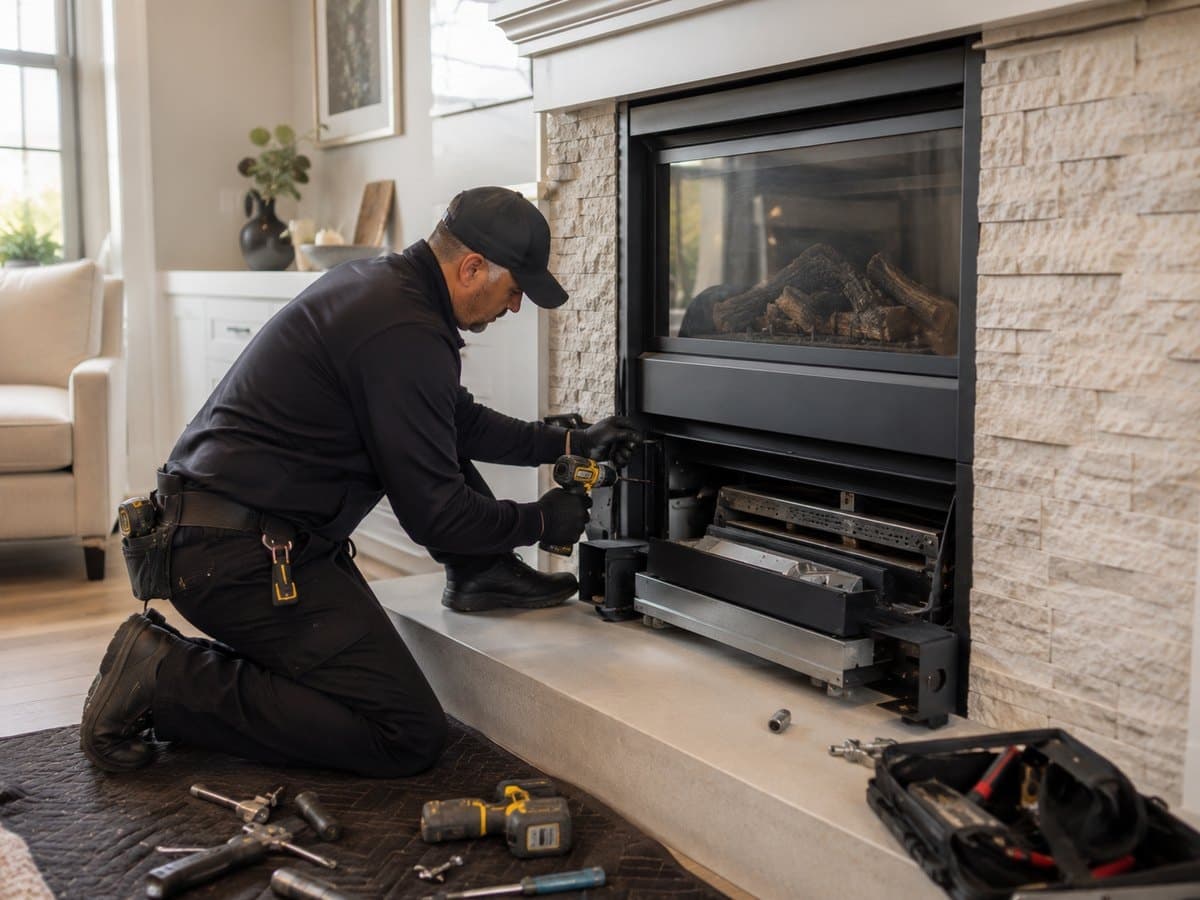
History and rating plate
When the problem started, what it does, recent power outages or propane refills, and the manufacturer, model and fuel type from the rating plate.
Look before testing
Glass removed on sealed units. Burner, logs, embers, pilot hood, igniter and wiring inspected for damage, debris and signs of overheating or sooting.
Measure, don’t guess
Thermocouple or thermopile output is measured, switches and remotes are tested, and the valve and ignition sequence are watched through a full start-up.
Venting and termination
The vent run and the outside termination are checked for blockage, damage, separated joints and clearance problems.
Findings and options
You’re told what failed, why, the repair options and whether parts are still available for your model, before any repair is scheduled.
If a gas leak is suspected at any point, the appliance is shut off and the gas supply issue is referred to your gas utility, or handled as gas-line work. Leaks in piping are not something to diagnose by smell alone or to work around.
Venting and termination checks
A lot of gas fireplace “repairs” turn out to be venting problems. On a direct-vent unit, the termination cap on the outside wall or roof is both the exhaust and the air intake. If it is blocked, crushed or too close to something, the fireplace can starve for air, soot up or shut itself off.
What we look at on the vent system
- Wasp, mud dauber and bird nests in the termination cap
- Shrubs, vines, fences or new additions crowding the termination
- Caps bent or loosened by storms, pressure washing or roof work
- Separated, rusted or disconnected vent sections where they are visible
- B-vent caps, pipe condition and draft at the appliance
- Termination clearance from windows, doors and soffits per the installation manual
Roof terminations deserve a look after hurricane season. Wind can shift caps and storm collars, and water getting in around a vent penetration causes rust inside the appliance over time.
Gas piping and who handles it
Gas piping is regulated in Florida. Under F.S. 489.105, plumbing contractors may install gas lines and liquefied petroleum gas systems and related venting, and mechanical contractors may install LP and natural gas fuel lines within buildings. For propane, the Florida Department of Agriculture and Consumer Services licenses LP gas businesses under Chapter 527.
What that means for you: the fireplace itself (burner, pilot, igniter, valve-related diagnosis and controls) is what this repair service covers. Separate gas-line work, such as a new line, moving a line or changing the supply for a fuel conversion, is separate, permitted work that we also carry out. A new unit is a gas fireplace installation project.
Repair, service or a new unit?
- Something has stopped working: it won’t light, won’t stay on, clicks, soots or ignores the remote. That is a repair, and it is what this page covers.
- It works, but it’s due: filmy glass, a slightly tired flame, or no one has looked at it in a year or more. That is routine gas fireplace maintenance, usually a shorter visit with cleaning and testing rather than parts.
- It can’t be economically fixed: rusted-through burner or firebox, discontinued controls, or you want a different fireplace. That is a new-unit project; see gas fireplace replacement and installation, or, for a gas log set in a masonry fireplace, a sealed gas insert in the existing opening.
For wood-burning and factory-built wood fireplaces, see the main fireplace repair page. If you’d like to understand how the pilot, thermopile and valve work together before the visit, how a gas fireplace works explains it in plain terms.
What affects the cost of a gas fireplace repair
- The failed part: a thermocouple or batteries versus a gas valve, control module or glass assembly.
- Whether parts are still made for your model, or a listed substitute exists.
- Access, such as inserts that must be pulled out or roof-top terminations.
- Whether the fault is really in the venting and needs work outside or on the roof.
- Any gas piping work, which is quoted separately.
Parts, models and what is still available
On a gas appliance the model number decides more than the symptom does. Valves, ignition modules and remote receivers are model-specific, and generic substitutes are not appropriate on gas controls.
Some fifteen-year-old units are still fully supported. Others were discontinued along with the manufacturer, and no amount of searching will produce a valve. Establishing which you have at the first visit is more useful than a week of chasing suppliers — our page on identifying your fireplace make and model covers finding the rating plate and which makes still have parts.
Where the fault turns out to be supply rather than appliance — a flame that stays small, or drops when another appliance fires — that is usually an undersized or over-long gas line rather than anything wrong with the fireplace. Gas line installation explains why, and it is a diagnosis worth reaching before parts get replaced.
Repairs are carried out across Greater Orlando and Central Florida, with free estimates and same-day attendance where a slot exists. Calls are answered 24 hours Sunday through Friday and we are closed Saturday. If you can smell gas, leave the building and call 911 and the gas utility from outside before calling us.
References (4)
Facts and figures on this page come from these references.