Smell gas? Don’t touch the switch
If there is any gas smell, don’t press the remote, the wall switch or any light switch. Leave the home and call the gas utility or 911 from outside.
How remote and wall-switch control works
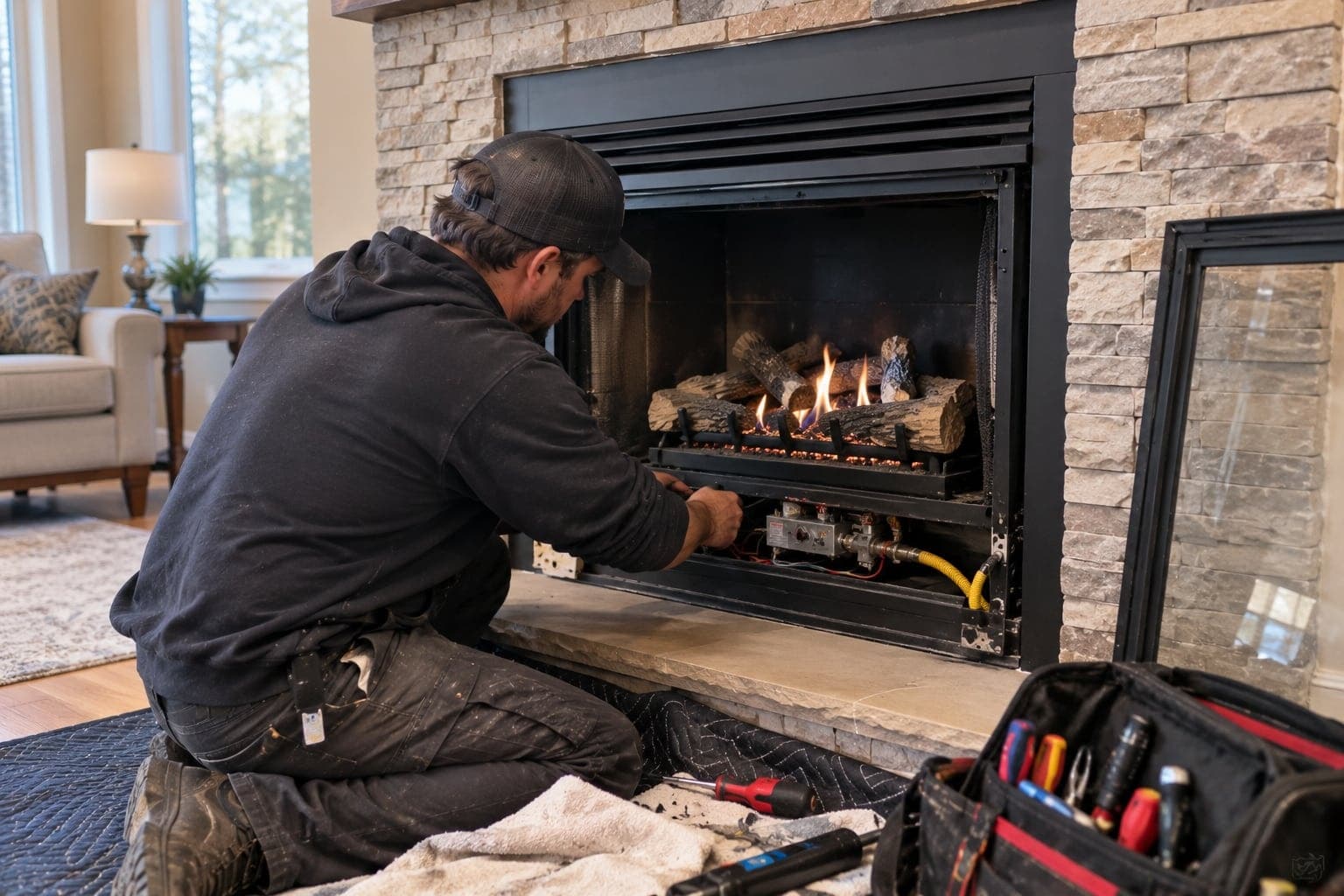
On many gas fireplaces the gas valve is turned on and off by a simple circuit. On standing-pilot units that circuit is powered by the pilot’s thermopile, which is why the fireplace still works in a power outage. A wall switch closes that circuit directly. A remote adds a receiver, usually in the space under the burner behind the lower grille, which closes the circuit when it hears the handset. Electronic-ignition units use a control module that the remote and switch talk to. Either way, the remote only works if the receiver has power and the fireplace itself is ready to light.
Match the symptom
| Symptom | Most likely cause | Safe check |
|---|---|---|
| Remote does nothing; wall switch works | Remote or receiver batteries, receiver switch, pairing | New batteries in both; receiver switch to REMOTE; re-pair per the manual |
| Wall switch does nothing; remote works | Receiver overriding the switch, or a loose switch wire | Check the receiver switch position; have the wiring checked |
| Neither control works | Pilot out, gas off, or a control fault | Look for the pilot flame; see won’t light |
| Works up close, not from across the room | Weak remote batteries or interference | Replace batteries; try from a different spot |
| Fireplace turns off by itself | Thermostat or timer mode | Switch the remote to manual mode |
| Fireplace won’t turn off | Receiver stuck on, switch set to ON, or a valve fault | Receiver switch to OFF; control knob to OFF; call |
Possible causes
01Receiver batteries
- What you may notice
- The remote display works, but the fireplace ignores it. Common after a long off-season.
- How it’s confirmed
- Replacing receiver batteries and checking the battery holder for corrosion, which Florida humidity speeds up.
02Receiver switch position
- What you may notice
- A three-position switch on the receiver or on the lower frame set to ON or OFF.
- How it’s confirmed
- Setting it to REMOTE so the handset controls the fireplace.
03Lost pairing
- What you may notice
- Stopped working after a battery change or power outage.
- How it’s confirmed
- Following the manual’s pairing (learn) procedure, usually a button on the receiver.
04Wall switch wiring
- What you may notice
- Switch stopped working after painting, remodeling or a surge.
- How it’s confirmed
- Checking the low-voltage wiring and connections between the switch and valve.
05Failed receiver, module or valve
- What you may notice
- Nothing responds with fresh batteries and correct settings; the pilot is lit.
- How it’s confirmed
- Testing the receiver output, the control module and the valve against the manual.
Safe checks for homeowners
- Replace the batteries in the handset and in the receiver, and in any battery backup pack.
- Find the receiver switch (see your manual for its location) and set it to REMOTE.
- Re-pair the remote using the manual’s steps.
- Check whether the remote is in thermostat or timer mode.
- Look through the glass for the pilot flame on standing-pilot units.
- Stop there. Wiring behind the wall switch, the valve and the control module are technician work.
If it won’t turn off
Set the receiver switch to OFF, or turn the gas control knob on the valve to OFF following the label on the unit. If the flame still doesn’t go out, leave the room, keep people away from the fireplace and call a technician or the gas utility. Don’t use it again until it has been repaired.
Red flags
- A fireplace that lights by itself or won’t shut off.
- Scorched or melted wiring, or a hot wall switch plate.
- A receiver or module that is wet or corroded, for example after a leak.
- Any gas smell.
What a technician checks
Controls
Handset, receiver, wall switch and settings are tested against the manual.
Circuit
Wiring and connections between switch, receiver and valve are checked.
Ignition
Pilot, thermopile output or the ignition module are checked, since a weak signal looks like a control fault.
Replacement parts
Receivers and remotes are matched to the valve and manufacturer; universal kits aren’t always compatible.
Where remote and switch problems go
| Fault | Where it’s fixed |
|---|---|
| Receiver, wall switch or wiring failed | gas fireplace repair |
| Remote works but the burner doesn’t respond | gas fireplace repair to check the valve and thermopile |
| Controls fine, unit due for its yearly check | gas fireplace service |
If the fireplace won’t light at all even at the valve, the problem is further down the chain; see a gas fireplace that won’t light. An electric unit with remote trouble is covered in an electric fireplace that won’t work. How the valve, receiver and thermopile connect shows why a dead receiver stops everything.
References (1)
Facts and figures on this page come from these references.