On this page
Factory-built fireplaces and framed chimney chases are common in many newer Orlando-area homes. Each one was designed, tested and listed as a complete system: the metal firebox, its refractory panels, the damper, the chimney pipe and the parts at the top of the chase. That system approach is what makes a prefab fireplace safe with only small clearances to the wood framing around it, and it is also why a worn-out unit can’t simply be rebuilt with whatever parts fit.
This page is part of our fireplace repair services. If you aren’t sure yet whether your fireplace needs replacing, start there; many problems with doors, dampers and panels are repairable.
How to identify your fireplace
Everything about repair or replacement depends on the manufacturer and model, so the first job is finding the listing label (the manufacturer plate). It is usually a metal plate or foil sticker in one of these places:
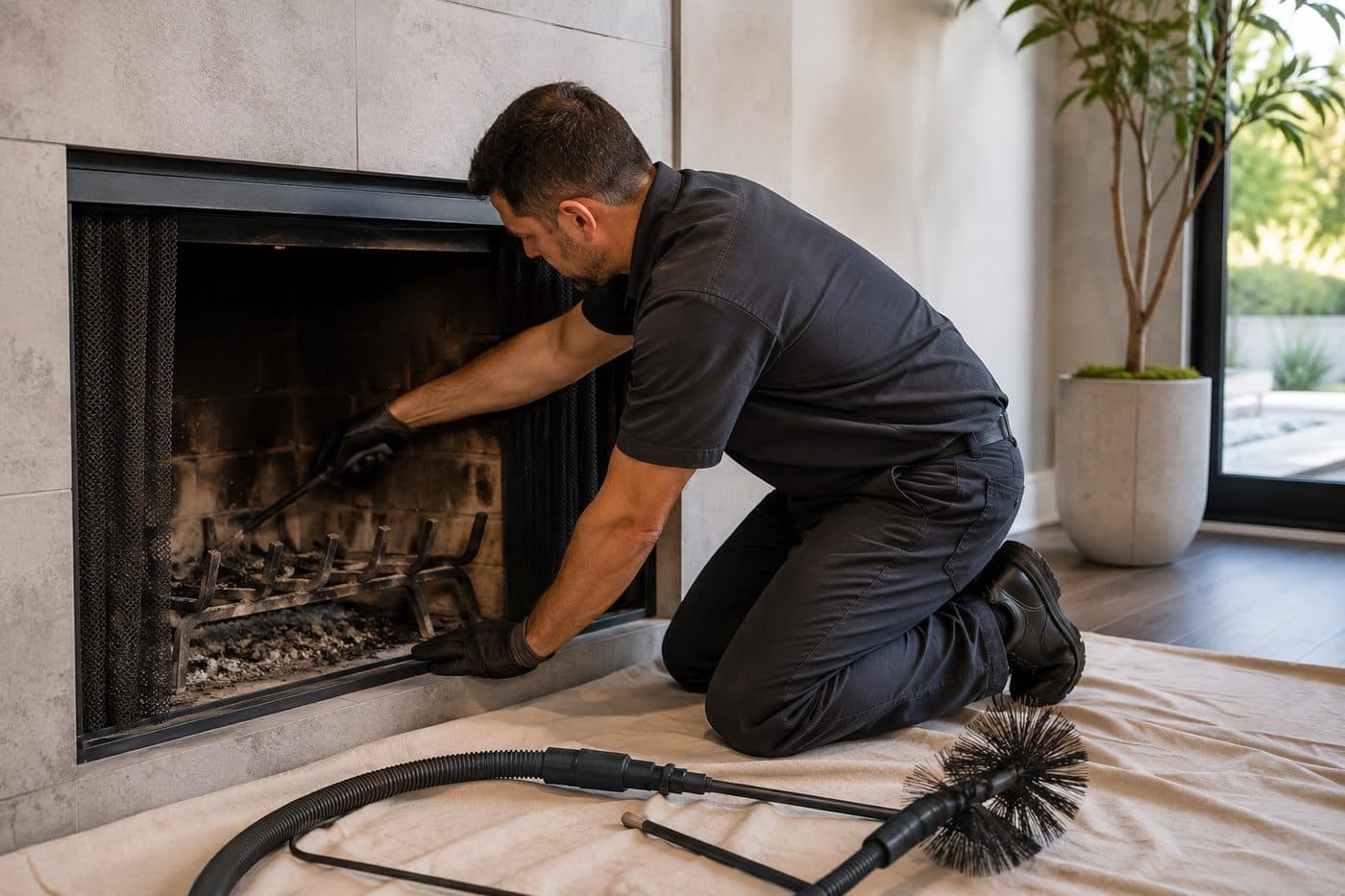
- On a side wall just inside the firebox opening, near the front edge.
- Behind the lower louvered grille or kick panel (many lift or swing off).
- On the smoke shelf or near the damper, visible with a flashlight looking up.
- Inside the upper grille on units with top louvers.
Photograph the label and write down the manufacturer, model number, serial number and any listing or standard number printed on it. The owner’s manual, if you have it, shows the same information and the approved parts list. If the label is missing, burned or unreadable, the shape of the firebox, the chimney pipe size and markings on the chimney sections can sometimes narrow it down, but a positive match is not always possible. Don’t pry out panels to look; they break easily and may be the only ones left for that model.
Repair or replace?
Replacement makes sense when the fireplace can no longer be returned to its listed condition. These are the most common situations:
| Condition | Often repairable when… | Usually means replacement when… |
|---|---|---|
| Cracked or missing refractory panels | Replacement panels for your model are still available and the firebox behind them is sound. | Panels are discontinued, pieces are missing and metal is exposed, or the firebox behind them is damaged. |
| Rust in the firebox | Surface rust only, and the source of the water (often a chase cover or storm collar) can be fixed. | The firebox floor or walls are rusted through or perforated. |
| Warped components | A single bolt-on part, such as a damper or door, can be replaced with the manufacturer’s part. | The firebox, smoke shelf or chimney sections are distorted, usually from overfiring. |
| Missing or damaged listing label | The model can still be identified reliably from the manual or records. | The unit can’t be identified, so approved parts and clearances can’t be confirmed. |
| Discontinued model | The manufacturer or a successor still supplies the needed parts. | Critical parts are no longer made for the model. |
Water is a big part of the story in Central Florida. Rust inside a prefab firebox very often starts at the top of the chase, where a rusted or pooling chase cover lets rain run down the chimney pipe. If that’s the cause, chase cover replacement and chase and prefab chimney repair need to happen with, or before, any fireplace replacement, or the new unit will face the same water.
Mixing parts voids the system
A factory-built fireplace’s safety depends on parts from the same listing working together. Using another brand’s panels, chimney pipe or doors, or installing a firebox on an old chimney it wasn’t listed with, means the combination hasn’t been tested. If the right parts can’t be found, replacement is the safe answer.
What a proper replacement has to be
A replacement wood-burning fireplace must be a listed factory-built fireplace system, tested to UL 127, the standard for factory-built fireplaces, and installed exactly as the manufacturer’s instructions say. The Florida Building Code, Residential (R1004) requires factory-built fireplaces to be listed and labeled and installed according to the conditions of their listing.
In practice, the installation instructions control almost everything: the framing dimensions and clearances to combustibles, the chimney pipe and its supports, firestops where the pipe passes through ceilings, the termination and cap at the top of the chase, the size of the hearth extension and what materials the surround can be made of. Whether any existing chimney components can stay depends entirely on the new unit’s listing; in many cases the whole system is replaced together.
A building permit may be required depending on your jurisdiction. Orlando-area cities and counties each run their own building departments, so the permit and inspection requirements are confirmed for your address before work is scheduled.
Replacement options
The opening and chase you have now shape what fits, but you are not locked into another wood-burning unit.
Zero-clearance wood-burning fireplace
The like-for-like choice: a new listed wood-burning firebox with its matching chimney system. It suits owners who actually burn wood on the few cool evenings Central Florida gets. Modern units may offer better doors and dampers than the original, which helps with the odor and air-conditioning losses that come with an idle fireplace in a humid climate.
Electric fireplace or electric insert
Many Orlando homeowners burn rarely and mainly want the look. An electric firebox or insert gives flame effect and optional heat with no flue, no combustion and no gas. It still has to suit the opening, and the chimney above should be capped and sealed so it doesn’t keep leaking air and water. If the unit needs a new dedicated circuit, that part is electrical work.
Gas fireplace
A direct-vent gas fireplace is a common upgrade in newer Central Florida homes. The replacement unit and its venting must be listed for that use and installed per the manufacturer’s instructions. The gas supply is separate, permitted work that we also carry out.
Gas units need a permitted gas supply
Running or modifying gas piping and connecting a gas appliance are permitted and inspected work in Florida, regulated under F.S. 489.105 for natural gas and FDACS Chapter 527 for propane. If you choose a gas unit, that supply work is quoted as its own stage — see getting gas to the fireplace.
Taking the fireplace out of service
If nobody in the house will use a fireplace, removing or sealing it off is also worth pricing out. That can mean closing the opening and capping or removing the chimney above the roof.
How a prefab fireplace replacement works
Survey and identify
We record the existing unit from its label, measure the opening, framing and chase, and inspect the chimney and chase top for water damage.
Choose a unit that fits the listing
Options are matched to the framed opening, chase height and how you actually use the fireplace. The findings and the options are explained before anything is ordered.
Permit where required
Permit and inspection requirements are confirmed with the local building department for your address.
Remove the old system
The old firebox and any chimney components that won’t be reused come out, with the room protected and debris hauled away.
Install per the manufacturer’s instructions
Firebox, chimney pipe, firestops, termination, hearth and surround are installed to the listed clearances. Any gas connection is made as part of the gas-line scope.
Check and hand over
The unit is checked for operation, the listing label is left in place and visible, and you keep the manual for your records.
What drives the cost of a replacement
- The type of replacement: wood-burning, electric or gas (gas adds a permitted supply and connection).
- Whether the chimney system is replaced along with the firebox, and the chase height.
- Framing changes needed to fit the new unit’s listed dimensions and clearances.
- Hearth and surround work, from reusing the existing finish to new tile or stone.
- Water damage in the chase, and whether the chase cover or framing needs repair first.
- Permit requirements for your jurisdiction.
Identifying what you have
Replacement conversations almost always start with a model number, and almost as often with the fact that nobody can find one. The rating plate is a metal or foil label inside the firebox on a side wall, behind the lower louvre panel, or inside the control cavity on a gas unit.
Legacy makes are the ones that end up here. Marco, Preway, Martin and some older Superior lines were fitted in large numbers across Orange, Seminole and Osceola counties from the 1970s onward, and parts for them have not been manufactured in decades. Our page on legacy and current fireplace makes covers which still have support and which do not.
Where the unit is being replaced anyway, it is worth deciding at the same time whether to stay with wood or change fuel. The opening is already coming apart, the chase is already open, and doing both at once costs far less than doing them two years apart — see changing fuel during a replacement.
Replacement work is carried out across the Greater Orlando service area, with free estimates that set out the wood, gas and electric options separately.
References (5)
Facts and figures on this page come from these references.