On this page
- The code a dryer vent repair has to meet
- Crushed transition hose and foil or vinyl connectors
- Disconnected ducts in the attic
- Replacing termination caps
- Recessed dryer boxes and pushing the dryer back
- When the run itself is the problem
- Condensation and water in the duct
- Gas dryers
- What affects the cost of a dryer vent repair
- Fitting a vent where there is not one
Most dryer vent problems show up the same way: long drying times, a hot laundry room, lint where it shouldn’t be. A cleaning fixes the ones caused by lint. The rest are physical faults in the duct itself, and they come back no matter how often the vent is brushed. This page covers those repairs and the code rules they have to meet.
What dryer vent repair covers
01Crushed or restricted sections
- What you may notice
- Airflow drops after the dryer is moved or attic work is done; the hose behind the dryer is folded flat.
- How it’s confirmed
- Transition and reachable duct checked; readings taken with the dryer pulled out and pushed back to find a crush point.
02Disconnected or loose joints
- What you may notice
- Lint on attic insulation, a musty laundry room, weak air at the cap even after cleaning.
- How it’s confirmed
- The run is traced in the attic or chase and joints are checked for separation, backwards laps and missing seals.
03Damaged or non-compliant duct
- What you may notice
- Foil accordion or vinyl hose, hose hidden inside a wall, rusted or dented pipe, screws through the duct.
- How it’s confirmed
- Duct material and joints compared with the code; damaged or non-compliant sections are replaced with smooth metal duct.
04Leaking joints and water in the duct
- What you may notice
- Drips at the dryer connection, rust streaks on the duct, water stains on the ceiling below the run.
- How it’s confirmed
- Condensation at sags is separated from roof or cap leaks before anything is replaced.
05Termination problems
- What you may notice
- A flap stuck open or shut, broken louvers, a mesh guard, a cap loose on the wall or roof.
- How it’s confirmed
- The hood or cap is operated with the dryer running and replaced if the damper can’t open and close freely.
06Routing defects
- What you may notice
- A run that is over the length limit, has tight elbows or ends in the attic or a soffit.
- How it’s confirmed
- Length and fittings are counted; smoothing elbows is a repair, a new route is a reroute.
Dryer vent repair isn’t HVAC or appliance repair
This work covers the exhaust duct from the back of the dryer to the outside termination. Air conditioning ductwork belongs to an HVAC contractor, and faults inside the dryer itself, such as heating elements, thermostats or the drum belt, belong to an appliance technician.
The code a dryer vent repair has to meet
Florida’s residential code sets the rules in section M1502 (FBC-R 2023 via UpCodes). The points that drive most repairs:
- Exhaust goes outside the building, not into an attic, soffit or crawl space
- Metal duct with a smooth interior, 4-inch nominal diameter
- Joints not fastened with screws or similar fasteners that reach into the duct and catch lint
- Duct supported and secured, with sealed joints
- Maximum 35 feet, reduced for each elbow, unless the dryer maker’s instructions allow otherwise
- A permanent label within 6 feet of the connection if the equivalent length exceeds 35 feet
- A backdraft damper at the termination and no screen
- Termination located per the dryer maker’s instructions, or else at least 3 feet in any direction from openings into the building, including ventilated soffits
- Flexible transition duct listed to UL 2158A, no more than 8 feet, and never concealed in a wall or ceiling
Each rule, with its section number and a worked length example, is explained in our plain-English guide to the Florida dryer vent code.
Crushed transition hose and foil or vinyl connectors
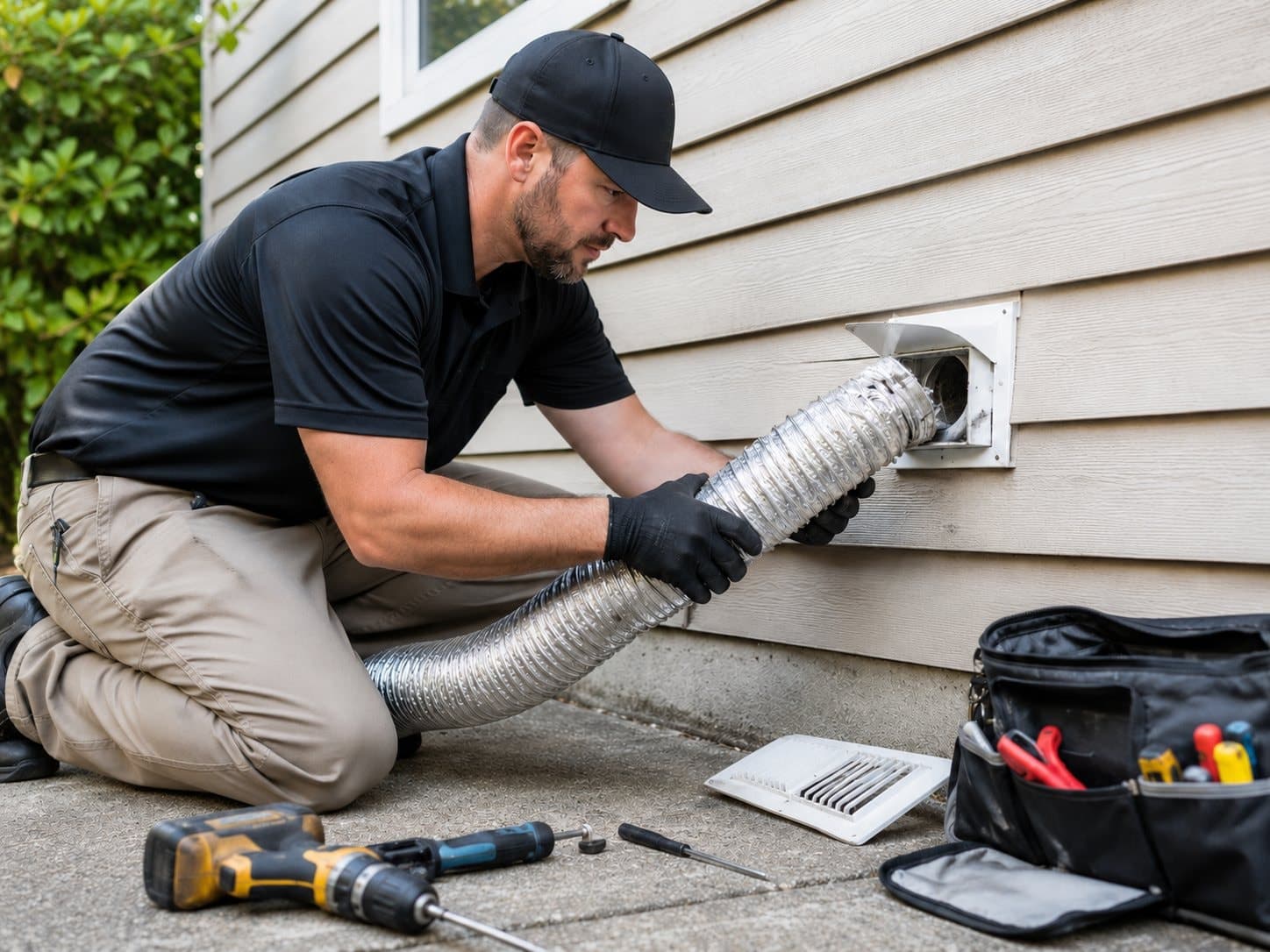
The short connector between the dryer and the wall takes the most abuse. Every time the dryer is pushed back, a flexible hose can fold or flatten behind it, and a flattened hose can cut airflow sharply without anyone noticing. White vinyl hose and thin foil accordion hose are still common, even though the U.S. Fire Administration advises replacing coiled-wire foil or plastic venting with rigid, non-ribbed metal duct.
We replace the connector with the shortest practical run of listed metal transition duct or, where the space allows, rigid or semi-rigid metal with smooth bends. Hose that has been run inside a wall or ceiling is removed from the concealed space entirely, because the code does not allow a flexible transition duct to be hidden in construction. The goal is a connection that still works after the dryer is slid back into place, so we check the airflow with the dryer in its final position.
Disconnected ducts in the attic
Ducts that run through the attic can separate at a joint over time, particularly where they were only pushed together, where a support has failed, or where someone has worked in the attic and knocked a section loose. The dryer then fills the attic with hot, damp, lint-laden air. The USFA notes that exhaust vented into an attic, crawl space or wall can lead to mold and poor indoor air.
Signs include lint on the attic insulation, a musty smell near the laundry, weak airflow at an outside cap even though the reachable duct is clean, or a roof cap that barely moves. We trace the run, replace damaged sections with smooth metal duct, lap the joints so the male end points in the direction of airflow, seal them with foil tape rather than screws, and support the run so it can’t sag or pull apart again.
Replacing termination caps
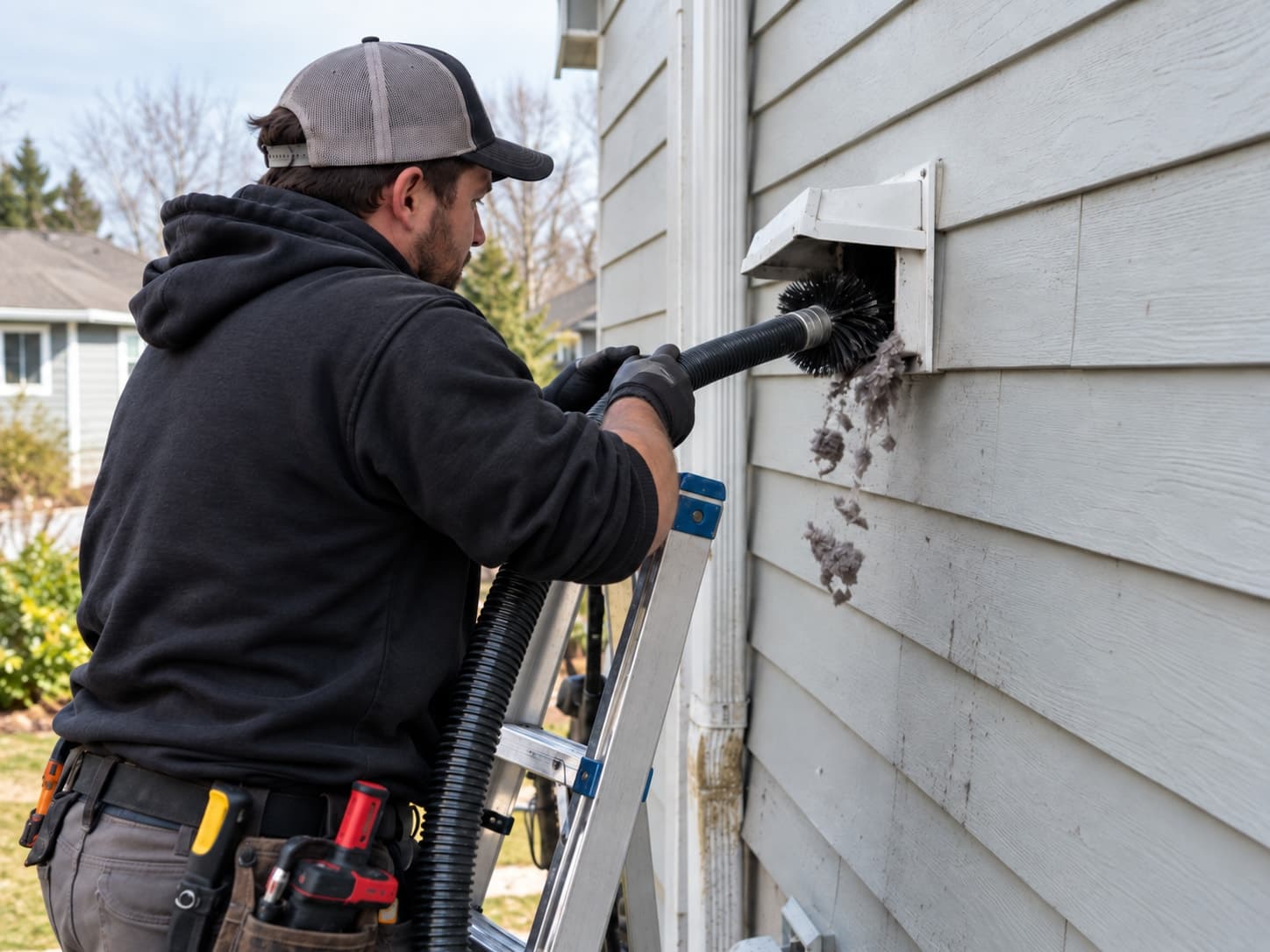
The cap outside is often the cheapest part and the biggest restriction: stuck flaps, louvers that no longer open, built-in screens and mesh “pest guards” all trap lint. A replacement needs a backdraft damper and no screen. Cap styles, roof caps, birds and clearance rules are covered on the vent cover replacement page.
Recessed dryer boxes and pushing the dryer back
Laundry closets in many homes are shallow, and the dryer ends up pressed against the wall with the hose crushed behind it. A recessed dryer vent box set into the wall gives the connection a pocket to sit in, so the dryer can go back farther without folding the transition duct. Where the wall allows, a recessed box often restores a surprising amount of airflow for a small repair. Low-profile periscope-style metal connectors can solve the same problem when a box isn’t practical.
When the run itself is the problem
Every elbow counts against the 35-foot limit, so a run that measures 25 feet can already be over it. Smoothing sharp elbows and straightening sags are repairs; moving the termination or rebuilding the route is a bigger job, explained under giving the vent a new, shorter route. Where a run truly can’t be shortened, a listed dryer exhaust power ventilator is the code’s fallback, and the booster fan guide explains when one makes sense. An existing fan that alarms or stops running is covered on a dryer booster fan that isn’t working.
Condensation and water in the duct
Warm, wet exhaust can condense where a duct crosses cooler space, and water collects at sags; the USFA notes condensation in long or bent vents attracts lint. The fixes are sloping the duct toward the outside, removing low spots, sealing joints and, where the dryer maker calls for it, insulating the duct. If you’re seeing drips or rust, start with why there’s water in a dryer vent to rule out a roof or cap leak.
Gas dryers
We work on the exhaust side only
A gas dryer’s exhaust contains combustion products, including carbon monoxide, so a disconnected or crushed vent matters more. We repair the vent; we don’t disconnect, repair or reconnect gas lines or appliance gas connections. Gas-line work is a separate job from appliance service, and we carry that out too. If you smell gas, leave the home and call the gas utility or 911 from outside.
What affects the cost of a dryer vent repair
The biggest factors are how much duct is replaced, whether the run is in an open attic or inside finished walls and ceilings, whether exterior finishes or roofing have to be cut and patched, roof height and material for roof terminations, and the parts involved (caps, recessed boxes, listed power ventilators). The repair is scoped after an inspection and explained before any work is scheduled. Many repairs are found during a dryer vent cleaning, when the airflow reading stays low after the duct is clean.
Fitting a vent where there is not one
Not every call is a repair. Laundry rooms get moved, additions get built, and dryers occasionally turn out never to have been vented outside at all.
A new installation is the same set of decisions as a repair, with the route as the main variable: the shortest practical run to an exterior wall or the roof, rigid metal duct rather than foil flex, and as few elbows as the layout allows, because each one counts as several extra feet against the code length limit.
Where the only available route is long, that is a rerouting conversation rather than a repair — see dryer vent rerouting and relocation. And if the existing duct vents into a wall cavity, an attic or a garage rather than outside, that is doing real damage and should be dealt with promptly.
References (2)
Facts and figures on this page come from these references.