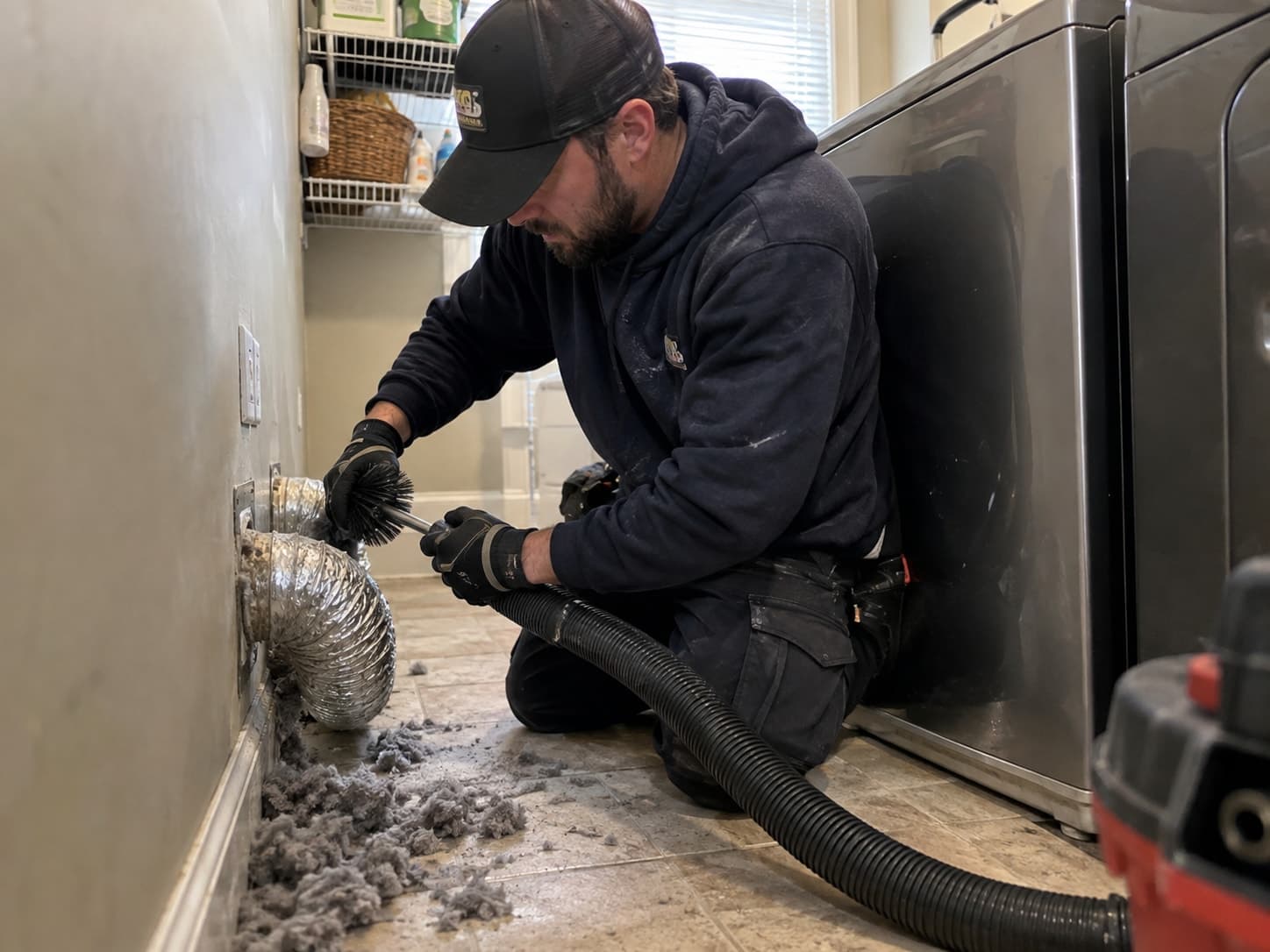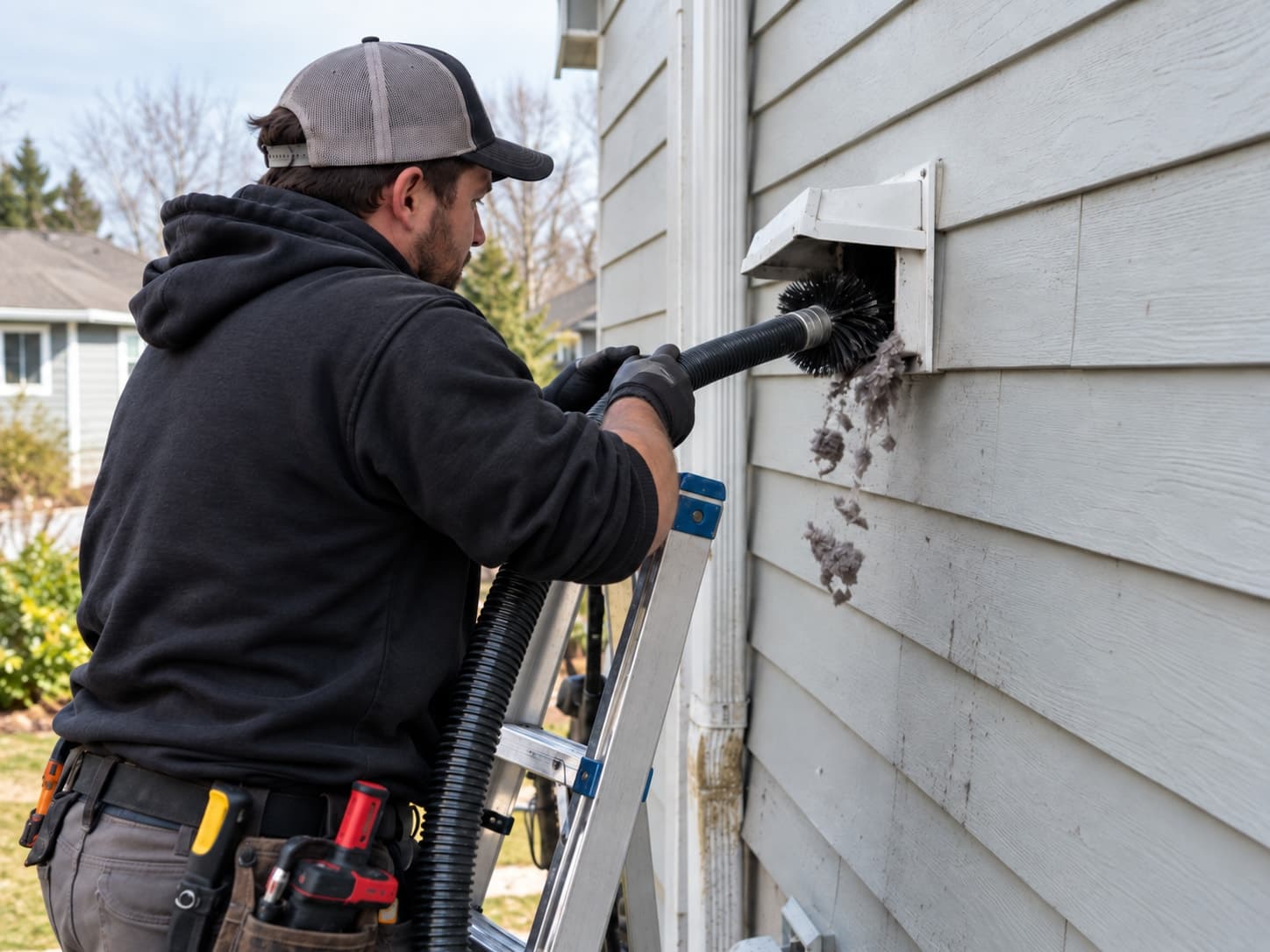
First, find the right vent
Houses have several exhaust caps: bathroom fans, a kitchen range hood, sometimes a whole-house fan or an old dryer vent that was abandoned when the laundry moved. It’s common to check a bath fan cap, feel nothing, and assume the dryer vent is blocked. Before drawing conclusions, confirm which termination belongs to the dryer.
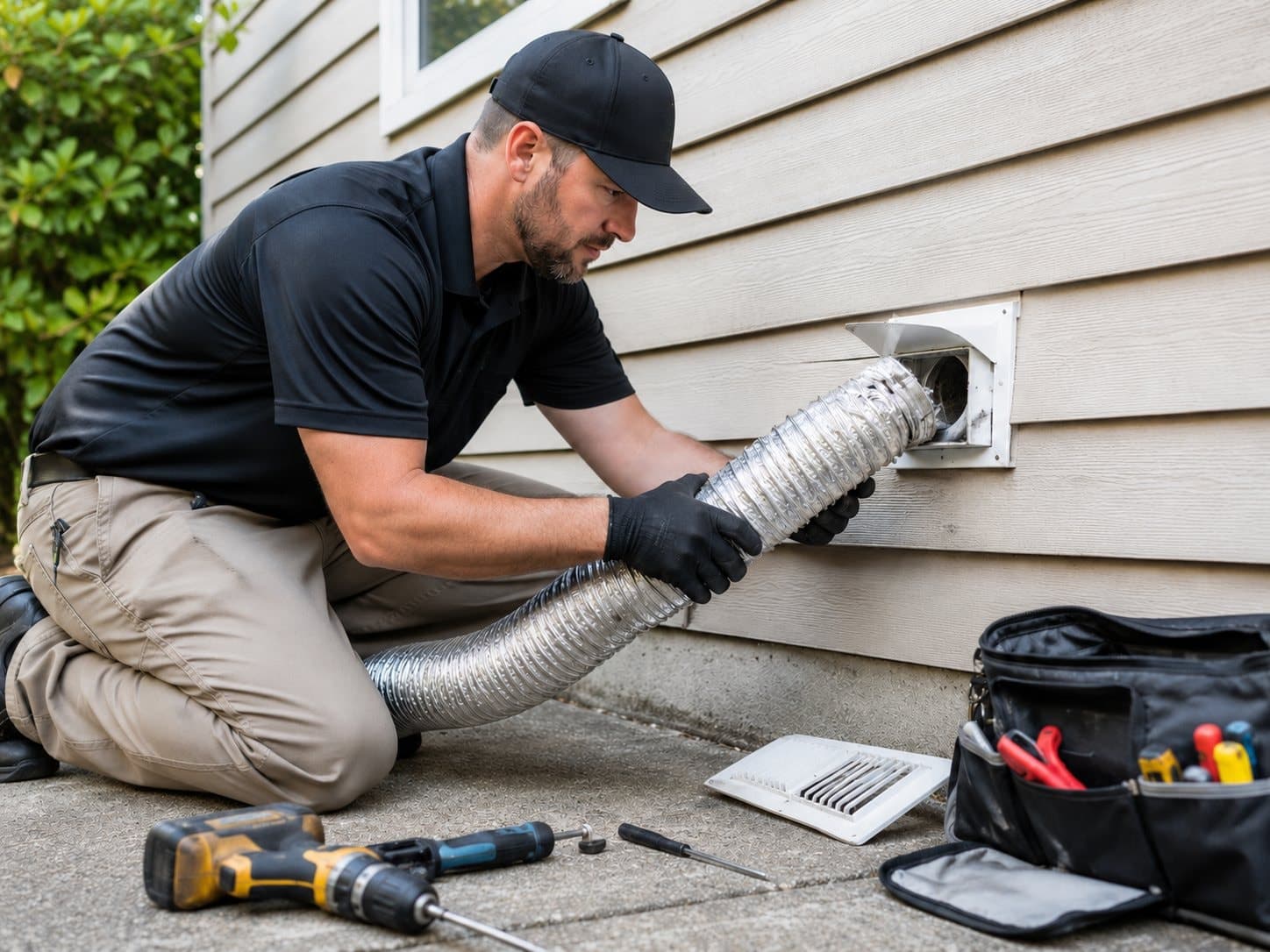
How to identify the dryer’s termination
Start from the laundry room
Note which wall the dryer sits against and whether the duct goes into the wall behind it or up into the ceiling. A duct that goes up usually ends on the roof or a high wall.
Have someone switch the dryer on
With the dryer set to air-only or no heat, watch the caps on that side of the house. The dryer’s flap should lift as the drum starts turning and drop when it stops.
Check the roof from the ground
If no wall cap moves, the vent may exit through the roof. From the yard, look for a cap above the laundry area and for lint on the roofing around it. Binoculars help. Don’t climb onto the roof to check.
How to check airflow safely
Run the dryer empty, or with a few dry towels, on an air-only, air-fluff or no-heat setting so nothing gets hot while you test. Hold your hand a few inches from the hood opening and watch the flap. There’s no single “right” strength, because it depends on the dryer and the length of the run, but a working vent gives a steady stream you can clearly feel and a flap that stays open. The dryer’s airflow when the vent was last cleaned, if anyone measured it, is the best comparison.
| At the outside vent | What it suggests | Next step |
|---|---|---|
| Strong, steady air; flap wide open | The vent is probably fine | If loads still take too long, see slow-drying causes |
| Weak air; flap barely lifts | Restriction somewhere: lint, a crushed hose, or a long run | Check the hose behind the dryer, then have the duct cleaned |
| Air around the edges; flap stays shut | Flap stuck, painted over, warped or jammed with lint | Clear what you can reach; the cap may need replacing |
| Lint caked around the opening or on a mesh | The termination itself is choking the flow | Remove loose lint by hand; screens must come off |
| Nothing at all | Blocked solid, disconnected inside, or the wrong cap | Confirm it’s the dryer’s vent, then check indoors for escaping air |
| Nothing outside, but a hot, humid laundry room | Exhaust is leaking indoors at a joint or the hose | Stop using the dryer until the connection is found |
Possible causes, most likely first
Why air isn’t reaching the outside
01Lint packed in the duct
- What you may notice
- Airflow faded gradually over months; drying times crept up; the dryer and the room run hot.
- How it’s confirmed
- Airflow is read at the termination, the duct is cleaned from end to end, and the reading is repeated to show the difference.
02Flap or damper that won’t open
- What you may notice
- Air leaks around the edges of a closed flap; louvers stuck together; paint across the hinge; a cracked or sun-brittle plastic hood.
- How it’s confirmed
- The hood is opened and cleared and the damper checked for free movement. Florida’s code requires a backdraft damper and no screen at the termination.
03Lint collecting around the exterior vent
- What you may notice
- Grey fuzz on the siding, stucco or plants below the hood; lint packed behind a mesh or grille.
- How it’s confirmed
- The termination is cleaned and checked for a screen, an undersized opening or a damper that sticks.
04Crushed or kinked transition hose
- What you may notice
- Airflow dropped suddenly after the dryer was moved or pushed back; foil or vinyl hose flattened behind the dryer.
- How it’s confirmed
- The dryer is pulled out and airflow compared with the hose straightened; a crushed hose is replaced with a listed metal connector.
05Duct disconnected inside a wall or the attic
- What you may notice
- Almost no air outside even though the dryer blows hard; lint on attic insulation; a musty laundry room; condensation or stains on the ceiling.
- How it’s confirmed
- The run is traced through the attic or at access points to find the separated joint, which is reconnected with sealed, supported metal duct.
06Failing blower or a lint-choked blower wheel
- What you may notice
- Weak air even with a clean, short vent; rattling, grinding or a humming motor; lint clogging the inside of the machine.
- How it’s confirmed
- A technician compares the airflow leaving the dryer with the airflow at the termination. If the dryer itself is moving little air, the blower is appliance-repair work.
Dryer vent system, from dryer to termination
- 1Lint screen. Catches most lint inside the dryer. What gets past it collects in the duct.
- 2Transition duct. Short connector from the dryer to the wall. Easily crushed behind the machine.
- 3Duct run. Smooth 4-inch metal duct through walls, floors or the attic.
- 4Elbows. Every bend adds resistance and counts against the allowed duct length.
- 5Roof cap. Roof termination, common on two-story homes. Hard to see and to clean.
- 6Wall hood. Side-wall termination. Must open freely and has no screen.
- 7Backdraft damper. Flap that opens under airflow and closes to keep out air, rain and pests.
When the exhaust is going indoors
A dryer pushes the water from a load out with its exhaust. The U.S. Fire Administration notes that a full load of wet clothes can hold as much as one and a half gallons of water, and that dryers exhausting into an attic, crawl space or wall can cause poor indoor air and mold. Florida’s residential code requires dryer exhaust to be carried to the outdoors (FBC-R M1502.2 and M1502.3).
Gas dryer with no airflow outside
A gas dryer’s exhaust carries combustion products, including carbon monoxide. If there’s no air at the outside vent and the dryer is gas, stop using it until the vent is checked, keep CO alarms working, and don’t disconnect or move the dryer yourself. If you smell gas, leave the home and call the gas utility or 911 from outside.
More checks you can do yourself
- With the dryer off, clear loose lint from the outside of the hood by hand or with a vacuum
- Look at the flap: does it swing freely when you lift it gently?
- Look behind the dryer with a flashlight for a flattened or pulled-off hose
- Feel for warm, damp air in the laundry room or at the ceiling while the dryer runs
- From the attic hatch, look for lint on the insulation or a duct end lying loose
- Clean the lint screen and make sure it seats fully
Don’t push a garden hose, leaf blower or brush kit into a run you can’t see the end of. On long or roof-terminated runs, that tends to pack lint into an elbow or the cap, and it can pull apart a joint that was barely holding.
Red flags
- A burning smell with weak airflow: stop the dryer now. Our page on a dryer that smells like it’s burning explains what to do.
- The dryer shuts itself off mid-cycle or its top is too hot to touch.
- Lint or moisture stains in the attic, or water dripping near the laundry: see why water ends up in a dryer vent.
- Airflow returns after a cleaning but fades again within months: the run itself may be the problem, covered in a dryer vent that keeps clogging.
What a professional diagnosis involves
Confirm the termination
The dryer’s vent is identified and the route to it traced, including roof or high-wall exits.
Read airflow at both ends
Exhaust velocity is measured at the termination on a no-heat setting. Where it’s useful, the dryer’s output is checked at its outlet too, which separates a vent problem from a blower problem.
Inspect the connection and the run
The transition hose, the wall connection and every reachable joint are checked, including the attic run.
Clear, repair or replace
Lint is cleaned out, a stuck hood is freed or replaced, and a disconnected or crushed section is repaired. Airflow is read again at the end.
If you’d like the whole system looked over first, a whole-system vent inspection covers the hose, joints, run and cap. When the fix is simply a clogged duct, a full dryer vent cleaning restores the flow; a broken or screened hood is handled through vent cover replacement.
Getting the airflow back
| What’s stopping the air | Where it’s fixed |
|---|---|
| Lint through the duct | dryer vent cleaning |
| Nest, plug or near-total blockage | clearing a blocked vent |
| Stuck or screened exterior flap | a new vent hood |
| Crushed or disconnected duct | duct repair |
| Can’t tell which | an inspection with airflow testing |
Make sure you’re checking the right exit; bath and kitchen fans often vent nearby. Local: dryer vent cleaning in Winter Garden or St. Cloud dryer duct cleaning. What you can safely check yourself is covered in DIY checks vs. a professional cleaning.
References (2)
Facts and figures on this page come from these references.