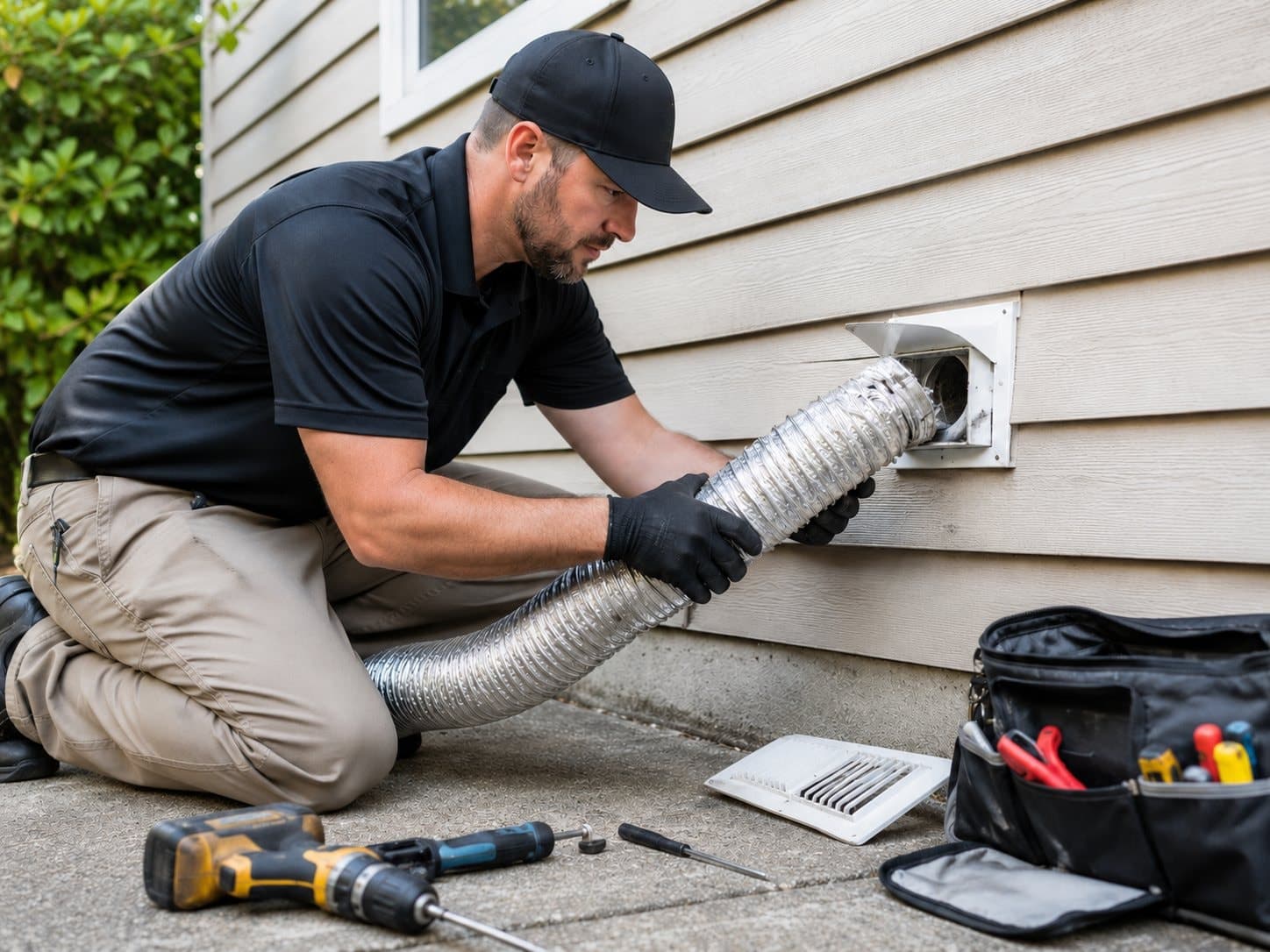
Where this page applies
This page covers the City of Winter Garden. Horizon West is an unincorporated area outside city limits; its Census figures appear below only for comparison.
A young house can still have a tired vent
Winter Garden’s housing is among the newest in the Orlando area. The median home was built in 2004, and 39.3% of homes went up between 2010 and 2019 alone. South of the city, the Horizon West census area is newer still: a median year built of 2014, with 97.2% of homes built in 2000 or later and 15.1% built since 2020 (Census ACS via Census Reporter: Winter Garden; Horizon West).
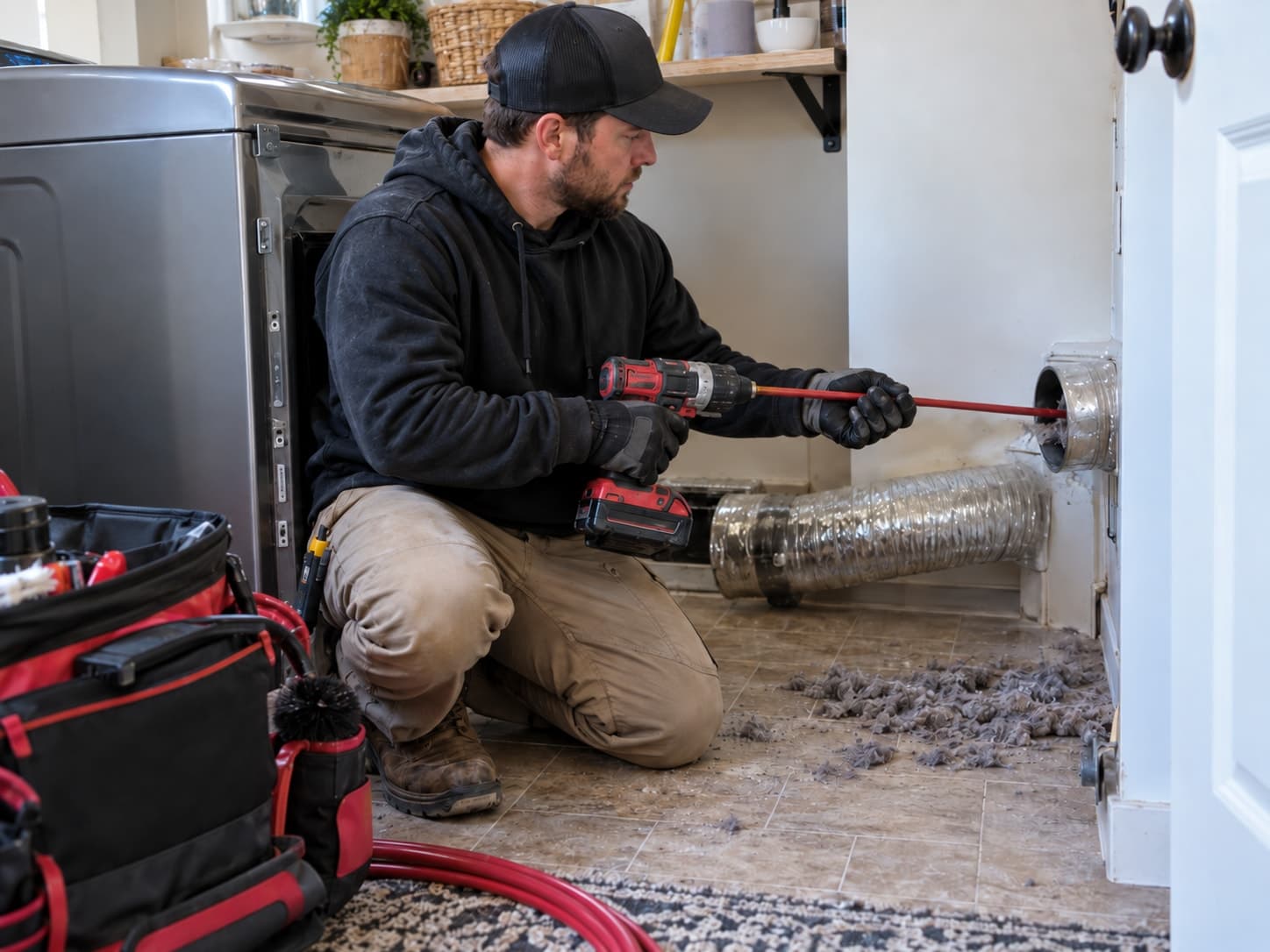
Homes that new rarely need a dryer vent cleaning because of age. They need one because of layout and installation. Average household size is 2.96 people in Winter Garden and 3.1 in Horizon West, so these dryers are not idling, and the ducts behind them are often longer and more hidden than in an older ranch house. The first cleaning in a newer home is also the first time anyone looks at the whole run, which makes it partly an installation check.
Signs it’s time to clean the vent
- Longer drying times: loads that need a second cycle (what slow drying usually means)
- Heat: an upstairs laundry room that turns hot and muggy while the dryer runs
- Lint at the exit: fluff on the roof around the cap or behind the wall-hood flap
- A warning light: many newer dryers show a vent or airflow alert
The cleaning itself follows the same order every time: airflow read at the exit, the dryer pulled out and the transition duct checked, the full exhaust duct brushed and vacuumed through the elbows, the wall hood or roof cap cleared and its damper checked, then a second airflow reading. How dryer vent cleaning works has the details; vents that end on the roof are covered on roof-terminated dryer vent cleaning.
Dryer vent system, from dryer to termination
- 1Lint screen. Catches most lint inside the dryer. What gets past it collects in the duct.
- 2Transition duct. Short connector from the dryer to the wall. Easily crushed behind the machine.
- 3Duct run. Smooth 4-inch metal duct through walls, floors or the attic.
- 4Elbows. Every bend adds resistance and counts against the allowed duct length.
- 5Roof cap. Roof termination, common on two-story homes. Hard to see and to clean.
- 6Wall hood. Side-wall termination. Must open freely and has no screen.
- 7Backdraft damper. Flap that opens under airflow and closes to keep out air, rain and pests.
Second-floor laundry and the long run to the roof
Some newer two-story plans put the laundry upstairs next to the bedrooms, and the U.S. Fire Administration notes that laundry placed in upstairs rooms, hallways and closets may need longer ducts to reach outside. From an upstairs laundry the duct often rises through the ceiling into the attic, turns, runs across the trusses and exits through a roof cap. Each turn matters more than most owners expect.
Florida’s residential code caps a dryer duct at 35 feet, and every fitting uses up part of that allowance according to Table M1502.4.5.1. The deduction depends on the elbow’s shape, which is why two runs of the same length can behave very differently (FBC-R 2023, M1502.4.5).
| Fitting | Counts as |
|---|---|
| 90° elbow, 4-inch radius, mitered | 5 ft |
| 90° elbow, 6-inch radius, smooth | 1 ft 9 in |
| 90° elbow, 10-inch radius, smooth | 1 ft 6 in |
| 45° elbow, 4-inch radius, mitered | 2 ft 6 in |
| 45° elbow, 6-inch radius, smooth | 1 ft |
A worked example: 20 feet of straight duct from an upstairs laundry to the roof, with three tight mitered 90° elbows, already adds up to 35 feet of equivalent length. The same route built with smooth long-radius elbows uses far less of the allowance. The code does let the dryer manufacturer’s instructions set the length where the model is known, and requires a permanent label within 6 feet of the dryer connection when the equivalent length is over 35 feet. If your laundry is upstairs and there is no label, the run may be within the limit, or nobody measured it.
Installation faults to look for in a newer home
New-build dryer vent faults to rule out, and how each shows up
01Crushed transition hose behind the dryer
- What you may notice
- Slow drying from the first year, a dryer that sits tight against the wall, a vent warning on a new machine.
- How it’s confirmed
- The dryer is pulled out and the connector is checked for kinks, flattening, length and whether it is a listed transition duct.
02Loose or unsealed joint in the attic
- What you may notice
- Weak airflow at the roof even after cleaning, lint on attic insulation, a warm, damp smell in the upstairs laundry.
- How it’s confirmed
- Airflow at the termination is compared with what the dryer is pushing; where the attic run is reachable, the joints are looked at directly.
03Duct squeezed inside a wall or ceiling
- What you may notice
- A run that clogs again quickly, or a section that brushes will not pass through easily.
- How it’s confirmed
- Resistance to the brush and the before-and-after airflow readings point to a narrowed section; the code requires cavities to allow the duct without deformation.
04Joints fastened with screws
- What you may notice
- Lint that keeps snagging at the same spot; clumps pulled out on the brush.
- How it’s confirmed
- Screw tips inside the duct catch the brush and lint. FBC-R M1502.4.2 says ducts shall not be joined with screws or similar fasteners.
05Wrong cap on the roof
- What you may notice
- Lint on the roof tiles or shingles around the cap, a flap that never seems to open.
- How it’s confirmed
- The cap is checked for a working backdraft damper and for any screen, which the code prohibits at a dryer termination; a fine grille made for a bath fan can trap lint the same way.
06Termination too close to a soffit vent
- What you may notice
- Lint on the soffit or eave, humid air being drawn back into the attic.
- How it’s confirmed
- Unless the dryer manufacturer specifies otherwise, the code requires the termination to be at least 3 feet from openings into the building, including ventilated soffits.
None of these requires a careless builder. They are easy mistakes to make in an attic in summer and impossible to see once the ceiling is closed. They are also the reason a newer vent can keep clogging even though it is only a few years old. For a closer look at the whole run without cleaning, an inspection with airflow testing is the better fit.
Builder warranty timing
Builder warranties differ in length and in what they cover, and we can’t tell you what yours says. What we can suggest is to find out before it runs out, because an installation fault found inside a warranty period may be something to raise with the builder rather than pay to fix yourself.
If your home is still under a builder warranty
Read the warranty’s section on mechanical and ventilation items
Note the coverage period, what counts as a defect and how claims have to be submitted.
Have the vent checked well before the deadline
Leave time for the builder to respond. A cleaning with before-and-after airflow readings shows whether lint or the installation is the problem.
Keep the findings
Ask for the readings and any installation problems in writing, and take your own photos of anything you can see, such as a crushed connector or a screened roof cap.
Ask before anyone opens walls or ceilings
If the fix means changing the duct inside a finished wall or the attic, check whether the warranty requires the builder to do that work first.
Cleaning, or something more?
Most newer vents only need a cleaning. A duct packed solid, or lint escaping onto attic insulation, calls for heavy lint removal. Almost no air at the roof, or a nest behind a broken flap, is a job for clearing a blocked vent. A crushed connector or a loose attic joint is a duct repair, not a cleaning.
HOA rules and the outside vent cover
Check with your association before changing a visible cap
Planned communities in and around Winter Garden often have architectural rules on exterior changes, and a wall hood or roof cap that looks different from the original may need approval. Check your association’s guidelines before replacing one. Whatever the rules say about appearance, the cap still has to meet the code: a backdraft damper, and no screen, even a decorative one.
Cleaning the duct and clearing lint from the existing cap usually changes nothing the association controls. Where a cap is broken, screened or the wrong type for a dryer, replacement with a compliant vent cover can often be done in a matching color or style. Florida’s other dryer vent rules, including why booster fans are not a fix for a long run, are laid out in what the Florida code requires.
Booking a dryer vent cleaning in Winter Garden
Cleaning is available throughout the City of Winter Garden, from Stoneybrook West to East Garden Manor and the historic downtown. Most households need a cleaning about once a year; a busy upstairs laundry with a long run to the roof may need it sooner. Tell us whether the laundry is upstairs, where the vent seems to end, and whether the home is still under a builder warranty. Rental homes follow the same process; owners with several properties can use dryer vent cleaning for rental properties. For other work on the house, see everything we handle in Winter Garden. Nearby, the same service covers Ocoee dryer duct cleaning, vent cleaning for Oakland homes and dryer vents in Windermere.
References (4)
Every Winter Garden figure above, with its source.
- 1Census Reporter: Winter Garden city, ACS 2020–2024 (tables B25034, B25035, B25010)
- 2Census Reporter: Horizon West CDP, ACS 2020–2024
- 3Florida Building Code, Residential 2023, Chapter 15, Section M1502 and Table M1502.4.5.1, via UpCodes
- 4U.S. Fire Administration, Clothes Dryer Fires in Residential Buildings, Topical Fire Report v13i7