On this page
- Inspection or cleaning: which one do you need?
- When an inspection makes sense
- What the inspection covers
- How a dryer vent airflow test works
- The code check: what Florida’s residential code expects
- Buying or moving into a home
- Disconnected runs in the attic
- Gas dryers and carbon monoxide
- What affects the cost of an inspection
- Seeing inside a concealed duct
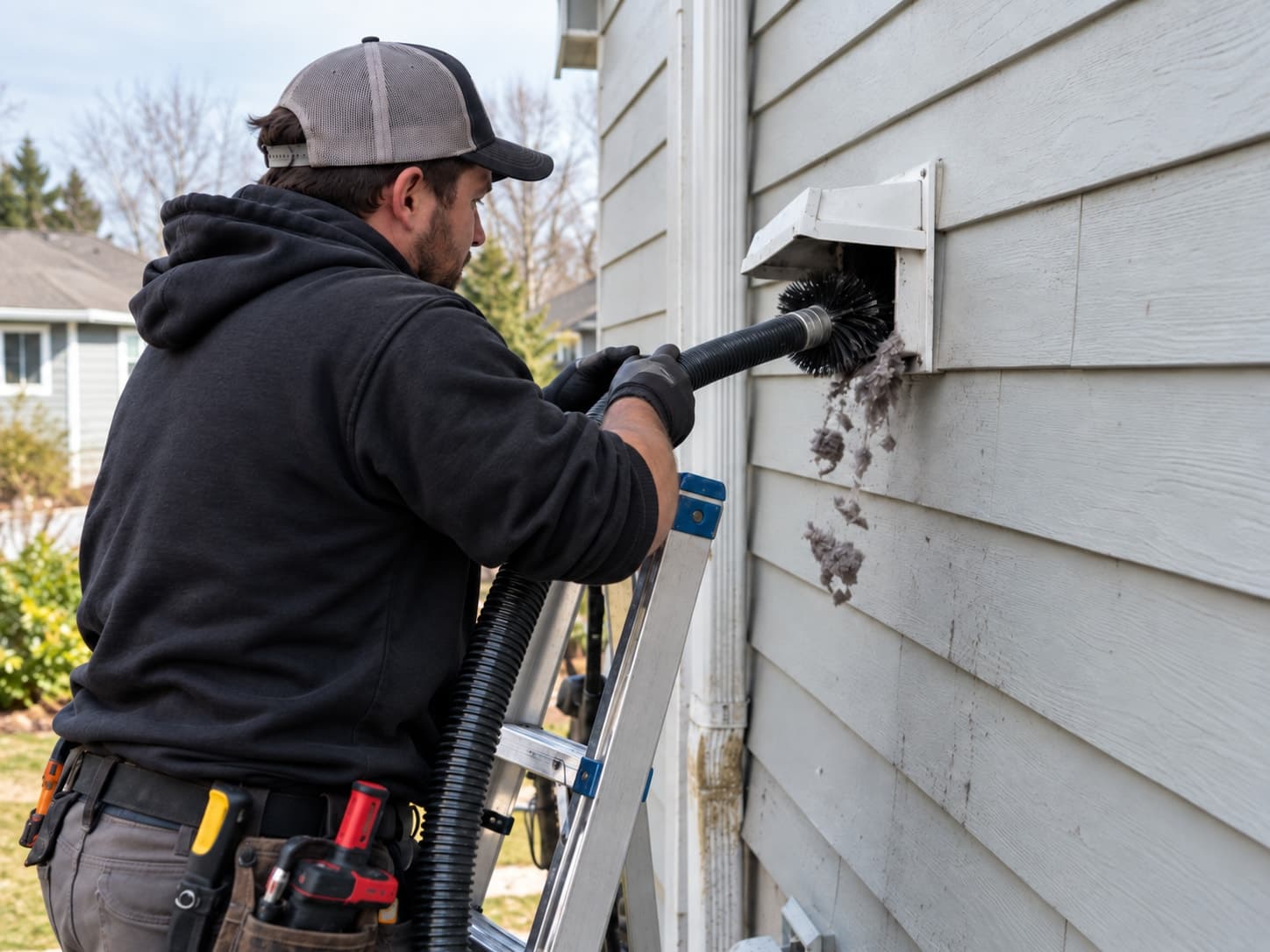
Most dryer vents are hidden for almost their entire length. You can see a few inches of hose behind the machine and a hood or cap outside, and everything in between runs through a wall, a ceiling or the attic. A dryer vent inspection follows that hidden path and tests it, so the decision about what to do next is based on measurements and what is actually inside the wall, not on guesswork.
It is a different job from a routine dryer vent cleaning, even though the two are often done on the same visit. Cleaning is a fix for one cause, lint. Inspection is diagnosis: it tells you whether lint is the problem at all, or whether the duct is too long, crushed, disconnected, made of the wrong material, or ending at a cap that can’t open.
Inspection or cleaning: which one do you need?
| Feature | Dryer vent inspection | Dryer vent cleaning |
|---|---|---|
| Question it answers | Is this vent safe, working and built to code? | Is lint restricting this vent, and can it be removed? |
| Main output | Airflow and pressure readings, a traced route, a list of faults and code gaps | A clear duct and a before-and-after airflow comparison |
| Best for | Home purchase, new occupancy, a remodel, repeat clogs, unexplained heat or odors | Routine maintenance on a vent that is otherwise sound |
| Leads to | Cleaning, repair, a new cover or a reroute, or nothing at all | Usually nothing more until the next cleaning |
Question it answers
- Dryer vent inspection
- Is this vent safe, working and built to code?
- Dryer vent cleaning
- Is lint restricting this vent, and can it be removed?
Main output
- Dryer vent inspection
- Airflow and pressure readings, a traced route, a list of faults and code gaps
- Dryer vent cleaning
- A clear duct and a before-and-after airflow comparison
Best for
- Dryer vent inspection
- Home purchase, new occupancy, a remodel, repeat clogs, unexplained heat or odors
- Dryer vent cleaning
- Routine maintenance on a vent that is otherwise sound
Leads to
- Dryer vent inspection
- Cleaning, repair, a new cover or a reroute, or nothing at all
- Dryer vent cleaning
- Usually nothing more until the next cleaning
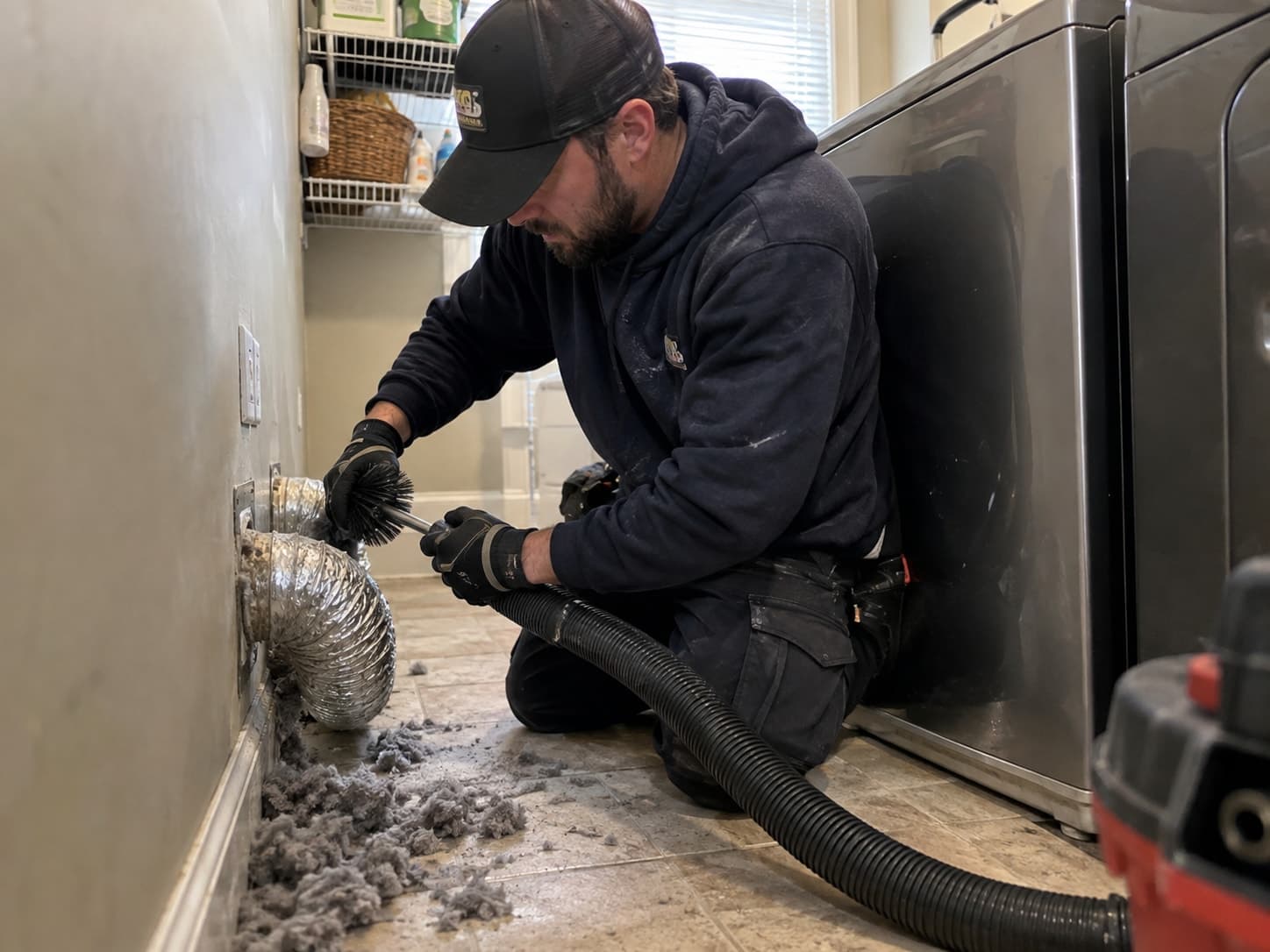
If the dryer is simply slower than it used to be and the vent has worked well for years, a cleaning is usually enough. If you are not sure whether the dryer or the vent is at fault, the guide on telling a vent problem from a dryer problem covers the checks that separate the two.
When an inspection makes sense
Good reasons to book an inspection rather than a cleaning alone
- You are buying a home, or just moved into one, and have no history on the vent
- The vent was cleaned recently, yet drying times are still long
- The vent needs cleaning much more often than it should
- The dryer shows an airflow or “check vent” warning with a clean duct
- There is lint in the attic insulation or a musty smell near the laundry
- You are adding a gas dryer, replacing the dryer, or moving the laundry
- The outside flap barely moves, even though nothing looks blocked
- A home inspector or insurer flagged the vent and you want specifics
What the inspection covers
Dryer vent system, from dryer to termination
- 1Lint screen. Catches most lint inside the dryer. What gets past it collects in the duct.
- 2Transition duct. Short connector from the dryer to the wall. Easily crushed behind the machine.
- 3Duct run. Smooth 4-inch metal duct through walls, floors or the attic.
- 4Elbows. Every bend adds resistance and counts against the allowed duct length.
- 5Roof cap. Roof termination, common on two-story homes. Hard to see and to clean.
- 6Wall hood. Side-wall termination. Must open freely and has no screen.
- 7Backdraft damper. Flap that opens under airflow and closes to keep out air, rain and pests.
Trace the route
The path is worked out from both ends: where the duct leaves the laundry room, where it turns, whether it passes through the attic or a wall cavity, and where it ends. The termination is confirmed to belong to the dryer, not a bath fan or range hood.
Measure the length and count the fittings
The straight duct is measured and every elbow is identified by its angle and how tight the bend is, so the run can be converted to an equivalent length and compared with the code limit.
Test the airflow
With the dryer running on a no-heat setting, exhaust velocity is read at the outlet, and where the connection allows, back-pressure is read near the dryer. Readings are repeated with the dryer pushed back into its normal position.
Assess the hidden sections
Where the duct can’t be seen, the concealed sections are judged from what can be reached at each end and from how the run performs, and anything that can’t be assessed is noted. Typical hidden problems are crushed spots, separated joints, lint packing at elbows, screws protruding into the airstream and water standing in low points.
Check the transition and the termination
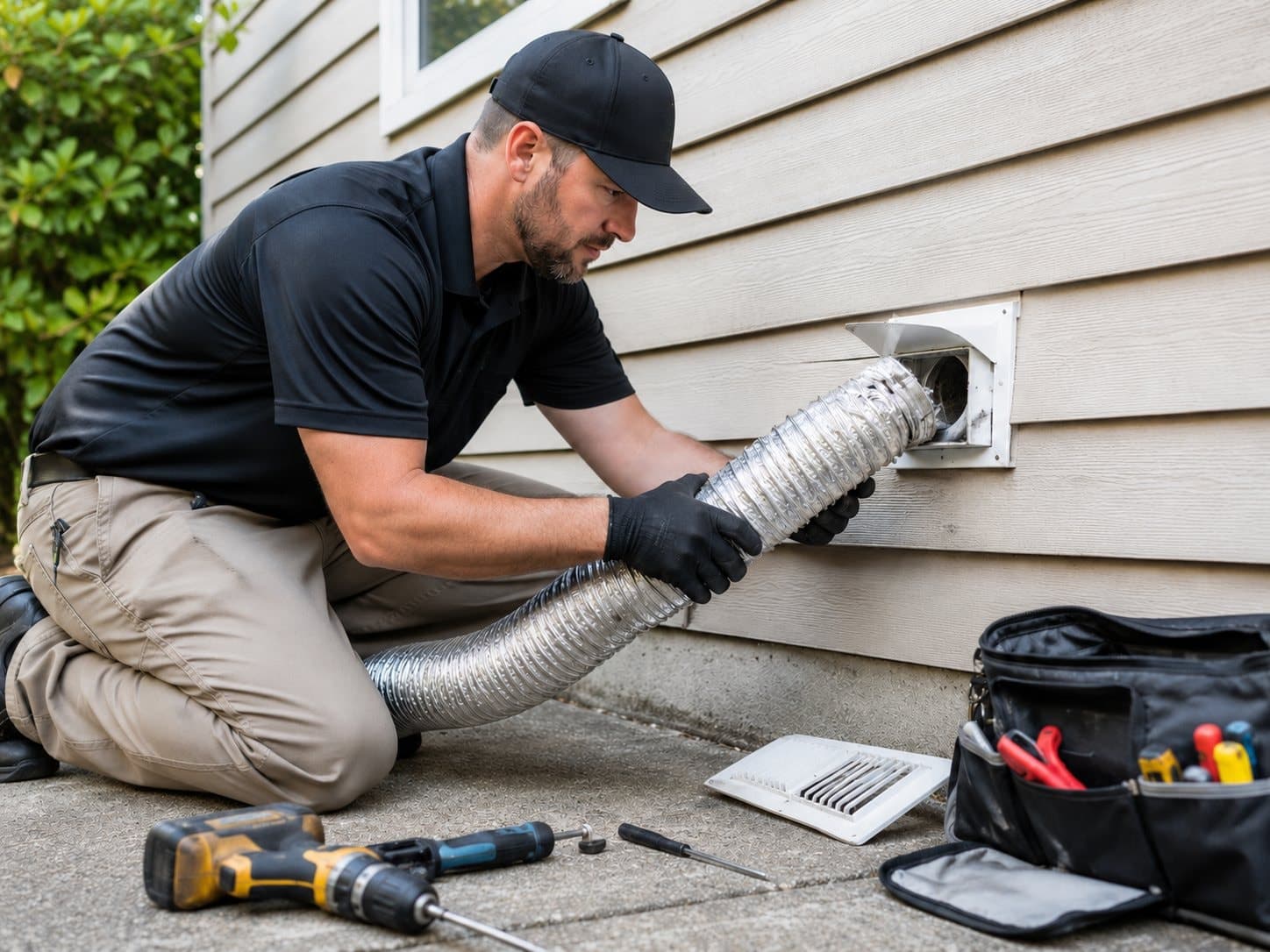
The connector behind the dryer is checked for type, length and crushing. Outside, the hood or roof cap is checked for a working backdraft damper, no screen, a clear opening and a sound seal to the wall or roof.
Explain the result
You get a plain answer for each part of the system: fine as is, needs cleaning, needs repair, or doesn’t meet code. Any repair is priced separately and nothing beyond the inspection is done without your go-ahead.
How a dryer vent airflow test works
There are two useful numbers. Velocity is how fast the exhaust leaves the outlet, read with a handheld airflow meter (an anemometer). Static pressure is how hard the dryer’s blower is having to push, read with a pressure gauge (a manometer) through a small test port or at the connection. They tell you different things: low velocity says not much air is getting out; high back-pressure says the duct is fighting the blower somewhere along the way.
Neither number has a universal pass mark. Dryer blowers differ from brand to brand, and many manufacturers publish their own venting limits in the installation instructions. That is why the readings are interpreted together with the route, the length and the dryer model, and why a single reading is less useful than a comparison: with the dryer out and then pushed back, before and after a section is cleared, or at the dryer end against the outlet end.
| What the test shows | Likely meaning | Usual next step |
|---|---|---|
| Low velocity, high back-pressure | A restriction in the duct: lint packing, a crushed section or a stuck damper | Cleaning, then a re-test; repair if the reading doesn’t recover |
| Low velocity, low back-pressure | Air is escaping before it reaches the outlet, often a separated joint | Find and repair the disconnect before any cleaning |
| Good reading with the dryer pulled out, poor once pushed back | The transition connector is being crushed behind the machine | A shorter, sturdier connector or a recessed wall box |
| Good velocity but long drying times | The vent is probably not the cause | Have the dryer itself checked by an appliance technician |
If the outlet shows almost no movement at all, the dedicated page on weak or no airflow at the outside vent walks through the possible causes in order. A dense plug, a nest or a flap stuck shut found this way is cleared under dryer vent blockage removal.
The code check: what Florida’s residential code expects
Dryer exhaust in Florida homes is governed by section M1502 of the Florida Building Code, Residential (FBC-R 2023, 8th edition, Chapter 15). An inspection compares what is installed with the points below. A house built under an older code edition isn’t automatically “illegal” for missing one, but each gap is a real performance or safety issue worth knowing about.
| Item | What the code says | What is looked for |
|---|---|---|
| Where it ends | The duct must terminate outside the building | Ducts ending in the attic, a soffit or a crawl space |
| Duct material | Metal with a smooth interior, at least 28 gauge, 4 inches nominal | Ribbed foil, vinyl or plastic used as the main duct; undersized pipe |
| Joints | Insert end points in the direction of airflow; joints sealed; no screws or similar fasteners | Joints lapped backwards, screws catching lint, unsealed seams |
| Support | Supported at intervals of no more than 12 feet and secured | Sagging runs, low spots holding water, separated sections |
| Transition duct | A single length listed to UL 2158A, no more than 8 feet, not concealed in construction | Unlisted foil or vinyl hose, hose run into the wall or ceiling |
| Length | 35 feet maximum, reduced for each fitting, unless the dryer maker’s instructions set the limit | A run that exceeds its equivalent-length limit |
| Length label | If equivalent length exceeds 35 feet, a permanent label within 6 feet of the duct connection | Long runs with no label |
| Termination | A backdraft damper; no screen; an open area of at least 12.5 square inches | Stuck flaps, mesh guards, undersized or crushed hoods |
| Booster fans | Only a dryer exhaust duct power ventilator listed to UL 705; household booster fans not allowed | Inline fans not built for dryer exhaust |
The plain-language guide to Florida’s dryer vent code goes through these rules one by one, including where they came from and how the fitting deductions work.
Why the fitting count matters so much
The code does not treat every elbow the same. Its fitting table charges a tight 4-inch-radius mitered 90-degree elbow as 5 feet of straight duct, while a smooth 90-degree bend with a 6-inch radius counts as 1 foot 9 inches. Two runs with the same tape-measure length and the same number of turns can land on opposite sides of the 35-foot limit depending on which elbows were used. That is why an inspection records the type of each fitting, not just how many there are.
Buying or moving into a home
A general home inspection in Florida is a visual one. The state’s standards of practice describe it as based on the “visible and apparent condition” of readily accessible components (Fla. Admin. Code R. 61-30.801). A dryer duct that runs through a finished ceiling to the roof is mostly neither visible nor accessible, so a report may say little about it beyond the connector and the outside hood.
A dedicated dryer vent inspection fills that gap. It is especially useful when the laundry is on the second floor or in the middle of the house, when the vent goes through the roof, or when the previous owners’ maintenance history is unknown. Buyers usually want to know three things before closing: whether the run is connected all the way out, whether it is short enough to work, and whether anything needs to be replaced. If the inspection finds a fault, the fixes are covered under repairing or replacing the dryer duct, and a run that is simply too long is addressed by relocating the vent to a shorter route.
Ask for the details in writing
Whoever inspects the vent, ask for the findings in writing with the readings, the equivalent length and the location of each problem. It makes it much easier to compare repair quotes, and it is useful to pass on if you ever sell the house.
Disconnected runs in the attic
A duct that has separated in the attic is the classic hidden fault, and it is one of the main reasons to test rather than assume. The dryer still runs, the laundry room may seem fine, and the outside cap simply gets less air than it should. Meanwhile, warm, damp, lint-laden exhaust is going into the attic. The U.S. Fire Administration notes that venting into an attic, crawl space or wall space can lead to mold and poor indoor air quality, in addition to the lint that settles there.
The airflow pattern gives it away: low velocity at the outlet without the high back-pressure a blockage would cause. Lint on the insulation around the duct, a joint that is only pushed together with no seal, or a roof cap that barely lifts confirm it. Finding a disconnect before cleaning matters, because brushing a separated duct pushes more lint into the attic. The signs a homeowner can check are on how to tell whether a dryer vent is disconnected or crushed.
Gas dryers and carbon monoxide
A gas dryer’s exhaust carries combustion products, and carbon monoxide can be among them. On an electric dryer, a leaking or blocked vent is mainly a lint, heat and moisture problem; on a gas dryer, the same fault can also let combustion gases into the house. The Consumer Product Safety Commission lists clothes dryers among the fuel-burning appliances worth having professionally checked and recommends checking vents to make sure they are not loose or disconnected.
- On a gas dryer, the joint where the dryer connects and any joints inside the laundry room are checked closely, because a leak there releases exhaust straight into living space.
- Crushed or disconnected sections are treated as priority repairs rather than items to watch.
- Working CO alarms should be installed on every level of the home and outside sleeping areas, as the CPSC carbon monoxide fact sheet recommends.
Exhaust side only
The inspection covers the vent, not the gas supply. Gas piping and the dryer’s gas connection are outside this service. Gas-line work is a separate job from appliance service, and we carry that out too. If you smell gas, don’t use switches or the dryer; leave the house and call the gas utility or 911 from outside.
What affects the cost of an inspection
Inspection pricing depends on the home, so there is no flat figure here. The factors that change the time involved:
- Whether the vent ends on a sidewall or on the roof
- How much of the run is hidden in finished walls and ceilings
- Attic access and conditions along the route
- Whether the inspection is combined with a cleaning on the same visit
- How easy the dryer is to reach and move
Seeing inside a concealed duct
Most of a dryer duct is hidden in a wall, a ceiling or an attic, and the faults that matter are exactly the ones you cannot see: a crushed elbow, a joint that has come apart inside the cavity, or a duct that was never connected to the outside at all.
A push camera run down the duct settles those, and it is worth doing when the symptoms do not add up — a duct that was cleaned recently but still will not move air, or lint appearing in a room, or a laundry that gets humid during a cycle.
That last one usually means the duct has disconnected inside the wall and is venting moist air into the structure, which is covered on a disconnected dryer vent. It is a repair rather than a cleaning, and it does not improve on its own.
References (5)
Facts and figures on this page come from these references.
- 1Florida Building Code, Residential 2023 (8th ed.), Chapter 15, Section M1502 Clothes Dryer Exhaust, via UpCodes
- 2U.S. Fire Administration, Clothes Dryer Fires in Residential Buildings (2008–2010), Topical Fire Report v13i7
- 3Florida Administrative Code R. 61-30.801, Home Inspector Standards of Practice, General (via Cornell LII)
- 4CPSC, Urges Inspection of Fuel-Burning Appliances to Prevent CO Poisonings (2002)
- 5CPSC, Carbon Monoxide Fact Sheet