On this page
This page covers the supply side of gas fireplace work. The appliances that sit on the end of it are on the gas fireplace installation and gas log installation pages.
If you smell gas now
Do not operate switches, do not look for the leak yourself. Get everyone out of the building and call 911 and your gas utility from outside. Come back to this page once the property has been made safe.
When a new line is needed
Most Orlando-area fireplaces that end up needing gas fall into one of a few situations.
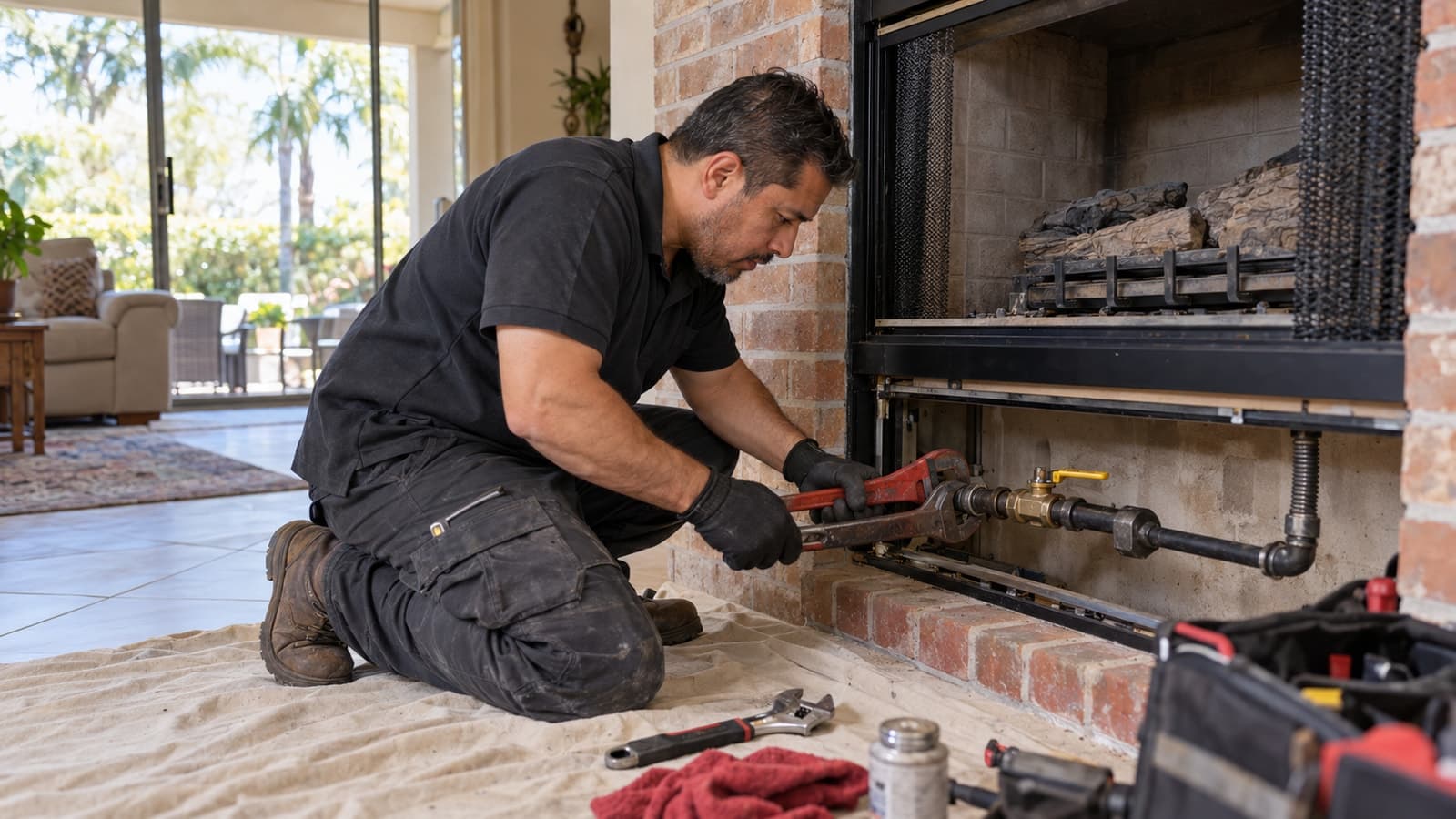
- An open wood fireplace being converted. There is no gas at the firebox at all, so a line has to be run to it. This is the most common case.
- A capped stub that was never finished. Builders sometimes rough in a line and cap it. It still needs proving, sizing against the new appliance and terminating with a proper valve.
- An old line that is too small. A stub that fed a small log set will not supply a modern insert or a linear unit without starving it, which shows up as a low, lazy flame.
- A new fireplace in a new location. Adding a unit to a wall that has never had one means the run, the valve and the appliance connection are all new work.
- A propane tank being added or moved. LP is common where natural gas has not been brought down the street, and the run from the tank is part of the same job.
- An outdoor connection. A patio unit needs an exterior-rated run and its own shut-off.
Sizing: the part that gets skipped
A gas line is not simply a pipe that reaches. It has to deliver enough volume at the right pressure while every other appliance in the house is running, and that is a calculation, not a guess.
What determines the pipe size
- The appliance input rating in BTU per hour, from the rating plate or the specification sheet
- Total length of the run from the meter or regulator, including every fitting
- Number and type of elbows and tees, each of which adds effective length
- What else is on the same system — water heater, range, dryer, pool heater, generator
- Fuel type, because natural gas and propane deliver different energy per cubic foot
- Available supply pressure and whether a second-stage regulator is involved
- Pipe material and its internal diameter, which is not the same as its nominal size
An undersized line looks like a broken fireplace
A unit starved of gas burns with a small, lazy flame, drops out when the water heater fires, or will not reach its rated output. People replace valves and ignition modules chasing this before anyone checks the pipe. If a fireplace has never run properly since the day it was fitted, supply is the first thing worth measuring.
Pipe materials
| Material | Where it suits | Notes |
|---|---|---|
| Black iron pipe | Traditional interior runs, exposed or concealed | Rigid and robust. Threaded joints, so the route has to be planned around fittings. |
| CSST (corrugated stainless steel tubing) | Long or awkward routes through framing and attics | Flexible and quick to route. Requires the manufacturer's fittings and correct bonding. |
| Copper | Permitted for LP in some situations | Rules differ between natural gas and propane; the code in force decides. |
| Approved appliance connector | The final short link from the valve to the appliance | A connector is not a substitute for the fixed run. It is the last piece only. |
Concealed runs in an attic or a wall cavity are the ones worth thinking about hardest, because nobody sees them again. Protection plates where the pipe crosses framing, correct support spacing and bonding for CSST are the details that matter later.
Shut-off valves and access
Every gas appliance needs a shut-off valve in the same room, ahead of the connector, that you can operate without tools and without lying inside the firebox. It sounds obvious. It is also the single most common thing found wrong on an existing fireplace.
Valve problems found on existing installations
01No valve at all
- What you may notice
- The connector runs straight from the pipe into the appliance.
- How it’s confirmed
- There is nothing to isolate the fireplace with, so any service work means shutting the whole house off at the meter. A valve is added.
02A valve buried behind the logs
- What you may notice
- You have to move ceramic logs or reach past the burner to find the key.
- How it’s confirmed
- Relocated or extended so it can be reached in an emergency without dismantling anything.
03A seized key valve
- What you may notice
- The floor or wall key will not turn, or turns without doing anything.
- How it’s confirmed
- Common after years unused in a humid house. The valve is replaced rather than forced.
04A missing floor-key escutcheon
- What you may notice
- An open hole in the floor or wall where the key goes.
- How it’s confirmed
- Looks cosmetic, but it is how debris gets into the valve. Refitted as part of the work.
05The wrong valve type
- What you may notice
- A valve not rated for gas, or one with no clear on/off indication.
- How it’s confirmed
- Replaced with an approved appliance shut-off with a visible position.
Natural gas and propane
Greater Orlando has both. Natural gas is piped and metered where the utility has mains in the street; propane comes from a tank on the property and is common in areas where mains never arrived. They are not interchangeable.
| Feature | Natural gas | Propane (LP) |
|---|---|---|
| Supply | Utility main and meter | Tank on the property, filled by a supplier |
| Energy per cubic foot | Lower, so the pipe carries more volume | Higher, so a smaller line can feed the same appliance |
| Operating pressure | Typically lower at the appliance | Higher, regulated down in stages |
| Appliance parts | Natural gas orifice and regulator setting | LP orifice and regulator setting — a conversion kit, not an adjustment |
| Vapour behaviour | Lighter than air, rises | Heavier than air, settles low — which changes where a leak collects |
| Tank work | Not applicable | Tank siting, distances and the run from it are part of the job |
Supply
- Natural gas
- Utility main and meter
- Propane (LP)
- Tank on the property, filled by a supplier
Energy per cubic foot
- Natural gas
- Lower, so the pipe carries more volume
- Propane (LP)
- Higher, so a smaller line can feed the same appliance
Operating pressure
- Natural gas
- Typically lower at the appliance
- Propane (LP)
- Higher, regulated down in stages
Appliance parts
- Natural gas
- Natural gas orifice and regulator setting
- Propane (LP)
- LP orifice and regulator setting — a conversion kit, not an adjustment
Vapour behaviour
- Natural gas
- Lighter than air, rises
- Propane (LP)
- Heavier than air, settles low — which changes where a leak collects
Tank work
- Natural gas
- Not applicable
- Propane (LP)
- Tank siting, distances and the run from it are part of the job
A fireplace moved between fuels needs the manufacturer's conversion kit for that model. Where no kit exists, the appliance cannot be converted, however similar it looks to one that can. Running an appliance on the wrong fuel is what produces soot, a yellow flame and, on a vent-free unit, a genuine safety problem.
How the work runs
Survey and measure
Where the meter or tank is, where the appliance will sit, what route the pipe can take, and what else is already on the system. The appliance BTU rating is confirmed from its plate rather than assumed.
Size the run
Length, fittings and total connected load are worked through to a pipe size. This happens before the estimate, not after the pipe is bought.
Confirm permitting with the jurisdiction
Fuel gas work is permitted and inspected in Florida, and the requirements differ between Orange, Seminole, Osceola and Lake counties and the cities inside them. What applies to your address is confirmed with the authority having jurisdiction before work starts.
Run the pipe
Routed, supported and protected where it crosses framing. Concealed sections are completed before anything is closed up.
Fit the shut-off valve
In the same room as the appliance, ahead of the connector, reachable without tools.
Pressure test
The new work is isolated and held under test pressure to prove it before it is connected to anything. No appliance is lit on an untested line.
Connect and commission
Appliance connected, joints leak-checked, operating pressure verified and the unit watched through a full cycle. You are shown where the valve is and how to close it.
What we do not claim
Fuel gas work in Florida is permitted and inspected, and permitting requirements vary by jurisdiction and by the scope of the job. We confirm what applies to your address before work starts rather than quoting a blanket answer on a web page — and we do not make licence, certification or credential claims here that have not been published.
Gas line work as part of a conversion
Most fireplace gas lines are installed as part of something larger. The order that avoids repeat visits is: decide the appliance, size the line to it, run and test the pipe, then fit the appliance.
What the line usually feeds
- Gas log set The lowest-demand option. A line sized for a log set may not suit a later upgrade, so say if you might change your mind.
- A gas insert Higher input than a log set and a liner up the flue. Worth sizing the line for from the start.
- A built-in gas fireplace A new appliance with its own direct vent. Highest demand and the most planning.
- Wood-to-gas conversion Start here if you have not chosen between the three yet.
Existing lines and leaks
Not every call is a new run. An old line often needs proving before a new appliance goes on it — particularly a stub that has sat capped since the house was built, or one in a property that has changed hands several times and where nobody knows what was done.
A faint gas smell near a fireplace is a different matter and is covered on my gas fireplace smells like gas. If you can smell it now, leave and call 911 and the utility first.
Where we run gas lines
Fireplace gas line work is available across Greater Orlando and Central Florida — Orange, Seminole, Osceola and Lake counties. Slab-on-grade construction is the norm here, which shapes how a line reaches an interior wall: routes generally go through the attic and down, rather than under the floor as they would further north. That is worth knowing before a fireplace position is settled, because the route can decide where a unit can practically go.
Estimates are free, and the line is quoted after the appliance and the route are known. If you are searching for gas line installation near me because a fireplace has already been bought, bring the model number to the first call — it sets the sizing.
References (3)
Facts and figures on this page come from these references.