Dryer vent troubleshooting by symptom
Before anything else, feel the drum a few minutes into a heat cycle. A hot dryer with damp clothes points to the vent; a dryer that barely warms points to the appliance itself. Our guide to telling a vent problem from a dryer problem goes through that split in detail. If the dryer is hot, use the table.
| What you notice | Most likely part | First safe check | Read more |
|---|---|---|---|
| Loads need a second cycle; laundry room runs hot | Lint in the duct run, a crushed transition hose, or a flap that won’t open | Clean and rinse the lint screen, then feel for strong air at the outside hood with the dryer on no-heat | Why drying takes so long |
| Scorched or burning smell during a cycle | Lint near the heat source, driven by restricted exhaust | Stop the dryer and let it cool; don’t restart it to see if the smell returns | What a burning smell means |
| The vent clogs again months after a cleaning | Run too long, too many elbows, flexible duct, a screened or undersized cap | Look at the termination: is there a screen, a cage or a cap that barely opens? | Why a vent keeps clogging |
| Little or no air at the outside hood or roof cap | Disconnected or crushed duct, blocked cap, or a nest | Check behind the dryer for a hose that has come off; look for lint in the attic or wall cavity | No airflow at the vent |
| Drips from the duct, a wet hose or a stain near the laundry room | Condensation in a long or sagging run, or rain entering at the cap | Note whether it happens after drying cycles or after rain | Water in a dryer vent |
| Dryer too hot to touch, or stops partway through a cycle | Restricted exhaust tripping the dryer’s safety cutoffs | Clean the lint screen and check the hose behind the dryer; stop if it keeps cutting out | A dryer that overheats |
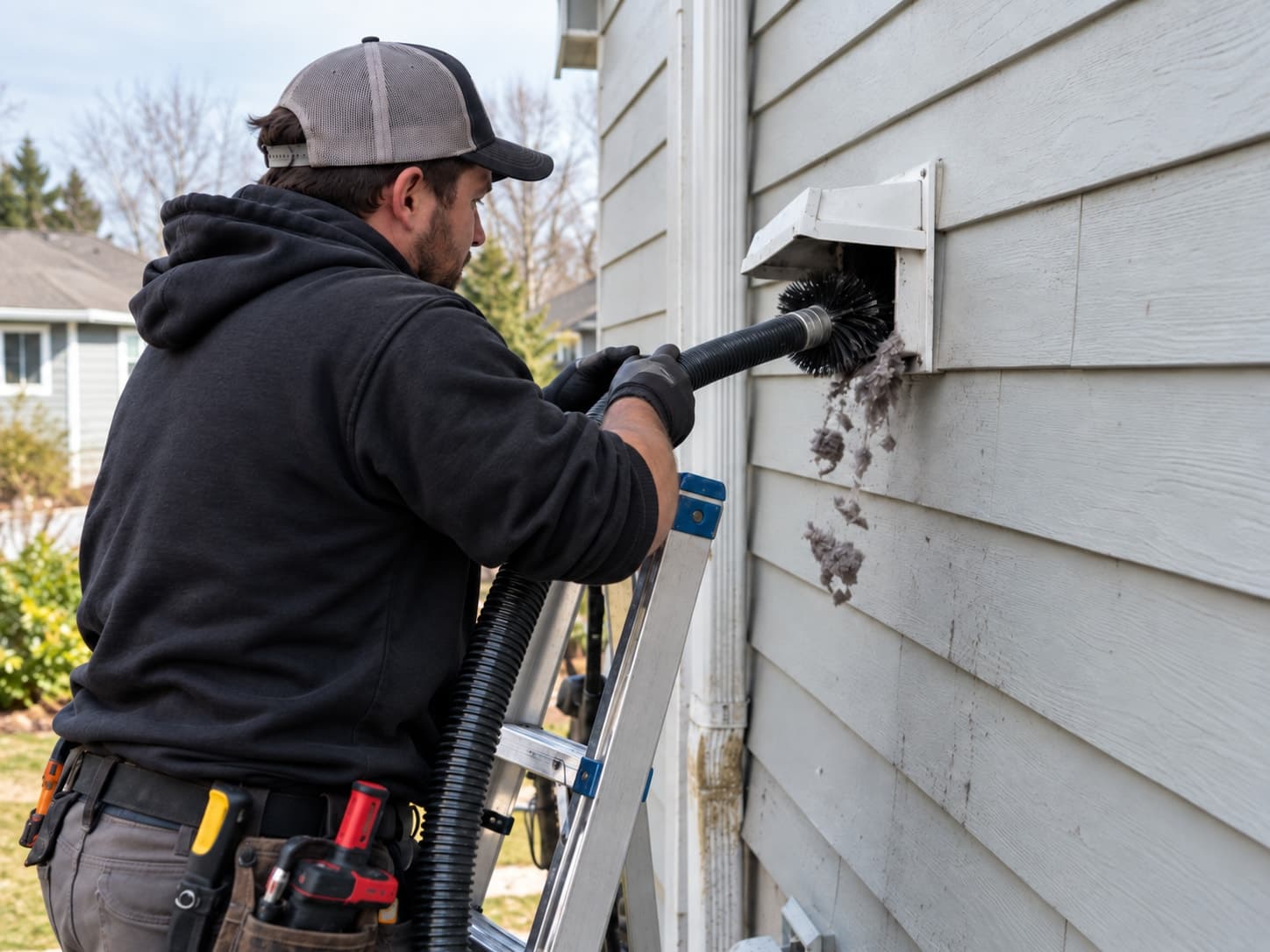
| Outside flap won’t open, won’t close, or is packed with lint | The exterior vent cover | Watch the flap with the dryer running, then check it closes when the dryer stops | A stuck flap or broken cover |
| Dryer vents through the roof and drying has slowed; lint on the shingles | Roof cap and the vertical run | Look at the roof around the cap with binoculars; don’t go up | A clogged roof dryer vent |
| Lint behind the dryer, in a closet or on attic insulation | A disconnected joint or crushed hose | Pull the dryer out and check the hose and both clamps | A disconnected or crushed vent |
| Booster fan silent, alarming or rattling | Power, pressure switch, lint on the fan, or a clogged run | Check the breaker and GFCI; don’t run the dryer with the fan off | A booster fan that isn’t working |
Stop the dryer, or schedule a visit?
| Urgency | Signs | What to do meanwhile |
|---|---|---|
| Get out and call 911 | Smoke, flames, or a burning smell that keeps getting stronger with the dryer off | Leave the home. Don’t open the dryer door. If it is a gas dryer and you smell rotten eggs, leave and call the gas utility or 911 from outside. |
| Stop using the dryer until it’s checked | Scorched smell during cycles; a cabinet too hot to keep your hand on; clothes hot enough to be uncomfortable; the dryer shutting off mid-cycle; no air at the outside cap; lint collecting in the attic or wall | Unplug an electric dryer or turn it off at the controls. Don’t run heat cycles. Air-dry the essentials. |
| Book an appointment | Drying times creeping up; a check-vent light that returns after you clean the lint screen; lint around the outside hood; an occasional drip after cold-weather loads | Keep the lint screen clean, dry smaller loads, and don’t leave the dryer running when nobody is home. |
The caution is not theoretical. The NFPA found that failure to clean was a factor in 32 percent of home structure fires involving dryers in 2014–2018, and the U.S. Fire Administration lists failure to clean as the leading factor in residential dryer fires in its 2008–2010 data. More on how that happens is in our guide to dryer vent fire risk.
How dryer vent problems feed each other
Restricted airflow drives most dryer vent problems, and each one makes the next more likely. It helps to see it as a loop rather than five separate faults:
Air slows down
A long run, a crushed hose, extra elbows or a sticky flap reduce how fast air leaves. Slower air drops more lint along the way.
Drying takes longer and runs hotter
The dryer holds its heat and moisture longer, so cycles stretch out and the cabinet, the lint path and the exhaust run hotter.
Moisture lingers in the duct
Warm, wet air that moves slowly cools on the way out. In a long attic run it can condense, and damp lint sticks to the duct walls instead of blowing out.
Lint builds faster
Sticky lint narrows the duct further, which slows the air more. That is why a vent can seem to clog again soon after a cleaning if the underlying layout isn’t fixed.
Heat and lint meet
At the end of the loop is the burning smell: a hot dryer, reduced airflow and lint where it shouldn’t be.
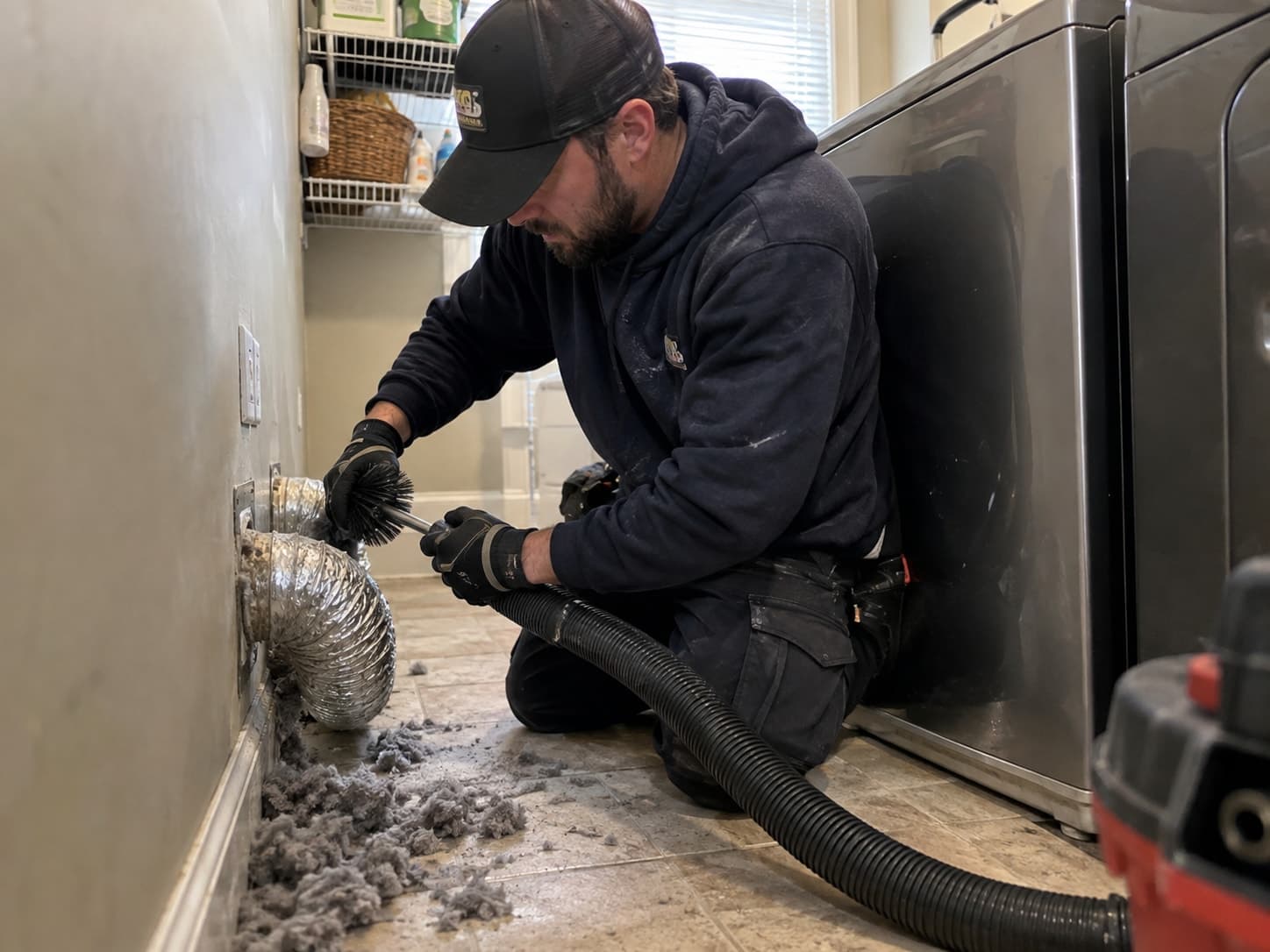
Breaking the loop means restoring airflow. A full dryer vent cleaning clears the lint; if the cause is the layout itself (a crushed section, a disconnected joint, plastic or foil hose), the duct needs repair or replacement so the next cleaning lasts.
Dryer vent system, from dryer to termination
- 1Lint screen. Catches most lint inside the dryer. What gets past it collects in the duct.
- 2Transition duct. Short connector from the dryer to the wall. Easily crushed behind the machine.
- 3Duct run. Smooth 4-inch metal duct through walls, floors or the attic.
- 4Elbows. Every bend adds resistance and counts against the allowed duct length.
- 5Roof cap. Roof termination, common on two-story homes. Hard to see and to clean.
- 6Wall hood. Side-wall termination. Must open freely and has no screen.
- 7Backdraft damper. Flap that opens under airflow and closes to keep out air, rain and pests.
Wall vents and roof vents fail differently
| Feature | Vent through an outside wall | Vent through the roof |
|---|---|---|
| Typical run | Often short and fairly straight on a first-floor laundry | Often longer, rising through the attic from an interior or second-floor laundry |
| Where lint collects | At the hood flap and in the hose behind the dryer | Under the roof cap and at the bottom of vertical sections, where lint falls back |
| What you can check | The flap and airflow, directly, from the ground | Only lint on the shingles around the cap, from the ground; leave the roof to a pro |
| Water problems | Rare, unless the hood is damaged or the duct slopes back toward the dryer | More likely: condensation in the attic and rain at a poorly seated cap |
| Usual service | Cleaning, cover replacement | Roof vent cleaning, sometimes rerouting |
Typical run
- Vent through an outside wall
- Often short and fairly straight on a first-floor laundry
- Vent through the roof
- Often longer, rising through the attic from an interior or second-floor laundry
Where lint collects
- Vent through an outside wall
- At the hood flap and in the hose behind the dryer
- Vent through the roof
- Under the roof cap and at the bottom of vertical sections, where lint falls back
What you can check
- Vent through an outside wall
- The flap and airflow, directly, from the ground
- Vent through the roof
- Only lint on the shingles around the cap, from the ground; leave the roof to a pro
Water problems
- Vent through an outside wall
- Rare, unless the hood is damaged or the duct slopes back toward the dryer
- Vent through the roof
- More likely: condensation in the attic and rain at a poorly seated cap
Usual service
- Vent through an outside wall
- Cleaning, cover replacement
- Vent through the roof
- Roof vent cleaning, sometimes rerouting
What the code says a working vent looks like
The Florida Building Code, Residential (M1502) sets the baseline that most repeat problems violate: a smooth-walled 4-inch metal duct, a length limit of 35 feet that is reduced for every fitting, a backdraft damper at the end and no screen at the termination (UpCodes, FBC-R 2023 ch. 15). A bird guard or screened cap is a common cause of repeat clogs. If your run is longer than the limit, rerouting the vent to a shorter path may do more than cleaning more often. The details are in our Florida dryer vent code guide.
Symptom guide, service or local page?
The guides above explain what each symptom points to. The work itself is a service: dryer vent cleaning for lint, roof dryer vent cleaning for roof exits, duct repair for crushed or loose ducts and an inspection with airflow testing when the cause isn’t clear. Local cleaning pages cover the same work in each city, for example Orlando dryer duct cleaning, vent cleaning for Kissimmee homes or dryer vents in Winter Garden.
References (3)
Facts and figures on this page come from these references.