Where this page applies
This page covers the City of Kissimmee. Buenaventura Lakes and Poinciana use Kissimmee addresses but are unincorporated Osceola County.
Signs a Kissimmee dryer vent needs cleaning
- Towels or sheets need a second cycle, or come out damp at the hems; see why loads take two cycles
- The dryer or the laundry closet gets unusually hot while it runs
- The outside flap barely lifts, or there’s little or no air leaving the vent
- Lint on the lanai, the pool deck or the roof near the cap
- A vent or airflow warning on the dryer’s display
What the cleaning covers
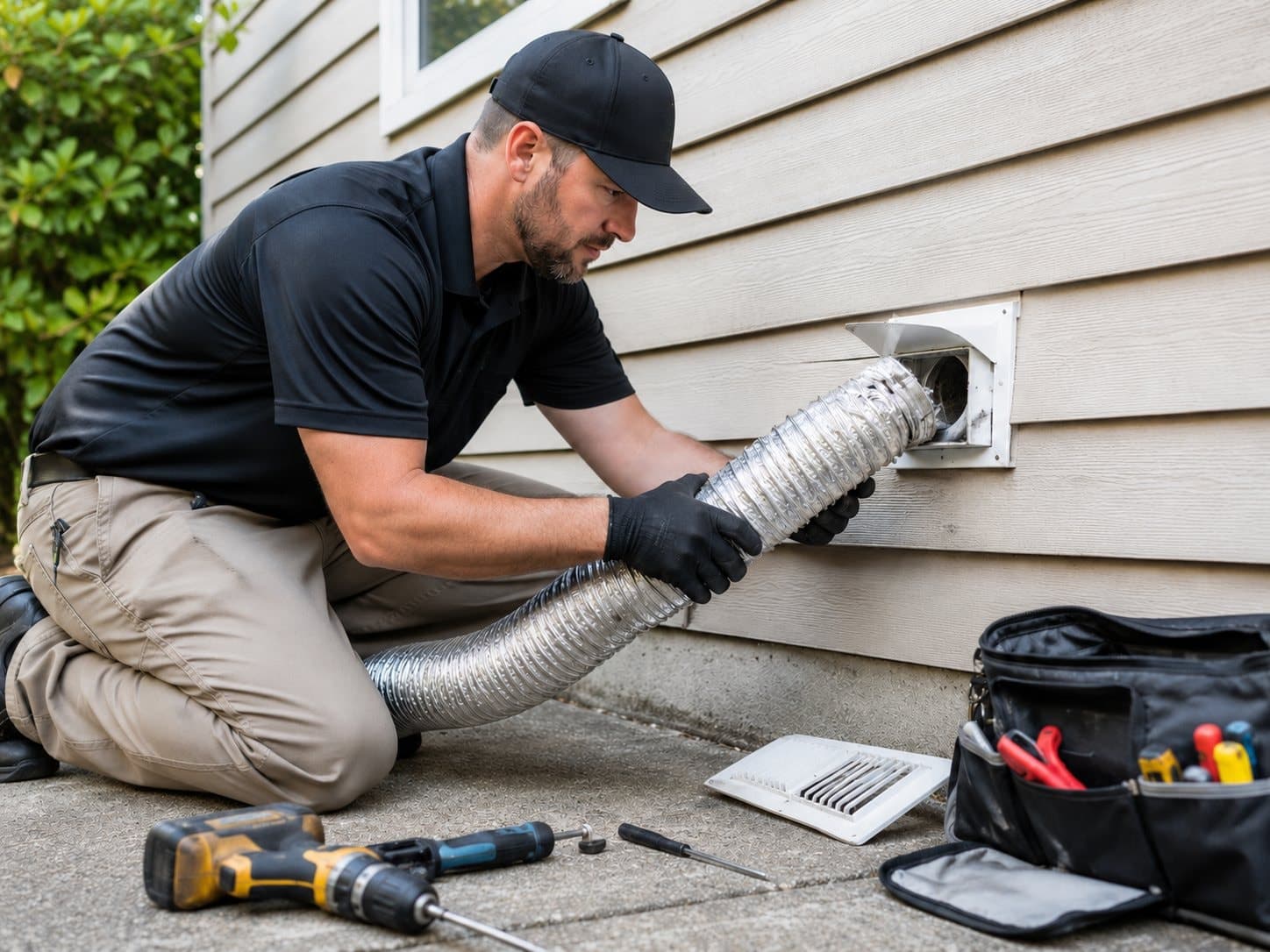
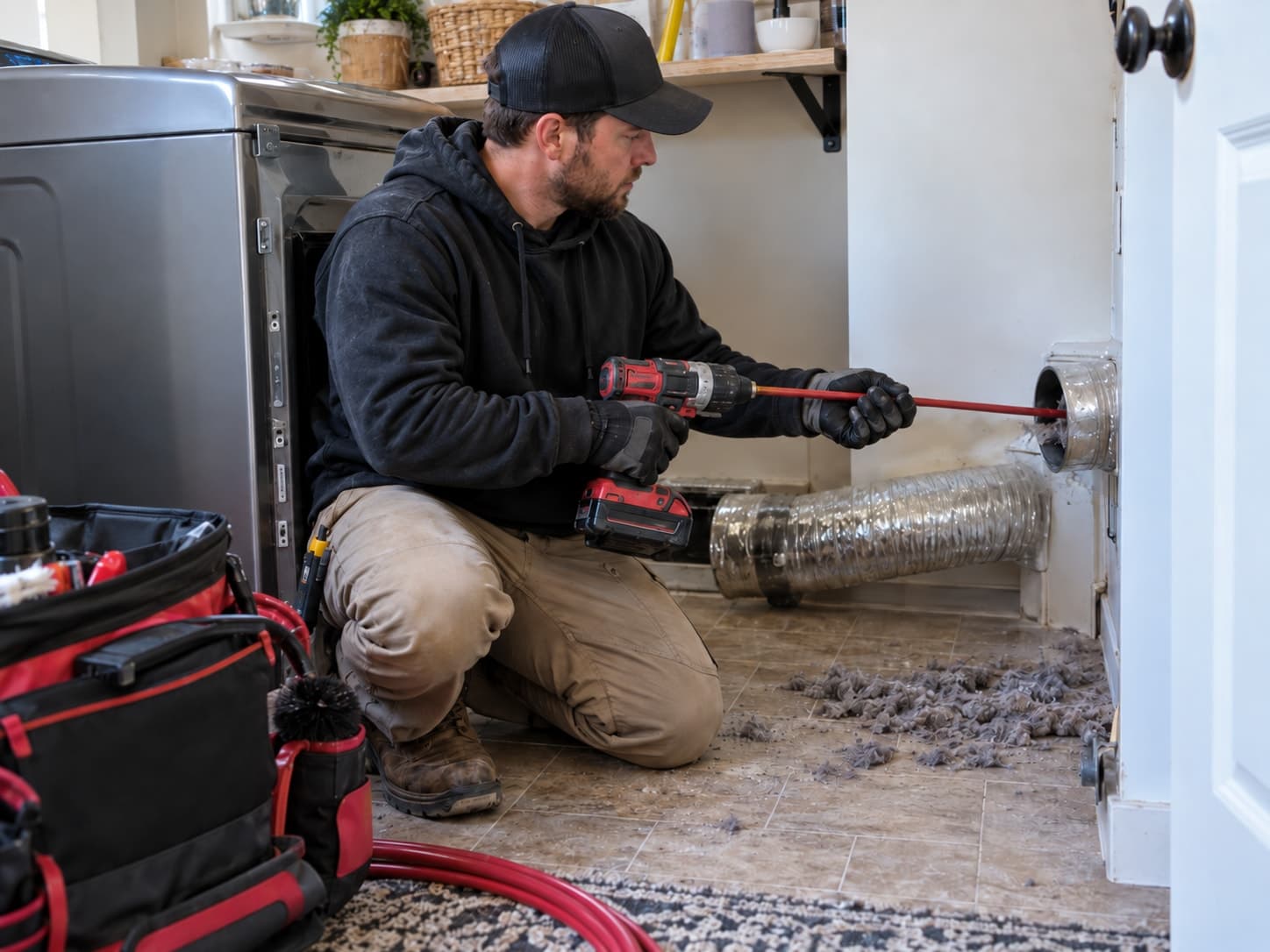
Airflow is read at the outside exit first. The dryer is pulled out and the transition duct behind it is checked for kinks, crushing and the right material. The duct run, through the wall, a ceiling or the attic, is brushed and vacuumed end to end, with extra attention at the elbows. Lint is cleared from behind the wall-hood flap or under the roof cap, and the backdraft damper is checked to open with the airflow and close when the dryer stops. Then the dryer is reconnected and airflow is read again, so the two numbers can be compared. The full process is laid out in how dryer vent cleaning works.
Family homes and rentals
Most Kissimmee dryer vents belong to households that live in the home, and for them the usual rule applies: clean about once a year, sooner with a big family, a long run or a roof exit. The city also has a lot of rented housing: 53.7% of occupied homes are renter-occupied, which counts long-term tenants as well as anything else. And some homes are short-term rentals, second homes rented between the owner’s visits, or townhomes run by a manager for an absentee owner. In those, nobody who lives there is watching the dryer, laundry volume is set by bookings, and problems tend to surface as a guest complaint instead of a gradual change someone notices. The rest of this page covers those homes in more detail.
Florida has a formal line for when a home becomes a vacation rental. The Department of Business and Professional Regulation treats a house, townhouse or condo unit as transient public lodging when it is rented to guests more than three times in a calendar year for stays of less than 30 days, or is advertised as regularly rented that way, and such properties need a state vacation rental license (DBPR). A license says nothing about the condition of the dryer duct. The vent is a maintenance item the owner or manager has to track separately.
The resort-home areas south and west of Kissimmee
Many purpose-built vacation home communities, including the ones named below, sit outside the Kissimmee city limits, in unincorporated Osceola County toward the US 192 corridor, Interstate 4 and the Polk County line. Osceola County controls where short-term rentals are allowed through its zoning, including a dedicated short-term rental planned development district (Osceola County STRPD). The county’s published list of subdivisions approved for short-term rental use names, among many others, Reunion Resort & Club, ChampionsGate, Windsor Hills, Formosa Gardens along West US 192, Lucaya Village and Terra Verde (Osceola County short-term rental listing, revised 05/2022).
Two cautions about the numbers on this page. The Census figures describe the City of Kissimmee itself, where 53.7% of occupied homes are rented, which counts long-term tenants as well as anything else; they do not describe the resort communities outside the city. And the county list says where short-term rental is allowed, not how many homes are actually rented. Neither is a count of vacation rentals, and we don’t have one.
Why turnover laundry is hard on a duct
A rental dryer does bulky work: bath towels, beach towels, pool towels, duvet covers and full sets of sheets, often several loads back to back on the same afternoon because the next guests arrive at four. Every one of those loads sends some fine lint past the screen, and it settles at elbows and behind the outside flap. The U.S. Fire Administration found failure to clean was the leading factor in residential dryer fires, and a dryer that runs more loads reaches that point sooner. We can’t give you a number of loads per stay that applies to every property, so the useful measure is your own: how many turnovers the home had since the last cleaning, and how the airflow reading compared then.
Guests add a second variable. Some clean the lint screen after every load, some never do, and a clogged screen pushes more lint into the duct. A short, polite note on the dryer asking guests to empty the screen costs nothing and helps.
Scheduling the cleaning around guest stays
Booking a vent cleaning into a rental calendar
Pick a real gap, not a tight turnover
A cleaning needs the dryer pulled out and run for airflow readings, and a roof vent needs dry weather on the roof. A blocked night or a mid-week vacancy is easier than squeezing it between an 11 a.m. checkout and a 4 p.m. check-in.
Do it before the laundry, not during it
Ask housekeeping to hold the dryer loads until the vent is done, or to finish them early. A duct cleaned while the dryer is mid-cycle can’t be tested properly.
Sort out access in advance
Some resort communities have a staffed or coded gate, and some owners keep laundry closets or the dryer locked in an owner’s closet. Register the visit with the gate and share the lockbox or door code the same way you would for any vendor.
Clear the path to the dryer
Stacked linens, detergent shelves and folding tables in front of the machine slow everything down. In a stacked washer-dryer closet, say so when booking.
Ask for the readings and findings in writing
Owners who don’t live locally should get the before-and-after airflow readings and any repair notes in writing from whoever does the work, so the next decision doesn’t depend on memory.
Townhome rentals vs detached two-story pool homes
| Feature | Townhome or villa | Detached two-story home |
|---|---|---|
| Where the laundry usually is | A closet off a hallway or kitchen, often with no exterior wall behind it | Upstairs near the bedrooms in some plans, off the garage in others |
| Where the vent often ends | The roof, or a rear wall reached through a ceiling run | The roof, a side wall or the soffit area, depending on the plan |
| Who controls the outside end | May be the association, if it maintains roofs and exteriors; check before booking | Usually the owner, sometimes with HOA rules on exterior changes |
| What to watch | Long hidden runs and a termination nobody on site can see | Roof caps with lint on them, and upstairs laundry rooms that run hot |
Where the laundry usually is
- Townhome or villa
- A closet off a hallway or kitchen, often with no exterior wall behind it
- Detached two-story home
- Upstairs near the bedrooms in some plans, off the garage in others
Where the vent often ends
- Townhome or villa
- The roof, or a rear wall reached through a ceiling run
- Detached two-story home
- The roof, a side wall or the soffit area, depending on the plan
Who controls the outside end
- Townhome or villa
- May be the association, if it maintains roofs and exteriors; check before booking
- Detached two-story home
- Usually the owner, sometimes with HOA rules on exterior changes
What to watch
- Townhome or villa
- Long hidden runs and a termination nobody on site can see
- Detached two-story home
- Roof caps with lint on them, and upstairs laundry rooms that run hot
Roof-terminated vents, common in both layouts, get their own treatment on the roof dryer vent cleaning page. If the outside end belongs to the association, the part of the job inside your unit can still be done, and the termination can be flagged to the association if it needs work.
What owners and managers should track
| Item to record | Why it helps | Who usually knows it |
|---|---|---|
| Date of the last vent cleaning | Sets the next one by use rather than by guesswork | Owner or manager |
| Turnovers since that date | The best local proxy for laundry volume | Booking platform or manager |
| Before and after airflow readings | A falling ‘before’ number means the interval should shorten | Whoever cleaned the vent |
| Where the vent ends (wall, roof, soffit) | Roof and long runs need attention sooner | Vent cleaning notes |
| Gas or electric dryer | Gas exhaust carries combustion products, including carbon monoxide | Dryer rating plate |
| Housekeeping reports of slow drying | Early warning between cleanings | Cleaning crew |
| Repairs made and parts replaced | Avoids paying twice for the same diagnosis | Owner or manager |
Turnover signs worth a message to the manager
- Towels still damp at the hems after a full cycle
- Turnovers running late because the dryer needs a second round
- Lint collecting on the pool deck, lanai or roof near the vent cap
- The laundry closet door or the wall behind the dryer warm to the touch
- A dryer error code about airflow or vent restriction
- Guest reviews mentioning a hot or musty laundry area
A burning smell during a turnover
Stop the dryer, let it cool and don’t run it for the next guests. The dryer burning smell page explains the likely causes and when to call 911. In a rental, the people using the dryer next may not know anything was wrong.
When cleaning alone won’t hold
If the airflow drops back to where it started within a few months of heavy bookings, the duct is probably not just dirty. A crushed connector behind a dryer that housekeeping pushes back hard against the wall, a separated joint in the attic, or a roof cap that holds lint all make a vent refill quickly. The dryer vent keeps clogging page covers those causes, and repairs to the duct fix them; a run that is simply too long is a case for rerouting to a shorter path. For owners with several homes, the rental property dryer vent service page explains how multi-property scheduling works.
If the duct is packed solid or lint is escaping into the laundry closet, heavy lint removal is the better fit; a nest or near-total blockage calls for clearing a blocked vent. A worn or screened hood is replaced as a new vent cover with a working damper, and a home purchase or a code question is better answered by a dryer vent inspection.
This page covers homes, townhomes and condo units used as residences or vacation rentals. Hotels, resorts with central laundries and commercial laundry rooms are outside its scope.
Booking a dryer vent cleaning in Kissimmee
Cleaning is available throughout the City of Kissimmee, from the South Beaumont Historic District to newer subdivisions. Tell us where the vent seems to end, whether the dryer is gas or electric, and for a rental, when the next gap between stays falls. For other work on the house, see chimney, fireplace and vent services in Kissimmee. Nearby, the same service covers St. Cloud dryer duct cleaning, vent cleaning for Orlando homes and dryer vents in Belle Isle.
References (5)
Public data and code references cited for Kissimmee.
- 1Census Reporter: Kissimmee city, ACS 2020–2024 (tables B25003, B25024, B25035)
- 2Florida DBPR: What types of rental properties need a vacation rental license
- 3Osceola County: STRPD (Short Term Rental Planned Development) district
- 4Osceola County: Short Term Rental Listing (revised 05/2022)
- 5U.S. Fire Administration, Clothes Dryer Fires in Residential Buildings, Topical Fire Report v13i7