On this page
- Why rental dryer vents clog faster
- How often should a rental dryer vent be cleaned?
- Scheduling cleaning between guest stays
- Signs tenants and cleaners should report
- Keeping a dryer vent maintenance log
- Landlords and long-term rental homes
- Managing several rental properties
- Condos, townhomes and HOA-managed vents
- Buying or taking on a rental property
- What affects the cost for rental properties
- Chimneys and fireplaces in the same properties
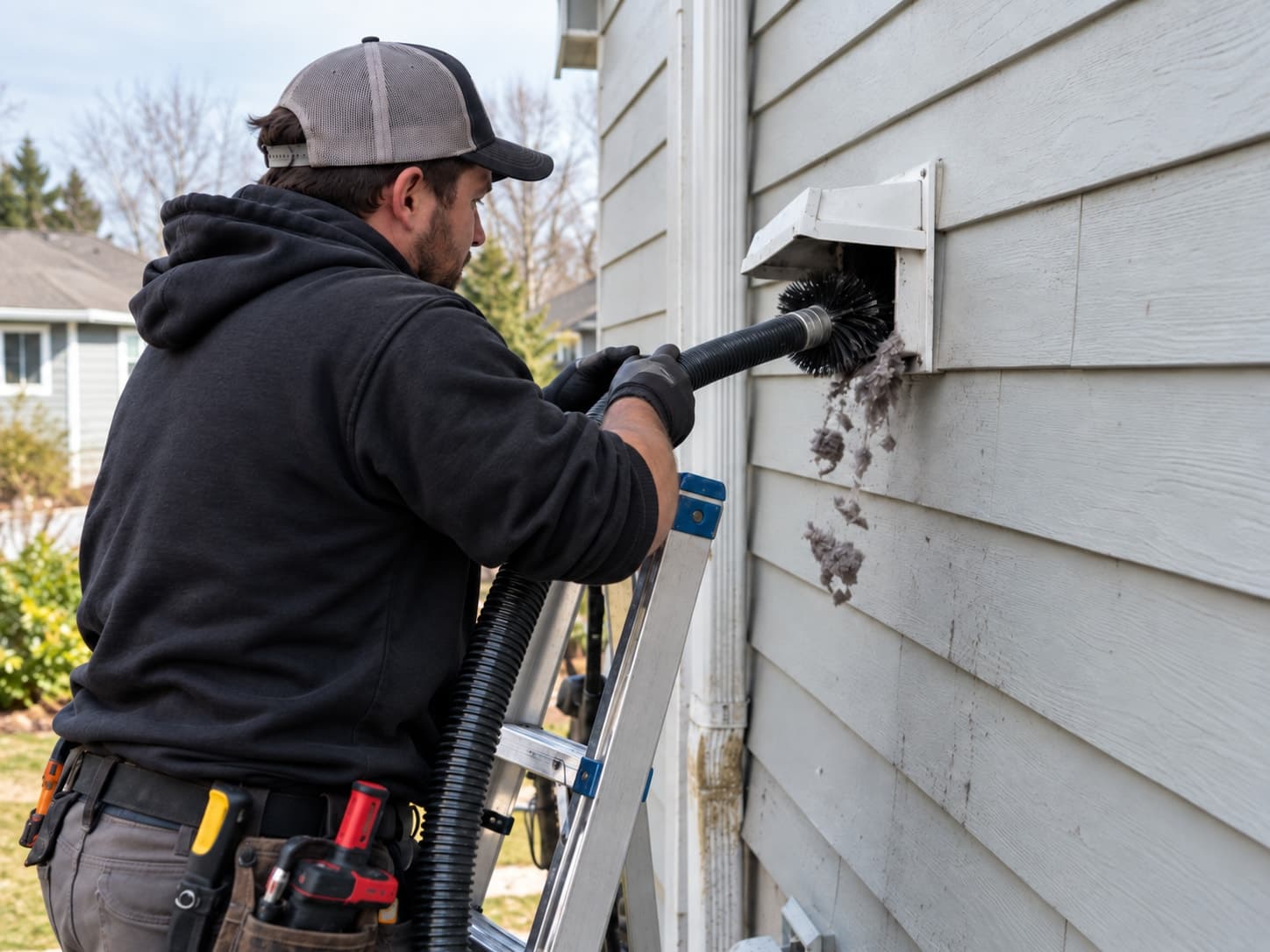
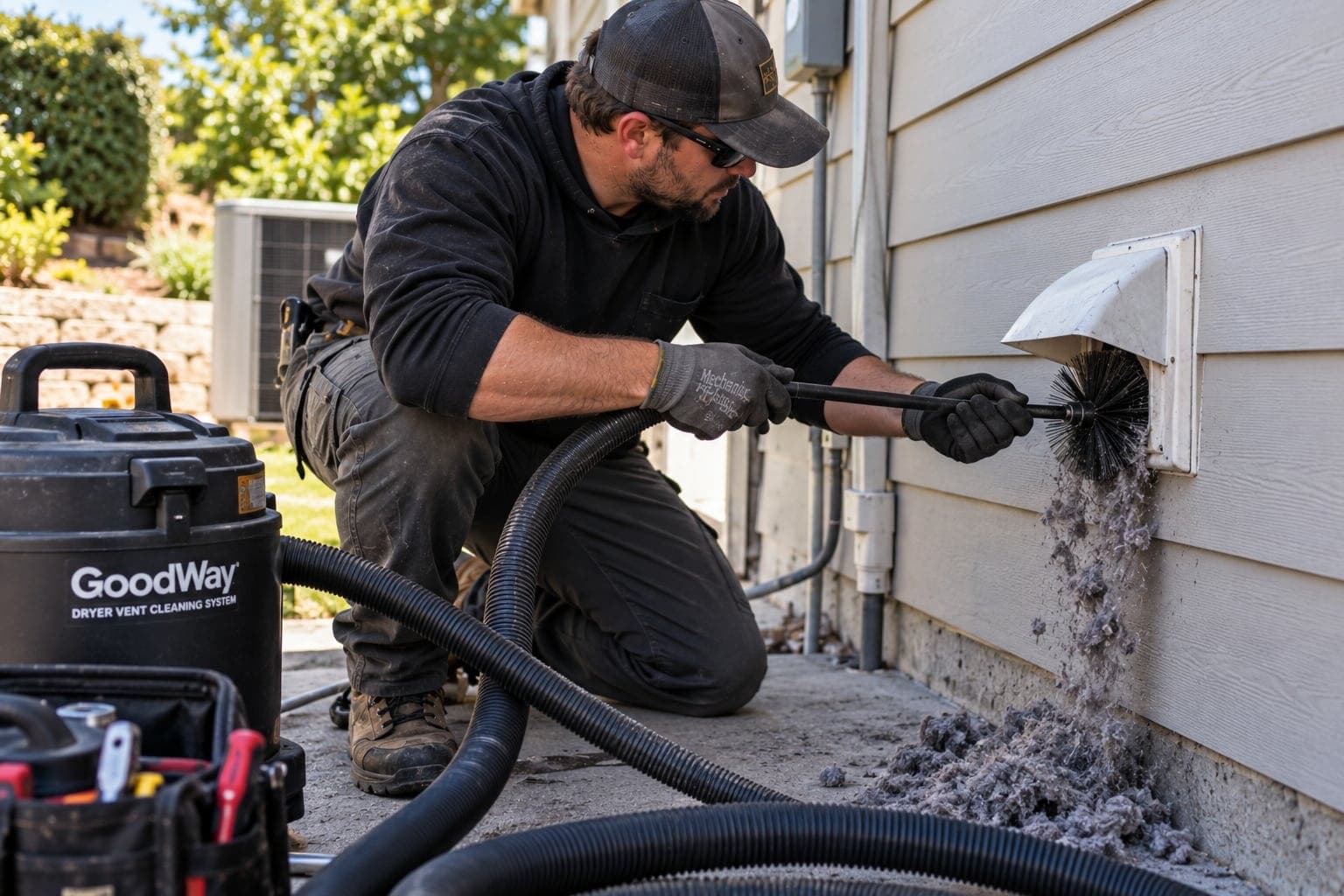
Owners of vacation rentals and long-term rental homes deal with the same dryer vent as any homeowner: a metal duct from the back of the dryer to a hood on the wall or a cap on the roof. What changes is how much the dryer is used, who is using it, and who notices when something goes wrong. The result is that rental vents often clog faster and get checked later than the one in the owner’s own house.
This page covers dryer vent cleaning for residential rentals: short-term and vacation homes, single-family rentals, and condo and townhome units. The cleaning itself is the same full-length brush-and-vacuum job with airflow checks described under standard dryer vent cleaning; what follows is about the parts that are different for owners and managers.
Scope
This service covers individual residential rental homes, condos and townhomes, one dryer vent at a time. Hotels, laundromats, commercial laundries and building-wide multifamily systems are outside it.
Why rental dryer vents clog faster
- Turnover laundry is lint-heavy. Every changeover means sheets, pillowcases, bath towels, beach towels and kitchen linens. Towels in particular shed a lot of fiber, and those loads tend to be large and back to back.
- Guests don’t know the house. A guest may never open the lint screen, may overload the drum, or may run a wet load twice rather than mention that drying is slow.
- Nobody lives with the symptoms. In a family home, someone notices when towels start taking two cycles. In a rental, each guest sees only a few days of it, and the cleaning crew is focused on turning the house over on time.
- Many rentals are two-story or townhome layouts. Laundry upstairs or in the middle of the unit often means a longer run or a roof termination, and longer runs collect more lint.
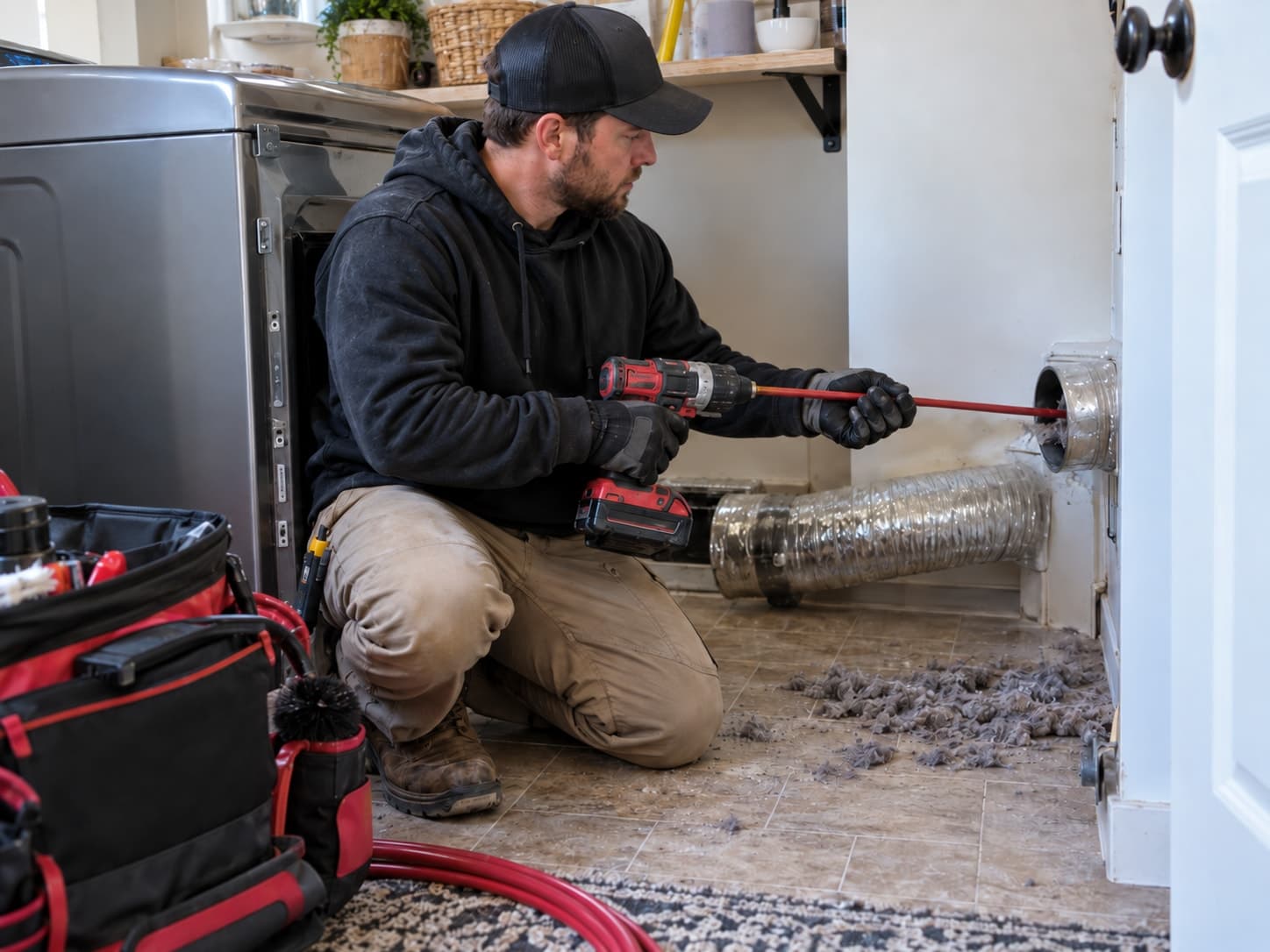
In the vacation-home communities around Kissimmee, Celebration and Lake Buena Vista, a single property can run several loads of linens at every checkout. That is the kind of use the typical “once a year” advice was never written for.
How often should a rental dryer vent be cleaned?
General safety guidance is to clean the lint out of the vent pipe once a year, or more often if clothes are taking longer than normal to dry (NFPA dryer safety tips, as published by the CSIA’s Dryer Safety site). The “or more often” part is what applies to most rentals. The right interval depends on how many loads the dryer actually runs and on the vent itself, so the table below is a way to think about it rather than a fixed rule.
| Property and use | Starting point | Shorten the interval if |
|---|---|---|
| Long-term rental, small household, short sidewall vent | The general once-a-year guidance | Tenants report longer drying times or the vent had heavy buildup at the last cleaning |
| Long-term rental, large household or daily laundry | Once a year at minimum, checked between tenancies | The run is long, goes to the roof, or has several elbows |
| Short-term rental with occasional bookings | At least once a year, timed with a quiet week | Occupancy increases or towels start coming out damp |
| Short-term rental booked most of the year | More often than once a year, based on what the previous cleaning found | The previous cleaning found heavy buildup, or the vent terminates on the roof |
The most reliable way to set the interval for a specific property is to look at what the last cleaning found. If the duct was heavily packed at twelve months, the next visit should come sooner; if it was light, the interval can stay. The guide on how often to clean a dryer vent explains the factors in more detail.
Scheduling cleaning between guest stays
Pick a real gap, not a back-to-back turnover
A vacant night or a blocked maintenance day avoids a technician working around the cleaning crew and a dryer full of linens. Ask how long the visit is expected to take for that specific vent, since roof terminations and long runs take longer.
Plan around the laundry, not just the booking
The dryer has to be pulled out and disconnected, so it can’t be mid-load. Schedule the cleaning before the turnover laundry starts or after it is finished.
Arrange access in advance
Share the door code or lockbox details, gate or guard-house instructions, parking rules and, for roof vents, any HOA rules about ladders or roof access.
Allow for the weather on roof vents
Roof caps can’t be serviced safely on a wet roof. In the summer wet season, a morning slot leaves room for afternoon storms, and a backup date helps.
Record the result
Note the date, what was found and any recommended follow-up in the property’s maintenance log before the next guests arrive.
Signs tenants and cleaners should report
The people who use the dryer every week are the early-warning system. A short list posted in the laundry area, or added to the cleaning crew’s checklist, turns vague complaints into useful reports.
Ask guests, tenants and cleaning crews to report
- Towels or sheets needing a second cycle, or coming out damp at the seams
- The dryer or laundry closet feeling much hotter than usual
- A burning or scorched smell while the dryer runs
- A “check vent” or airflow message on the dryer display
- Lint collecting around the outside hood or on the roof near the cap
- The outside flap not opening when the dryer is running
- A crushed or kinked hose behind the dryer, or lint on the floor behind it
- A musty or damp smell in the laundry area
A burning smell deserves an immediate response rather than a note for next month: the dryer should be taken out of use until it is checked. The article on dryer vent fire risk explains why lint and heat are a dangerous combination; in the NFPA’s analysis of home dryer fires for 2014–2018, failure to clean was a factor in about a third of them. The U.S. Fire Administration’s dryer safety flyer also recommends cleaning the lint filter before and after each cycle and making sure the outdoor vent covering opens when the dryer runs, both easy items to add to a turnover checklist.
Put the lint screen on the turnover checklist
Emptying the lint screen is the one habit that makes the biggest difference, and it is the one guests forget most. Adding “clean the lint screen, then check behind the dryer” to every turnover costs a minute and keeps more lint out of the duct.
Keeping a dryer vent maintenance log
A simple log is good practice for any owner, and more so when a management company, several cleaning crews or a series of tenants are involved. It shows when the vent was last cleaned, helps set the next interval, and gives you a record if an insurer, an HOA or a buyer ever asks about maintenance. A shared spreadsheet or a page in the property binder is enough. Useful columns:
- Date of cleaning or inspection, and who did it
- Where the vent ends (sidewall, roof) and roughly how long the run is
- How much lint was found, and any airflow readings you were given
- Parts replaced, such as the transition hose or the exterior vent cover
- Problems found but not yet fixed, with a target date
- Tenant, guest or cleaner reports about drying times or smells
Landlords and long-term rental homes
In a long-term rental, the practical window for dryer vent work is usually between tenancies, when the laundry area is empty and access is easy. It is also the right time to look at the transition hose, which tenants often replace or crush when they move their own dryer in and out. Check the lease for who is responsible for appliance and vent maintenance, and make the vent part of the move-in and move-out walkthrough.
If a tenant is bringing their own dryer, ask them to use a metal transition connector rather than vinyl or thin foil hose. Where the dryer is gas, remind them that the gas connection is work for a licensed professional.
Managing several rental properties
Owners and managers with more than one home get the most from treating dryer vents as a portfolio rather than one-off calls. A few habits make that easier:
- Rank properties by use, not address. The home booked most weeks, or with a roof termination, goes first; a lightly used long-term rental can stay on the annual cycle.
- Keep one log per property, so each vent’s interval is set from what its own last cleaning found.
- Note the termination type (sidewall, roof, association-maintained) in each property file, since it decides access, weather limits and visit length.
- Group nearby homes into one trip where vacancies line up, rather than booking each one separately.
The dryer vent guide for vacation rentals has a turnover-checklist version of this for cleaning crews and managers. Larger buildings and associations with many units are covered under commercial and multi-unit services.
Condos, townhomes and HOA-managed vents
In condos and townhomes, the dryer duct often passes through shared walls or ceilings to a termination on an exterior wall or roof that the association maintains. Before booking a cleaning, it helps to find out:
- Whether the association or the owner is responsible for the duct and the exterior termination
- Whether roof access requires association approval, a certificate of insurance or specific hours
- Whether the association already schedules vent cleaning for the building, so you don’t pay twice
- Where the unit’s vent actually ends, since several terminations on one wall or roof can be hard to tell apart
When the termination is on the roof of a townhome, the cap is serviced from the roof as described on the roof dryer vent cleaning page, subject to whatever access rules the association sets.
Buying or taking on a rental property
When you buy a rental or take over management of one, you usually inherit a dryer vent with no history. A dryer vent inspection with airflow testing establishes a baseline: where the vent goes, whether it is connected all the way out, whether it is a reasonable length, and whether the connector and cover are the right type. From there, the cleaning interval can be set on facts rather than guesses.
What affects the cost for rental properties
- Sidewall or roof termination, and roof height and material
- Length of the run and number of elbows
- How much lint has built up since the last cleaning
- Access arrangements, gated communities and HOA roof rules
- Transition hose or exterior cover replacement on the same visit
- Scheduling several properties on one trip
Chimneys and fireplaces in the same properties
Most of the portfolios we clean dryer vents for also have fireplaces, and they raise a separate problem: a guest or tenant will try to light one at some point, whatever the house rules say.
Doing both on one visit is the practical answer, because the expensive part of a rental visit is getting access to an occupied or turning-over property rather than the work itself. Chimney and fireplace service for rental portfolios, HOAs and management companies is covered on commercial and rental property chimney services.
Work is scheduled into turnover windows across Kissimmee, Davenport, Celebration, Four Corners and the rest of the cities we serve, with consolidated invoicing to the manager and free estimates across the portfolio.
References (3)
Facts and figures on this page come from these references.