On this page
- What annual service covers
- Carbon monoxide alarms
- Vent-free (ODS) fireplaces: the basics
- Gas logs in a wood-burning fireplace
- Pilot on or off in the Florida off-season?
- Ready before the first cold front
- Barrier screens and hot glass
- Ember media, logs and the look of the flame
- Blowers, remotes and the parts that fail with age
Service or repair?
This page is for a fireplace that works and is due for its yearly cleaning and check. If yours won’t light, won’t stay lit, shuts off or is sooting heavily, book a gas fireplace repair visit instead. If you smell gas strongly, leave the house and call your gas utility or 911 from outside.
Gas fireplaces are low-maintenance, not no-maintenance. In Central Florida they often sit for months between uses, which gives dust, lint, spiders and insects time to settle into the pilot and burner, and gives wasps time to build in the vent cap outside. An annual service deals with that before the season instead of in the middle of it.
NFPA 211 calls for chimneys, fireplaces and vents to be inspected at least once a year, and most gas fireplace manufacturers recommend yearly service by a qualified technician in their manuals.
| Feature | Gas fireplace service | Gas fireplace repair |
|---|---|---|
| Starting point | The fireplace lights, stays lit and responds to the remote or switch | Something has stopped working or is behaving oddly |
| Main work | Cleaning, resetting, testing and inspecting | Finding the failed part and replacing or correcting it |
| Parts | Usually none; worn items are noted | The failed component, ordered for your model |
| When to book | Once a year, ideally early fall | When the symptom appears |
Starting point
- Gas fireplace service
- The fireplace lights, stays lit and responds to the remote or switch
- Gas fireplace repair
- Something has stopped working or is behaving oddly
Main work
- Gas fireplace service
- Cleaning, resetting, testing and inspecting
- Gas fireplace repair
- Finding the failed part and replacing or correcting it
Parts
- Gas fireplace service
- Usually none; worn items are noted
- Gas fireplace repair
- The failed component, ordered for your model
When to book
- Gas fireplace service
- Once a year, ideally early fall
- Gas fireplace repair
- When the symptom appears
If a service visit turns up a failed part, it is explained as a separate recommendation. If the unit is already misbehaving, go straight to troubleshooting and repairing the fireplace. Units that are past economical repair are covered under replacing a gas fireplace.
Signs a working gas fireplace is due for service
- It hasn’t been cleaned or checked in the last year, or you don’t know when it last was
- White or grey film is building on the inside of the glass
- The flame looks smaller, lazier or more orange than it used to
- A faint odor lingers past the first few minutes of the season’s first fire
- The pilot takes a few tries to light after being off all summer
- Wasps, vines or plants are near the outside vent cap
- You’ve just bought the home and have no service history
What annual service covers
- Glass removed, cleaned of film and checked for cracks
- Glass gasket and frame checked on sealed units
- Logs, embers and media cleaned and set per the manufacturer’s diagram
- Burner ports and pilot assembly cleaned
- Thermocouple or thermopile checked and output measured
- Ignition, valve operation, wall switch and remote tested
- Flame appearance checked through a full burn
- Vent run and outside termination inspected for nests and damage
Glass and that white film
The cloudy white or gray film on the inside of the glass is a normal combustion deposit that builds up with use. Left for seasons, it can etch into the glass and becomes hard to remove. It is cleaned with a product approved by the manufacturer; general household glass cleaners are not what manuals recommend. On direct-vent units, the gasket is checked while the glass is out, because the glass is part of the sealed system. Why gas fireplace glass goes cloudy covers the causes in more detail.
Log and ember placement
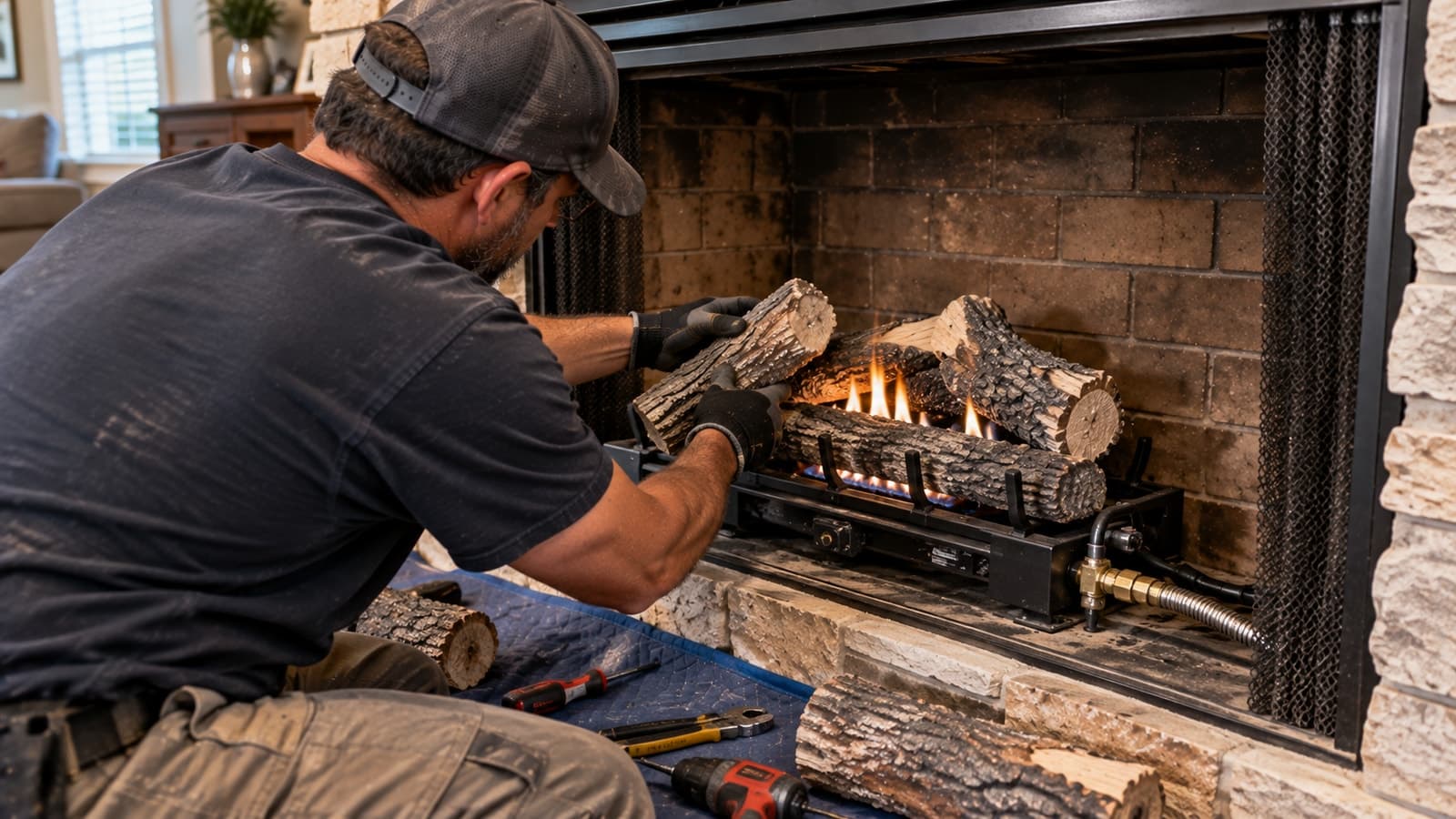
Gas logs look random but aren’t. Each set has a placement diagram, and a log that has been bumped a few inches can sit in the flame path, causing soot, a lazy yellow flame and odor. Ember material and glowing media are also placed only where the manual says. Worn, cracked or crumbling logs are noted for replacement.
Burner and pilot cleaning
A small pilot flame depends on a tiny orifice and a clean pilot hood. Dust, lint and spider webs are among the most common reasons a pilot burns weak, and a weak pilot doesn’t heat the thermocouple or thermopile enough. Cleaning the pilot assembly and burner ports, then measuring the sensor output, catches most off-season problems before they turn into a no-start.
Venting and termination
Outside, wasps, mud daubers and birds like the shelter of a vent termination, especially one that hasn’t had hot exhaust through it for months. We also look for plants, vines and new structures crowding the cap, storm damage on roof terminations and rust or separated sections where the vent is visible. A blocked termination can make a direct-vent fireplace soot up or shut itself off.
Carbon monoxide alarms
Any home with a fuel-burning appliance, gas fireplace included, should have working carbon monoxide alarms. A good general practice is an alarm on each level and outside sleeping areas, tested regularly and replaced when the manufacturer says the sensor has reached end of life. An alarm is not a substitute for service, and service is not a substitute for an alarm.
Vent-free (ODS) fireplaces: the basics
Vent-free fireplaces and logs have no flue; they release combustion products into the room. Their key safety device is the oxygen depletion sensor (ODS), a special pilot that shuts the gas off if the oxygen level in the room drops. A dusty or dirty ODS pilot can shut the unit off early or fail to work as intended, so cleaning it is a central part of vent-free service.
Follow the manual’s limits on room size and run time, and keep a window cracked if the manual calls for it. Vent-free units also add water vapor to the room, which is worth knowing in an already humid climate. Unvented gas logs may only go in a factory-built fireplace that is listed for them (FBC-R R1004.4).
Gas logs in a wood-burning fireplace
A vented gas log set sits in a masonry or factory-built wood fireplace and uses its chimney. Servicing one covers the burner pan, log placement and pilot like any gas unit, plus the parts a sealed fireplace doesn’t have: the chimney flue and cap, and the damper. Vented log sets need the damper held open, often with a clamp or stop, so exhaust can’t spill into the room. That clamp is checked every visit, because a damper that has been closed by mistake is a carbon monoxide risk. The chimney itself is looked at as part of a chimney inspection when it hasn’t had one recently. If you’d rather have a sealed unit than open-damper logs, a direct-vent gas insert is the usual upgrade.
Pilot on or off in the Florida off-season?
This applies to units with a standing pilot; many newer fireplaces use intermittent ignition and have no pilot burning between uses. For standing-pilot units, both choices are reasonable. Here is the trade-off:
| Feature | Leaving the pilot on | Turning the pilot off |
|---|---|---|
| Gas use | Burns a small amount of gas all the time | No gas used while off |
| Heat in the house | Adds a little heat to the firebox and room during AC season | None |
| Pests and debris | A warm, running pilot tends to discourage spiders and insects from nesting in it | An idle pilot assembly can collect webs and debris over the summer |
| Fall start-up | Ready to use | Needs relighting using the unit’s lighting instructions |
Gas use
- Leaving the pilot on
- Burns a small amount of gas all the time
- Turning the pilot off
- No gas used while off
Heat in the house
- Leaving the pilot on
- Adds a little heat to the firebox and room during AC season
- Turning the pilot off
- None
Pests and debris
- Leaving the pilot on
- A warm, running pilot tends to discourage spiders and insects from nesting in it
- Turning the pilot off
- An idle pilot assembly can collect webs and debris over the summer
Fall start-up
- Leaving the pilot on
- Ready to use
- Turning the pilot off
- Needs relighting using the unit’s lighting instructions
Whichever you choose, follow your manual’s shut-down and lighting instructions. If the pilot has been off all summer and won’t relight or won’t stay lit in the fall, that is a sign the pilot assembly needs cleaning; the pilot light guide explains why.
Ready before the first cold front
Orlando’s dry season typically starts in mid-October, according to NWS Melbourne, and January lows average around 52 °F (CurrentResults). That leaves only a handful of truly cool evenings, and a lot of fireplaces get switched on for the first time on the same night. Early fall is the best time for service, before the first cold front.
Quick pre-season checks you can do
- Replace batteries in the remote, receiver and any battery backup
- Test your carbon monoxide alarms
- Look at the outside vent cap for nests or plants growing over it
- Clear anything stored in front of or on top of the fireplace
- Read the lighting instructions before you need them
A faint smell the first time the fireplace runs each season is often dust burning off the burner and logs, and it should clear quickly. A smell that doesn’t clear, or a smell of gas, is different: see what to do if the fireplace smells like gas.
How a service visit goes
Check the unit
Model and fuel type from the rating plate, and a short run to see how it lights and burns before anything is touched.
Clean
Glass, logs, burner, pilot assembly and firebox cleaned; logs and embers reset to the diagram.
Test
Sensor output, ignition, switch and remote tested; flame checked through a full burn with the glass back on.
Inspect the venting
Vent run and termination checked inside and out, including for nests.
Report
The findings are explained. Anything that needs repair is explained as a separate recommendation, not done without your approval.
Between visits, the owner-side routine (batteries, glass, what not to touch) is covered in the gas fireplace maintenance guide. Gas-line work is a separate job from appliance service, and we carry that out too.
Barrier screens and hot glass
The glass front of a running gas fireplace gets hot enough to cause a serious contact burn, and it stays hot for a long time after the unit is switched off. Since 2015, gas fireplaces manufactured to the current standard have shipped with a barrier screen fitted in front of the glass for exactly that reason.
Two things go wrong with them. On older units there was never a barrier in the first place, and retrofit screens are available for many models. On newer ones the screen gets taken off — usually during cleaning or a house move — and never goes back.
Checked on the screen and glass at a service visit
- Whether a barrier screen is fitted and correctly seated
- Whether a retrofit barrier exists for an older unit that has none
- Glass condition: chips, scratches or clouding that will not clean off
- The gasket around the glass, which hardens and shrinks with heat cycling
- Clips and retaining hardware, which loosen over time
- Whether the glass has been refitted correctly after previous work
Homes with young children or anyone unsteady on their feet are the ones where this matters most. If your unit has no barrier, ask about it at the service visit rather than assuming nothing is available.
Ember media, logs and the look of the flame
The glowing material around the burner is not decoration in the loose sense — it is part of how the appliance was tested, and where it sits changes how the flame behaves.
Rock wool and ember chips break down and pack flat over a few seasons, which dulls the glow and can start to obstruct burner ports. Glass media and stones on a modern linear unit can drift out of position and sit over the ports. Ceramic logs shift, and a log resting where the flame wants to be is the most common single cause of a gas fireplace producing soot.
Replacing and repositioning media to the manufacturer's layout is part of a service. On a log set it is the difference between clean combustion and black deposits on the back wall, which is covered further on the gas log installation page.
Blowers, remotes and the parts that fail with age
What tends to need attention, and when
01Thermopile or thermocouple output dropping
- What you may notice
- The pilot lights and holds, but the main burner will not come on, or drops out after a while.
- How it’s confirmed
- Output is measured rather than guessed at. These weaken gradually, which is why the fault looks intermittent before it becomes permanent.
02Pilot assembly drifting or clogging
- What you may notice
- A lazy or noisy pilot, or one that will not reliably light.
- How it’s confirmed
- Cleaned and repositioned to the right relationship with the sensor. A spider web in the pilot tube is a genuinely common cause after an idle summer.
03Blower noisy or not running
- What you may notice
- A rattle or hum when the fireplace warms up, or no air movement at all.
- How it’s confirmed
- Bearings and the speed control are checked, and the blower housing cleared of dust that has baked on over the off-season.
04Remote receiver failing
- What you may notice
- The handset works intermittently, or only very close to the unit.
- How it’s confirmed
- Batteries first, then the receiver, which sits in the control cavity and gets cooked by heat over the years.
05Burner ports partially blocked
- What you may notice
- Flame missing along part of the burner, or lighting unevenly across it.
- How it’s confirmed
- Ports cleared and the flame pattern watched across the full burner once it is up to temperature.
06Corrosion under the burner
- What you may notice
- Rust flakes in the firebox, or staining below the burner pan.
- How it’s confirmed
- Usually means water has been getting in from above. The chimney or termination gets checked too, or a new burner goes the same way.
The units themselves vary a great deal in what parts are still available. Where a model is old enough that a valve or ignition module is no longer made, that is worth knowing at the service visit rather than after a week of chasing suppliers — our guide to identifying your fireplace make explains how the model is found and which makes still have parts.
Annual service is available across Orlando, Winter Park, Lake Nona, Kissimmee, Oviedo and the rest of the Central Florida service area, and estimates are free. Autumn is the sensible month: everyone calls in the same fortnight once the first cold front arrives.
References (5)
Facts and figures on this page come from these references.
- 1NFPA 211: Standard for Chimneys, Fireplaces, Vents, and Solid Fuel-Burning Appliances
- 2NWS Melbourne: The Florida Rain Machine (wet and dry season dates)
- 3Orlando weather averages (CurrentResults, NCEI normals)
- 4Florida Building Code, Residential 2023, Chapter 10 (R1004.4) (UpCodes)
- 5Florida Statutes § 489.105 (contractor categories, including gas work)