The short answer
A booster fan makes sense when a dryer duct is longer than the dryer can push through and there is no practical way to shorten it. It must be a unit listed to UL 705 for dryer exhaust, installed exactly as its maker specifies. Where the run can be shortened, straightened or moved to a closer wall, that is usually the better fix, because it removes the restriction instead of adding a machine to overcome it.
What a dryer booster fan is
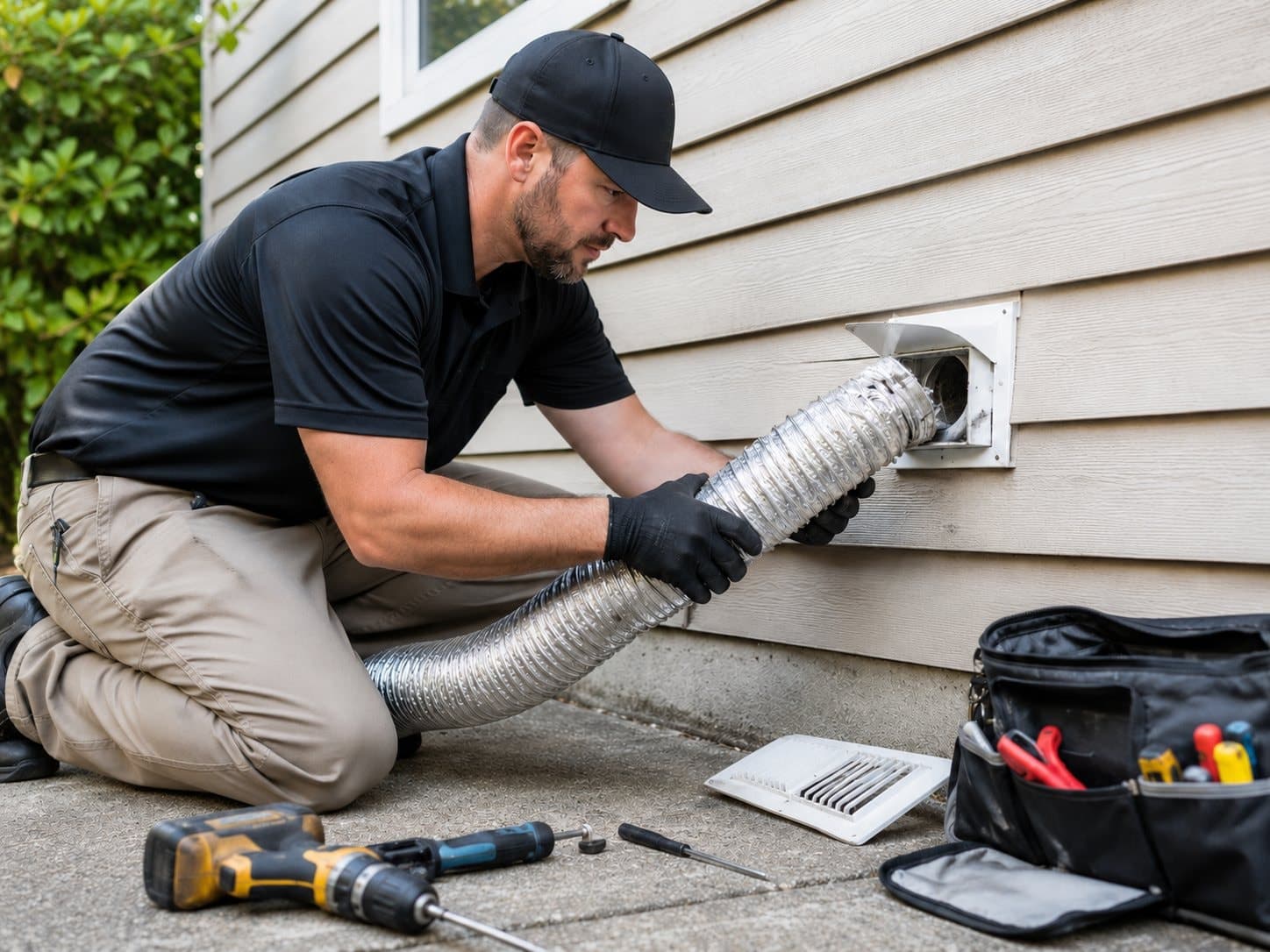
The code’s name for it is a dryer exhaust duct power ventilator (often shortened to DEDPV). It is an inline fan built into the dryer duct, usually a few feet or more downstream of the dryer, that adds suction so the exhaust keeps moving over a long or winding run. It is not the same as a general-purpose inline fan of the kind sold for bathroom or general ventilation, even if it looks similar.
Residential units are typically designed to switch on by themselves when they sense the dryer running, rather than being wired to the dryer. As an example of how they work, one manufacturer’s reference guide describes pressure and temperature sensors that sync the fan with the dryer, a status panel that confirms the fan is running and alerts to duct blockage, fan failure or excessive exhaust temperature, and a fan that shuts itself off if temperatures get too high (Tjernlund Dryer Duct Booster reference guide). Features differ by model, so the installation manual for the specific unit is what matters.
What Florida’s code requires
The Florida Building Code, Residential (2023) addresses booster fans in three places in Section M1502 (FBC-R 2023 via UpCodes):
| Section | Rule | In practice |
|---|---|---|
| M1502.4.4 | Domestic dryer exhaust duct power ventilators shall conform to UL 705 for use in dryer exhaust duct systems and be installed per the manufacturer’s instructions | Only a fan listed for dryer exhaust qualifies, and its installation manual becomes part of the requirement |
| M1502.4.5.3 | Where a power ventilator is used, the maximum duct length is determined by the ventilator manufacturer’s instructions | The fan maker, not the 35-foot table, sets how long the run may be |
| M1502.4.8 | Domestic booster fans shall not be installed in dryer exhaust systems | A general household inline fan is prohibited in a dryer duct |
The distinction between a listed power ventilator and a “domestic booster fan” is the whole point. A fan built for bathroom air isn’t designed for hot, lint-laden, moist dryer exhaust, and lint can build up on its blades and motor. The rest of M1502 still applies to a boosted run: smooth metal duct, no screws, a damper and no screen at the termination, and a permanent label near the dryer if the equivalent length exceeds 35 feet. Our Florida dryer vent code guide covers those rules in full.
When a fan makes sense, and when to reroute instead
| Feature | UL 705 booster fan | Shorten or reroute the duct |
|---|---|---|
| Best for | Runs that can’t be shortened: interior laundry rooms, upper floors far from an outside wall, condos with a fixed termination | Runs where a closer wall, a straighter path or fewer elbows is available |
| What it fixes | Adds airflow to overcome length and fittings | Removes the restriction itself |
| Moving parts | A motor, sensors and controls that can fail | None |
| Power | Needs a nearby outlet or circuit, per the maker’s instructions | None |
| Ongoing upkeep | The fan needs periodic inspection and cleaning, and the duct still needs cleaning | Normal duct cleaning only |
| Construction work | Usually limited to the fan location and access to it | Can involve drywall, exterior finishes or roofing |
| Code basis | M1502.4.4 and M1502.4.5.3 | M1502.4.5.1 (35 feet with fitting deductions) or M1502.4.5.2 (dryer maker’s length) |
Best for
- UL 705 booster fan
- Runs that can’t be shortened: interior laundry rooms, upper floors far from an outside wall, condos with a fixed termination
- Shorten or reroute the duct
- Runs where a closer wall, a straighter path or fewer elbows is available
What it fixes
- UL 705 booster fan
- Adds airflow to overcome length and fittings
- Shorten or reroute the duct
- Removes the restriction itself
Moving parts
- UL 705 booster fan
- A motor, sensors and controls that can fail
- Shorten or reroute the duct
- None
Power
- UL 705 booster fan
- Needs a nearby outlet or circuit, per the maker’s instructions
- Shorten or reroute the duct
- None
Ongoing upkeep
- UL 705 booster fan
- The fan needs periodic inspection and cleaning, and the duct still needs cleaning
- Shorten or reroute the duct
- Normal duct cleaning only
Construction work
- UL 705 booster fan
- Usually limited to the fan location and access to it
- Shorten or reroute the duct
- Can involve drywall, exterior finishes or roofing
Code basis
- UL 705 booster fan
- M1502.4.4 and M1502.4.5.3
- Shorten or reroute the duct
- M1502.4.5.1 (35 feet with fitting deductions) or M1502.4.5.2 (dryer maker’s length)
Before choosing a fan, it is worth checking whether a smaller change would bring the run within the limit. Replacing tight elbows with long-radius ones can recover a surprising amount of equivalent length, as the worked example in the code guide shows. Moving a roof termination to a sidewall, or taking a more direct route across the attic, may remove the need for a fan altogether. That comparison is the core of rerouting a dryer vent.
A fan is not a fix for a damaged duct
If airflow is weak because a duct is crushed, disconnected in the attic, packed with lint or capped with a screen, a booster fan won’t solve it, and it can hide the symptom while the fault stays in place. Those problems call for a full duct cleaning or duct repair first.
Drawbacks to plan for
- Lint on the fan. Some lint passes the dryer’s screen, and some of it can collect on the fan wheel and housing. Some units are designed to shed lint, but any fan in a dryer duct still needs to be looked at periodically.
- Maintenance access. The fan must be reachable for service, which is harder when it sits in an attic or a closed soffit. Plan the location with cleaning in mind.
- Sensors and pressure switches. Automatic activation depends on sensing the dryer. A sensor tube clogged with lint, or a switch out of adjustment, can leave the fan off while the dryer runs, and the dryer then has to push through a stopped fan.
- Noise and vibration. A fan mounted to framing can transmit hum or vibration into the house. Isolated mounts help.
- Power and failure. A fan needs electricity, and like any motor it can fail. A status panel or alarm, where the model has one, is worth putting somewhere you will actually see it.
- Gas dryers. A gas dryer’s exhaust contains combustion products, including carbon monoxide. Confirm the fan is approved for gas dryers, keep working CO alarms in the home, and don’t ignore a fan failure warning.
One manufacturer’s guide, for example, says its fan should be installed no closer than 2 feet from the exterior hood, with a minimum distance from the dryer that grows as the run gets longer. Details like these vary by model, which is why the code ties the installation to the maker’s instructions.
Cleaning a dryer vent that has a booster fan
What cleaning a boosted run involves
Find the fan and cut its power
The fan is unplugged or switched off at its disconnect before any work, so it can’t start while the duct is open.
Clean the duct in sections
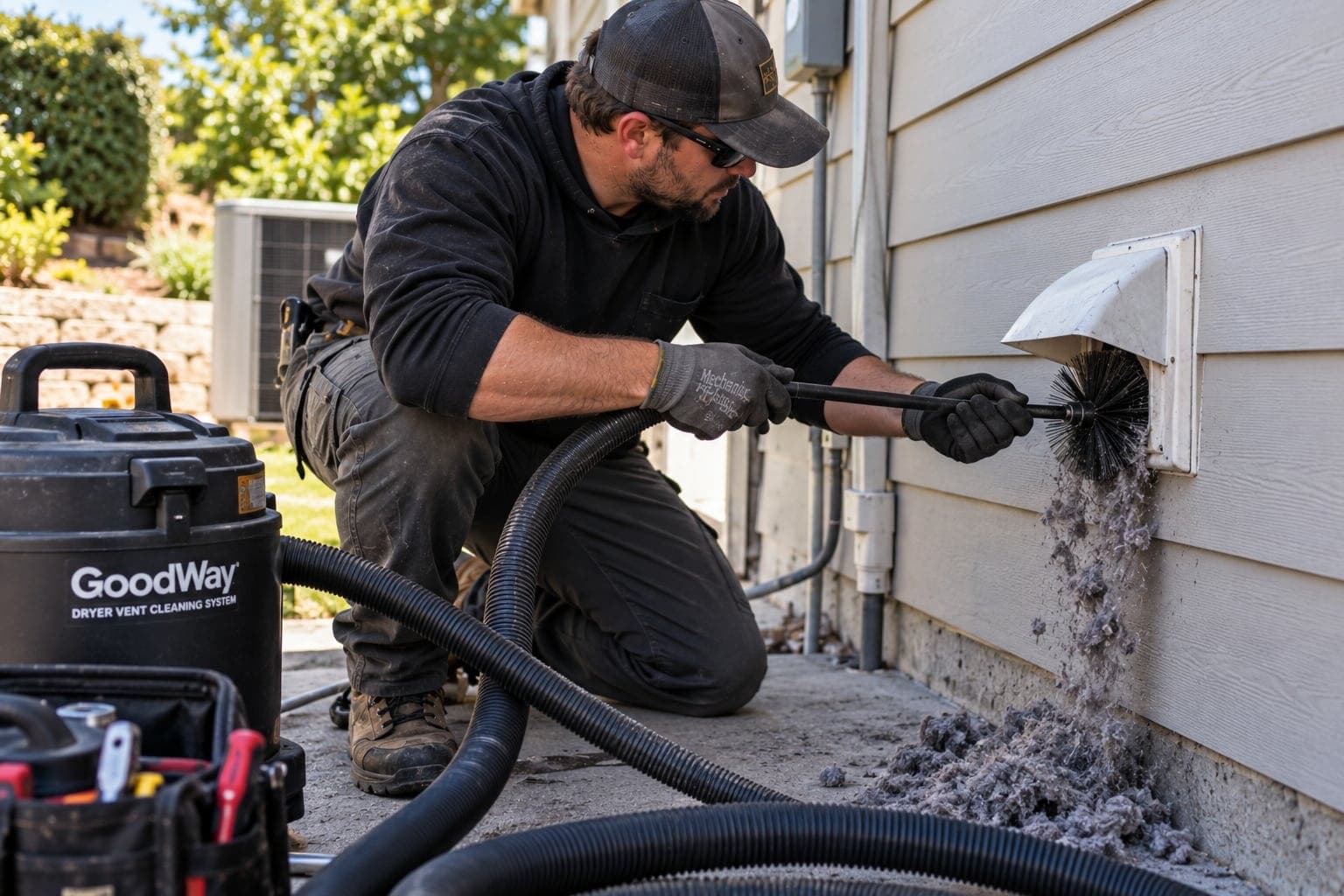
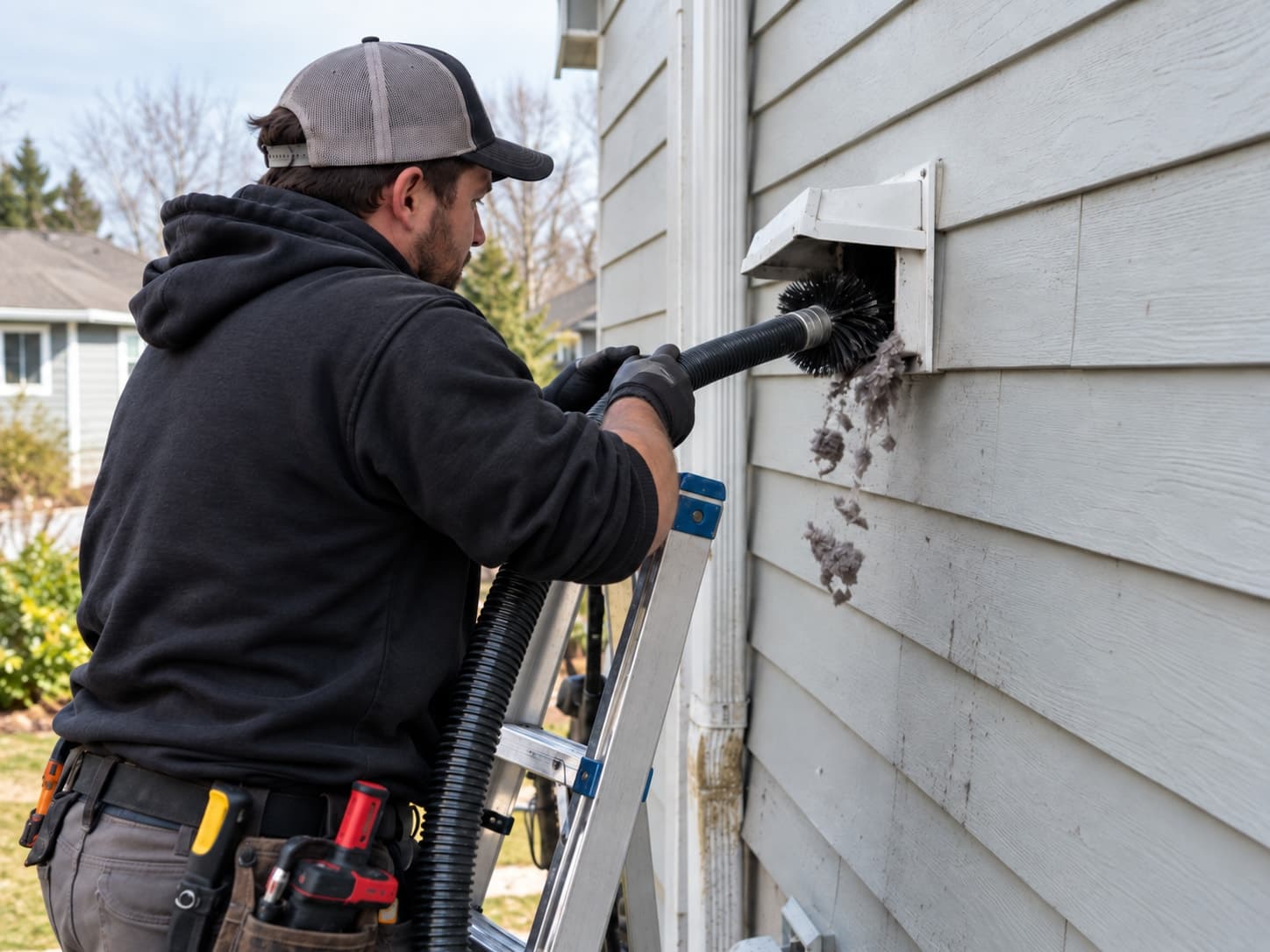
A rotary brush can’t pass through a fan housing, so the duct is cleaned on each side of the fan: from the dryer end to the fan, and from the fan to the termination, with the loosened lint vacuumed out.
Inspect and clean the fan itself
The fan wheel and housing are checked for lint and cleaned as the maker’s manual describes. Any sensor tube or port is checked for lint.
Check the termination
The damper is confirmed to open and close freely, with no screen. On a roof vent, the cap is cleared as well.
Restore power and test
With the dryer running, confirm the fan starts on its own, the status indicator (if any) shows normal operation, and there is strong airflow at the termination.
Because a boosted run is long by definition, it usually benefits from being checked more often than a short sidewall vent. Our guide to dryer vent cleaning intervals explains how to set one. If lint keeps building up quickly even with the fan working, the recurring clog symptom page lists the other causes to rule out.
If a booster is already installed and acting up, a booster fan that isn’t working covers the checks, and a clogged roof dryer vent covers the long runs that usually need one. Rental properties with boosted runs are common around the attractions; dryer vent cleaning around Kissimmee describes that housing.
References (2)
Facts and figures on this page come from these references.