What efflorescence is
Brick, mortar and the concrete in a chimney crown all contain some water-soluble salts. When rain soaks into the masonry, it dissolves those salts and carries them outward. At the surface the water evaporates and the salts stay behind as a white, powdery or crystalline film. The Brick Industry Association describes efflorescence as normally harmless and water-soluble, and says it needs two things at once: soluble salts and enough water to dissolve and move them (BIA Technical Note 23A).
That second condition is why efflorescence matters on a chimney. On brickwork less than about a year old it is often “new building bloom” from construction water and fades on its own. When it appears on an established chimney that used to be clean, BIA says it usually means a new source of water has reached the masonry.
Is it efflorescence, lime run, mold or paint?
Not every white mark is efflorescence, and the difference changes what you do next. BIA’s guide to brick stains notes that lime run and white scum are often mistaken for it (BIA Technical Note 23).
| What you see and feel | Likely deposit | Simple test | What it points to |
|---|---|---|---|
| Soft white powder or fluffy crystals, on brick faces or along mortar joints | Efflorescence | Brushes off dry; a damp cloth dissolves it. Returns after rain | Water soaking through the masonry |
| Hard, white or gray crust running down from a crack, joint or the crown edge | Lime run (calcium carbonate) | Won’t dissolve in water; feels like scale | A steady water path through a crack, often at the crown |
| Fuzzy, blotchy or smeared patches, sometimes gray or green, with a musty smell | Mold or mildew | Smears rather than brushes off; grows on paint, wood or dirt on the surface | Surface staying damp and shaded |
| Even white haze over a whole section, often after cleaning or new work | White scum or cleaner residue | Doesn’t brush off; not tied to wet areas | An earlier acid wash that wasn’t rinsed properly |
| Peeling or cloudy film on painted or sealed brick | Failing paint or sealer | Flakes off with a fingernail; may have powder behind it | Moisture trapped behind a coating |
What the location of the stain tells you
Where efflorescence shows up and the water source behind it
01Top courses, just under the crown
- What you may notice
- White bands on the upper brick, sometimes with lime run dripping from the crown edge.
- How it’s confirmed
- The crown is checked for cracks, missing overhang, a flat surface that holds water and an open joint around the flue tile.
02Along mortar joints over a wide area
- What you may notice
- White lines tracing the joints, sandy or recessed mortar, efflorescence heaviest on the side that faces the prevailing rain.
- How it’s confirmed
- Mortar joints are probed for gaps and softness to decide whether repointing is needed.
03Inside the firebox or smoke chamber
- What you may notice
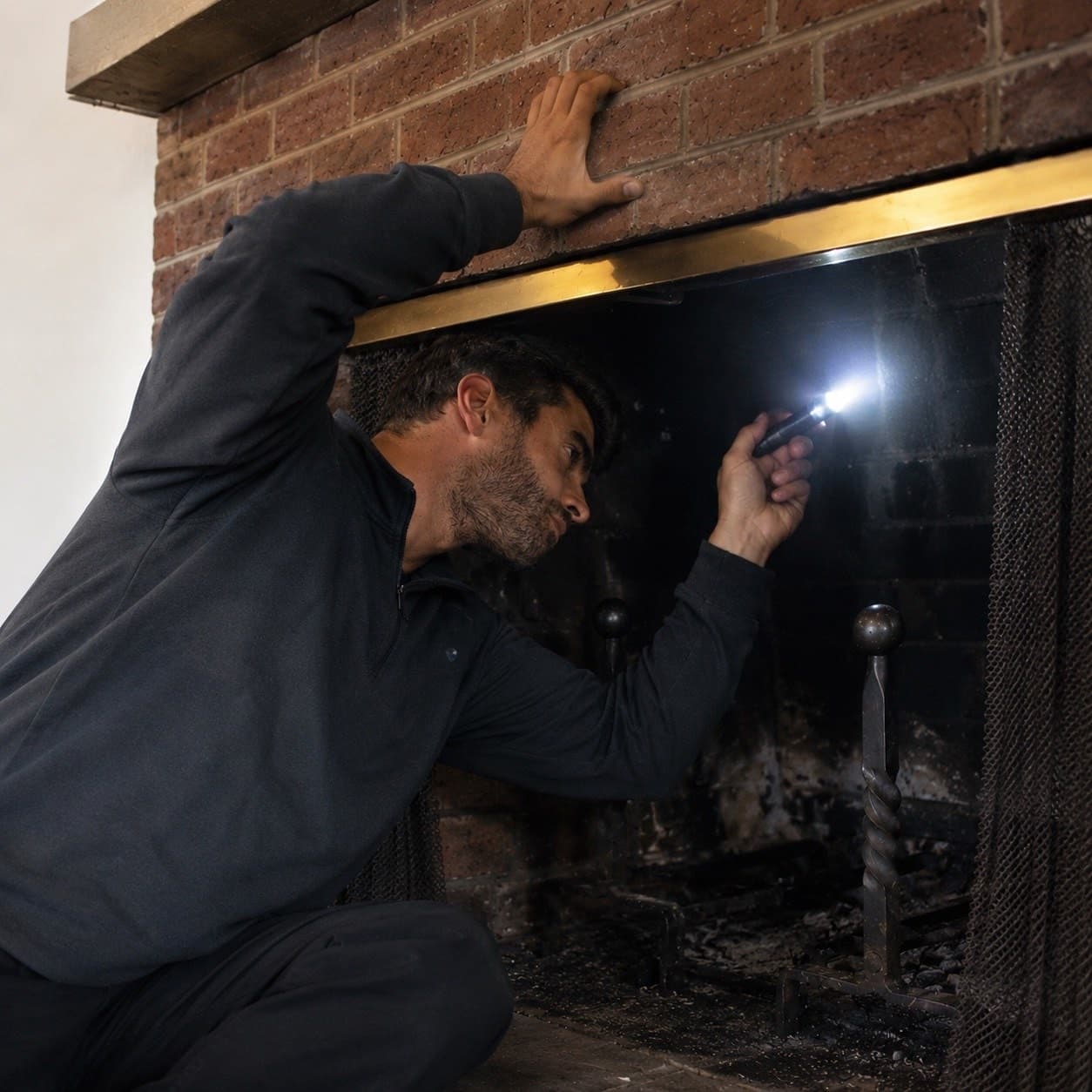
- White powder on the firebox walls, damper or smoke shelf, sometimes with rust on the damper and a damp smell.
- How it’s confirmed
- The cap, crown and flue are checked for water entering from the top, and the flue interior is looked at with a light.
04Chimney brick in the attic or near the roofline
- What you may notice
- White deposits on brick in the attic, just below where the chimney passes through the roof, sometimes with stained wood nearby.
- How it’s confirmed
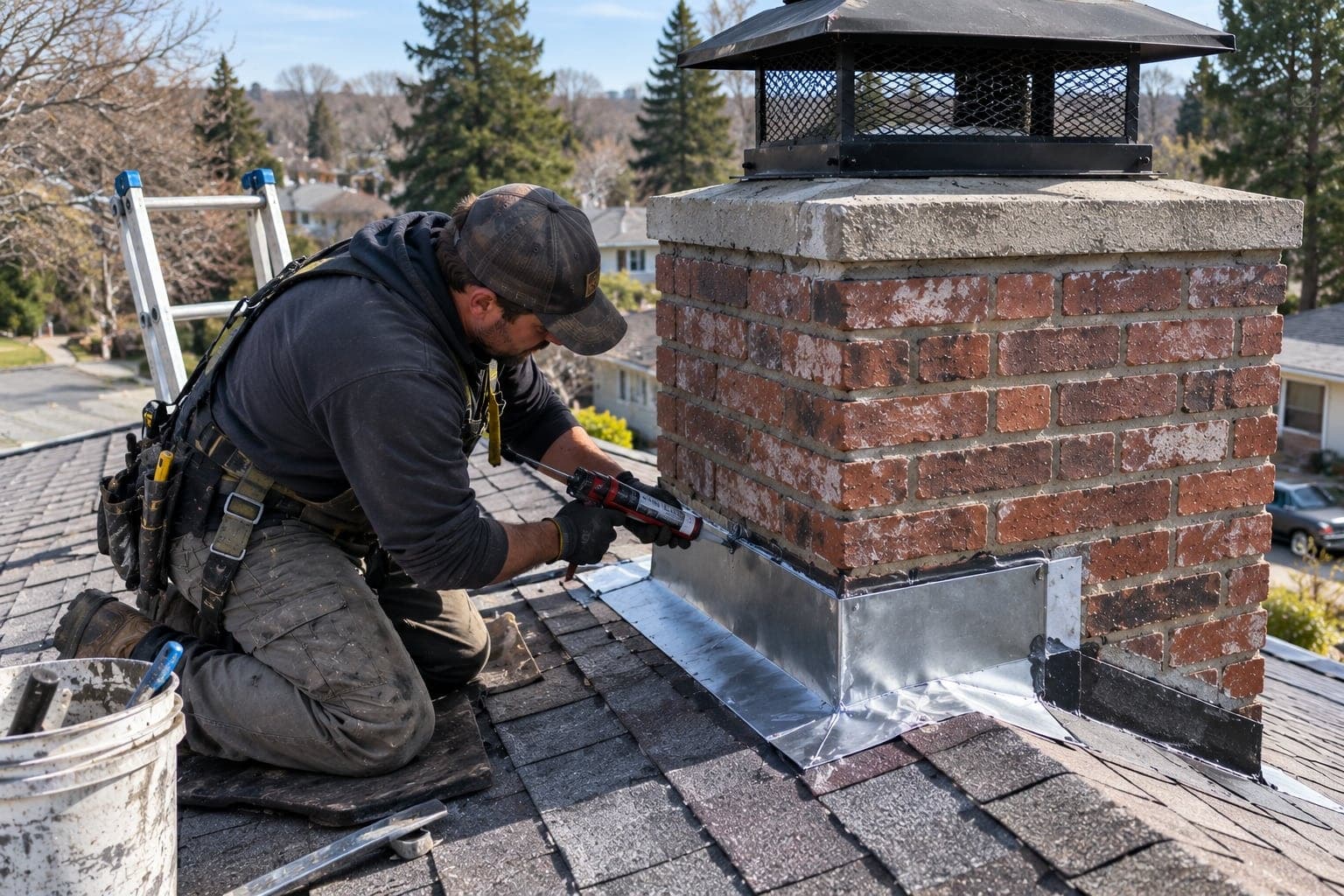
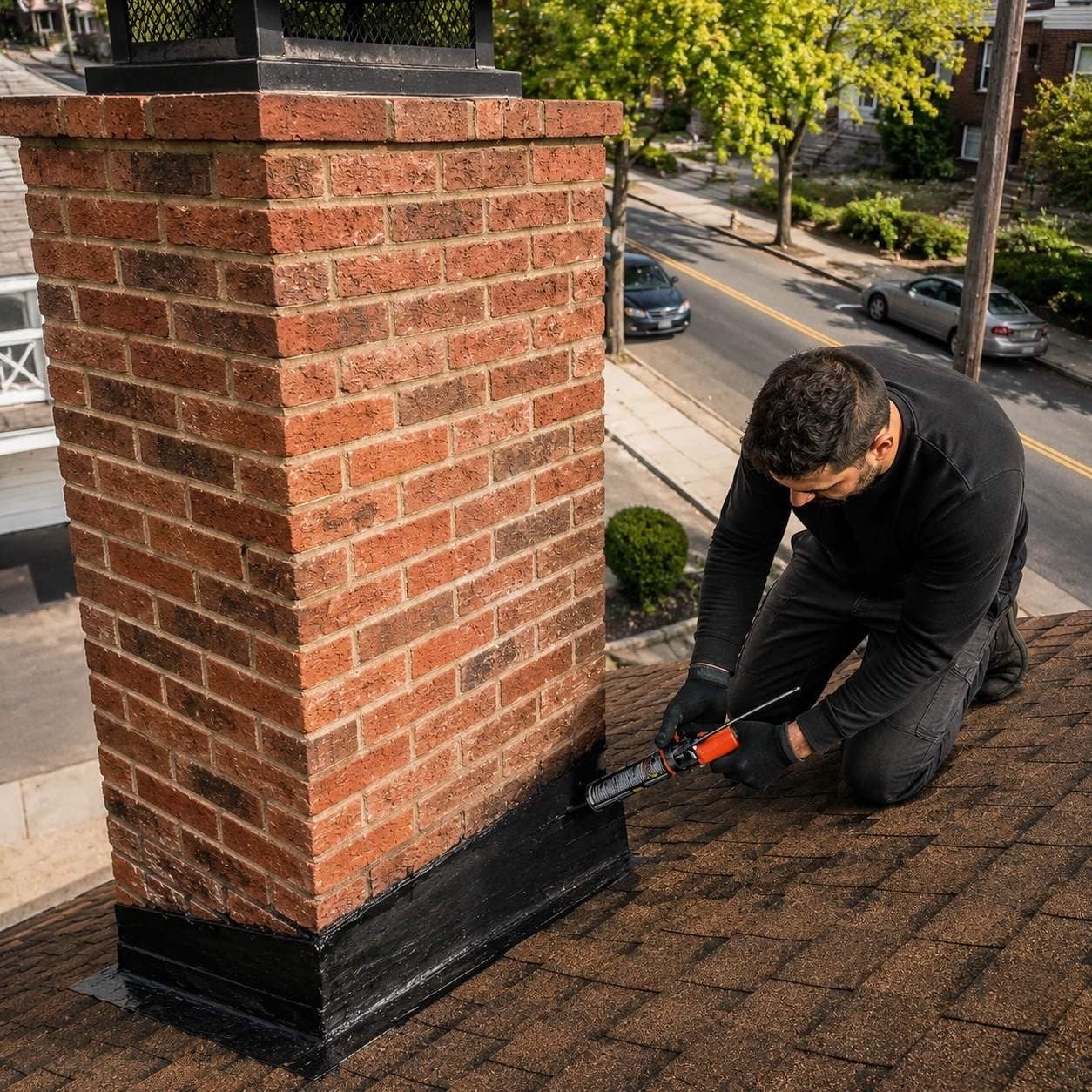
- Flashing and counter-flashing at the roofline are inspected, since water getting past them wets the brick below.
05Lower courses near the ground
- What you may notice
- White staining on the bottom few feet of brick, often where sprinklers hit or soil and mulch are piled against it.
- How it’s confirmed
- Comparing the pattern with irrigation and grade. Redirecting sprinklers is often the whole fix.
06Uniform bloom on a new or rebuilt chimney
- What you may notice
- Light, even white film in the first months after construction or major repair.
- How it’s confirmed
- Usually just watched. It generally fades with weathering if nothing else is wrong.
Masonry chimney and fireplace, cutaway
- 1Chimney cap. Metal lid with mesh sides over the flue opening. Keeps rain, debris and animals out.
- 2Crown. The concrete or mortar top of the masonry, sloped to shed water away from the flue.
- 3Flue liner. Clay tile or metal lining that carries smoke up and protects the masonry from heat.
- 4Flashing. Metal that seals the joint between the chimney and the roof.
- 5Brick & mortar. The chimney structure. Mortar joints and brick faces absorb water when they wear.
- 6Smoke chamber. The sloped transition that funnels smoke from the firebox into the flue.
- 7Damper. Metal plate at the throat (or a sealing lid on top) that closes the flue when not in use.
- 8Firebox. Where the fire burns. Firebrick laid in heat-resistant mortar.
- 9Hearth. Non-combustible floor extension in front of the fireplace opening.
How to clean efflorescence safely
In this order
Stop the water first
BIA recommends repairing the source of moisture and letting the brick dry before removing efflorescence. Cleaning a chimney that is still soaking just means cleaning it again next month.
Dry-brush
On a dry day, use a stiff natural-fiber or nylon brush. Avoid wire brushes: BIA warns that steel bristles can damage brick and leave particles that rust.
Only then, a little water
If powder remains, brush with a small amount of clean water. Don’t flood the brick; washing adds moisture that can bring more salts to the surface.
Leave stubborn deposits to a professional
Heavy buildup and lime run may need a cleaner made for brick, tested on a small area and used exactly as the label says. Acid-based cleaning of masonry is professional work.
Skip the muriatic acid and the pressure washer
BIA advises against unbuffered muriatic (hydrochloric) acid on brick: it can etch the brick, eat into mortar joints and create new stains of its own. High-pressure water can erode mortar and strip the outer face of the brick (BIA Technical Note 20). On a roof, either one is also a fall and chemical hazard.
Should you seal or waterproof the brick?
Sealing is the last step, not the first. BIA cautions that coating brickwork without stopping what is causing the efflorescence can make things worse: salts that can’t reach the surface crystallize just beneath it instead, and that pressure can pop the face off the brick. It specifically says coatings should not be the only treatment.
| Feature | Breathable water repellent | Film-forming sealer or paint |
|---|---|---|
| How it works | Soaks into the pores and repels liquid water | Forms a surface film over the brick |
| Water vapor | Lets moisture inside the brick dry out | Can trap moisture and salts behind the film |
| Risk on a chimney | Low, when the water source is already fixed | Peeling, hidden salt buildup and spalling |
| When it fits | After crown, flashing and mortar repairs | Rarely a good choice on chimney brick |
How it works
- Breathable water repellent
- Soaks into the pores and repels liquid water
- Film-forming sealer or paint
- Forms a surface film over the brick
Water vapor
- Breathable water repellent
- Lets moisture inside the brick dry out
- Film-forming sealer or paint
- Can trap moisture and salts behind the film
Risk on a chimney
- Breathable water repellent
- Low, when the water source is already fixed
- Film-forming sealer or paint
- Peeling, hidden salt buildup and spalling
When it fits
- Breathable water repellent
- After crown, flashing and mortar repairs
- Film-forming sealer or paint
- Rarely a good choice on chimney brick
Once the crown, cap, flashing and joints are sound, a vapor-permeable repellent can reduce how much rain the brick absorbs. Our page on water repellent treatment for chimney masonry explains product choice and timing. Brick that is already flaking or losing mortar needs brick and mortar repair before anything is applied, and the page on crumbling chimney bricks explains how trapped moisture causes that damage.
Red flags alongside white stains
- Brick faces flaking, popping off or turning to powder: moisture damage has moved past the cosmetic stage.
- Heavy efflorescence inside the firebox with rust on the damper: water is coming down the flue and should be traced before the fireplace is used.
- Stains on ceilings or walls next to the chimney. See interior stains beside the chimney.
- Deposits that keep growing within weeks of being brushed off: the water source is active.
Humid weather slows drying but doesn’t create efflorescence on its own; liquid water in the masonry does. The guide to how Florida humidity affects chimneys and fireplaces covers the difference between damp air and an actual leak.
What a professional assessment involves
The deposit is identified first, since efflorescence, lime run and mold lead to different fixes. Then the chimney is checked from the top down: cap, crown, flue tile joint, flashing, mortar joints and brick faces, plus the firebox and smoke chamber from inside. Where absorption is suspected, a small area can be wetted to see how quickly the brick takes on water. Repairs follow the water path, and cleaning and any water repellent come after the brick has dried out.
Stopping efflorescence at the source
| Where the water comes from | Where it’s fixed |
|---|---|
| Rain soaking into the brick | a breathable water repellent after repairs |
| Open mortar joints or spalled brick | masonry repair |
| Water entering at the top | crown repair |
| Stains inside the house or firebox | a leak diagnosis |
Washing the salts off is only cosmetic while water keeps moving through the brick. Chimney waterproofing explained covers when a repellent helps. Local: Winter Park chimney leak help or masonry repair in Mount Dora.
References (3)
Facts and figures on this page come from these references.