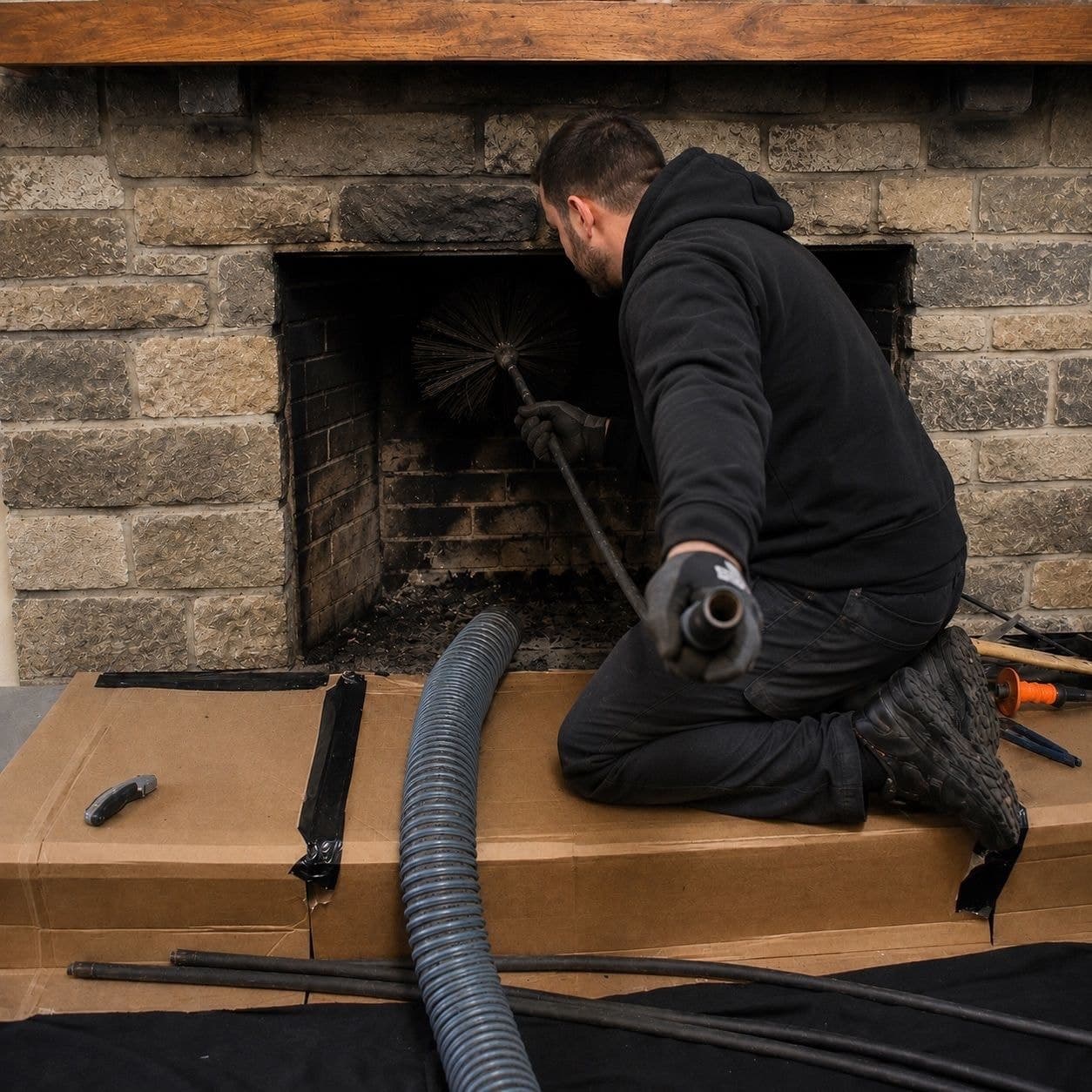
What to expect: in a Lake Mary home from the 1990s or 2000s, a sweep usually means brushing a round metal flue inside a framed chase, cleaning a firebox lined with refractory panels, and clearing the screen on the termination cap. Census estimates put the city’s median build year at 1997, with 43% of homes built in 2000 or later (Census ACS via Census Reporter). Homes of that age in Central Florida commonly have factory-built fireplaces; that’s an inference from build dates, and some custom homes here have masonry chimneys, so the first step is always confirming which you have.
How a factory-built wood fireplace is swept
Factory-built fireplace and chimney chase, cutaway
- 1Termination cap. The listed cap on top of the metal chimney pipe.
- 2Storm collar. Sealed band around the pipe that sheds water onto the chase cover.
- 3Chase cover. Sheet-metal top of the framed chase. Should slope, with a raised collar and drip edge.
- 4Chase. The wood-framed box, finished in siding or stucco, that encloses the chimney pipe.
- 5Chimney pipe. Listed metal flue sections made for this specific fireplace model.
- 6Fireplace unit. The factory-built metal firebox, tested and listed as one system with its chimney.
- 7Refractory panels. Molded liner panels lining the unit's firebox. Replaced only with listed parts.
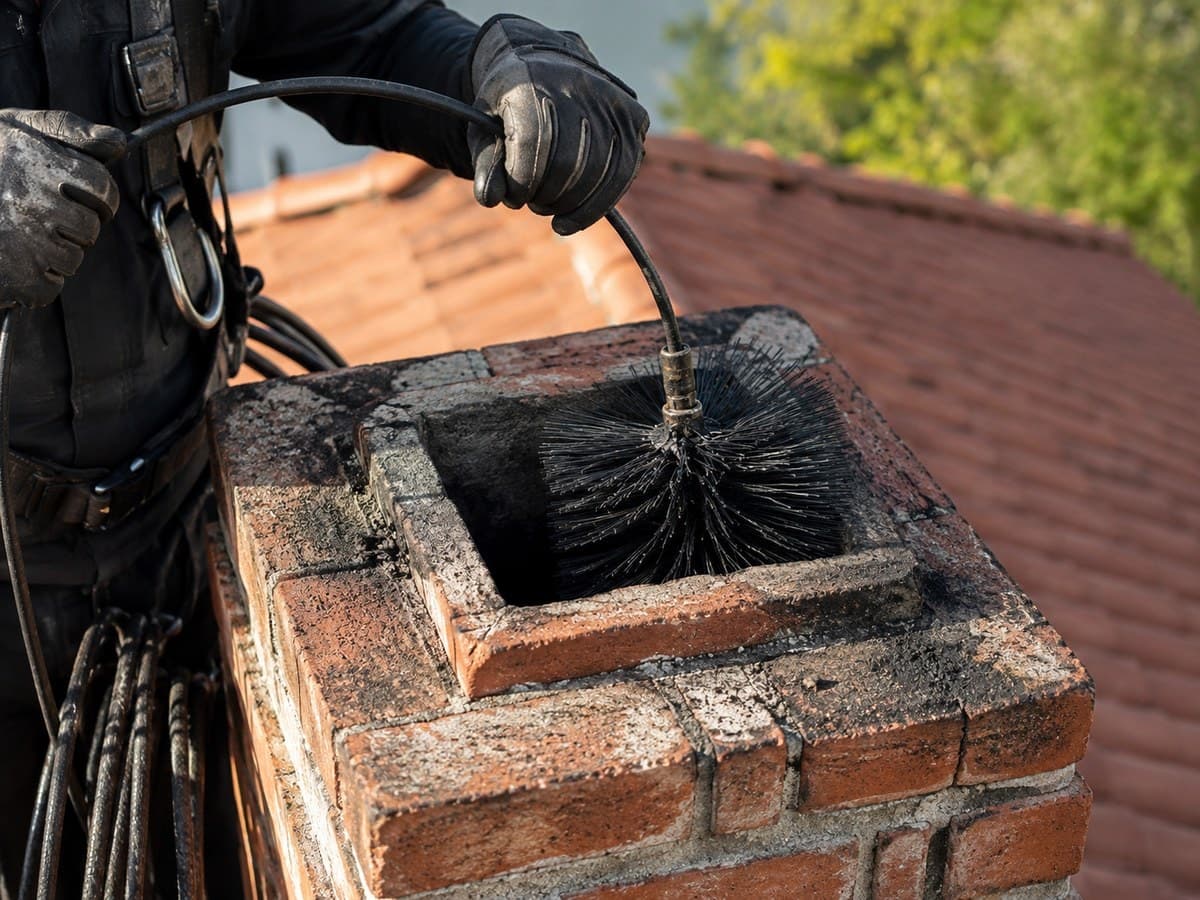
A factory-built fireplace is tested and listed as a complete system, so a sweep has to treat it gently. The metal flue gets a brush sized to its diameter and made for metal, since a stiff steel brush can score the inner wall. The refractory panels in the firebox are cleaned without scraping, because they crack and crumble more easily than firebrick. And the cap on top, which on many of these systems has a mesh spark screen, is where soot and debris tend to collect first.
What gets cleaned and looked at on a 1990s–2000s unit
- Metal flue sections, brushed full height from below, above or both
- Termination cap and its screen, cleared of soot and debris
- Refractory panels: cracks, gaps and crumbling edges
- Damper blade and linkage inside the unit
- Firebox floor, screen and any glass doors
- Signs of water from above: rust in the firebox or on the flue
A few fires a year: sweep, inspect or both?
NFPA 211 calls for chimneys, fireplaces and vents to be inspected at least once a year and cleaned when needed (NFPA 211). In a Lake Mary household that lights a handful of fires between December and February, the yearly inspection is the fixed part and sweeping is the variable part.
| How you use it | Sweep | Yearly check | What usually decides it |
|---|---|---|---|
| Never lit since you moved in | Only if debris or nests are found | Yes | Water, nests and cap condition, not creosote |
| A few fires each winter | When the check shows buildup | Yes | Soot on the cap screen and the upper flue |
| Most weekends in the cool months | Most years | Yes, with the sweep | Creosote stage and how well fires burn |
| Just bought the house | Before the first fire | Yes, before the first fire | Unknown history and last service date |
| Gas logs added to a wood-burning box | Once, to clear old wood-era deposits, then as needed | Yes | Flue and cap condition; the log set is serviced separately |
A light-use fireplace can still build up faster than expected if fires smolder. Damp or unseasoned wood and a partly closed damper produce cooler smoke, and cooler smoke leaves more deposits in a metal flue. If you’re unsure whether yours is due, the guide to how often to clean or inspect a chimney in Florida walks through the signs.
What a sweep can turn up on a 25-to-35-year-old unit
Common findings during a sweep, and where they lead
01Cracked or eroded refractory panels
- What you may notice
- Hairline cracks in the firebox walls, or crumbled pieces on the floor after a fire.
- How it’s confirmed
- Panels are checked after cleaning, when cracks are visible, and measured against the manufacturer’s replacement guidance.
02Rust or separated flue sections
- What you may notice
- Rust flakes in the firebox, or a flue that looks offset when you shine a light up.
- How it’s confirmed
- A light run up the clean flue shows corroded or separated joints.
03Damaged or non-matching cap
- What you may notice
- A cap that’s dented, loose or looks different from the one the system shipped with.
- How it’s confirmed
- From the roof, the cap is compared with what the fireplace’s listing calls for.
04Rusting chase cover
- What you may notice
- Rust streaks on the siding or stucco below the top of the chase.
- How it’s confirmed
- The cover is checked for pooling, holes and rust around the flue collar.
05Nests or debris
- What you may notice
- Chirping in spring and summer, twigs in the firebox, or smoke that won’t draw.
- How it’s confirmed
- Seen from the firebox or the top. Active chimney swift nests have to wait until the birds leave.
Parts for older factory-built units
Replacement panels, caps and flue sections have to be compatible with the fireplace’s listing, and some models from the 1990s are no longer made. If a sweep finds damage, the rating plate inside the unit (often found behind the screen or near the firebox opening) identifies the manufacturer and model. The guide to how long prefab fireplaces last covers when repair stops making sense.
Heathrow and HOA communities: exterior work after a sweep
Next door to Lake Mary, the unincorporated community of Heathrow was founded in 1985 and has about 2,200 homes in roughly 30 sub-developments (Wikipedia: Heathrow, Florida). Planned communities like it, and many subdivisions in Lake Mary proper, have associations that review exterior changes. Under Florida law, an association’s authority to approve the appearance of improvements extends only as far as its declaration of covenants and the guidelines published under it state or reasonably imply (F.S. 720.3035).
If the sweep finds the cap or chase cover needs replacing
Check your declaration and guidelines
Look for anything on roof-mounted equipment, chimney caps, colors or the chase exterior. Your management company can point you to the current version.
Decide whether it’s like-for-like
A same-style, same-color replacement is often treated differently from a new profile, a decorative shroud or a different finish. The documents say which.
Submit a request if required
Describe the part, its material and color. A photo of the existing cap and a product image usually cover it.
Schedule after approval
Keep the fireplace out of use in the meantime if the finding affects safety, such as a missing spark screen.
If you’re not sure whether you have a factory-built or masonry fireplace, the comparison in masonry vs. factory-built fireplaces shows how to tell from the firebox and the roof. A full chimney and fireplace inspection is the better booking than a sweep when you’ve just bought the house or something seems wrong.
Sweeping across Lake Mary, and when to book something else
Sweeps are available anywhere in the City of Lake Mary, from Timacuan to Woodbridge Lakes and the streets around Lake Emma. A fireplace that has sat unused for years, is heavily sooted or smells is better served by deep flue and soot cleaning in Lake Mary, and a home purchase calls for a Lake Mary chimney inspection. For everything else on the house, see chimney and fireplace services across Lake Mary. Neighboring sweep visits in Sanford and chimney sweeping in Longwood are handled the same way.
References (4)
Figures for Lake Mary and the references used on this page.