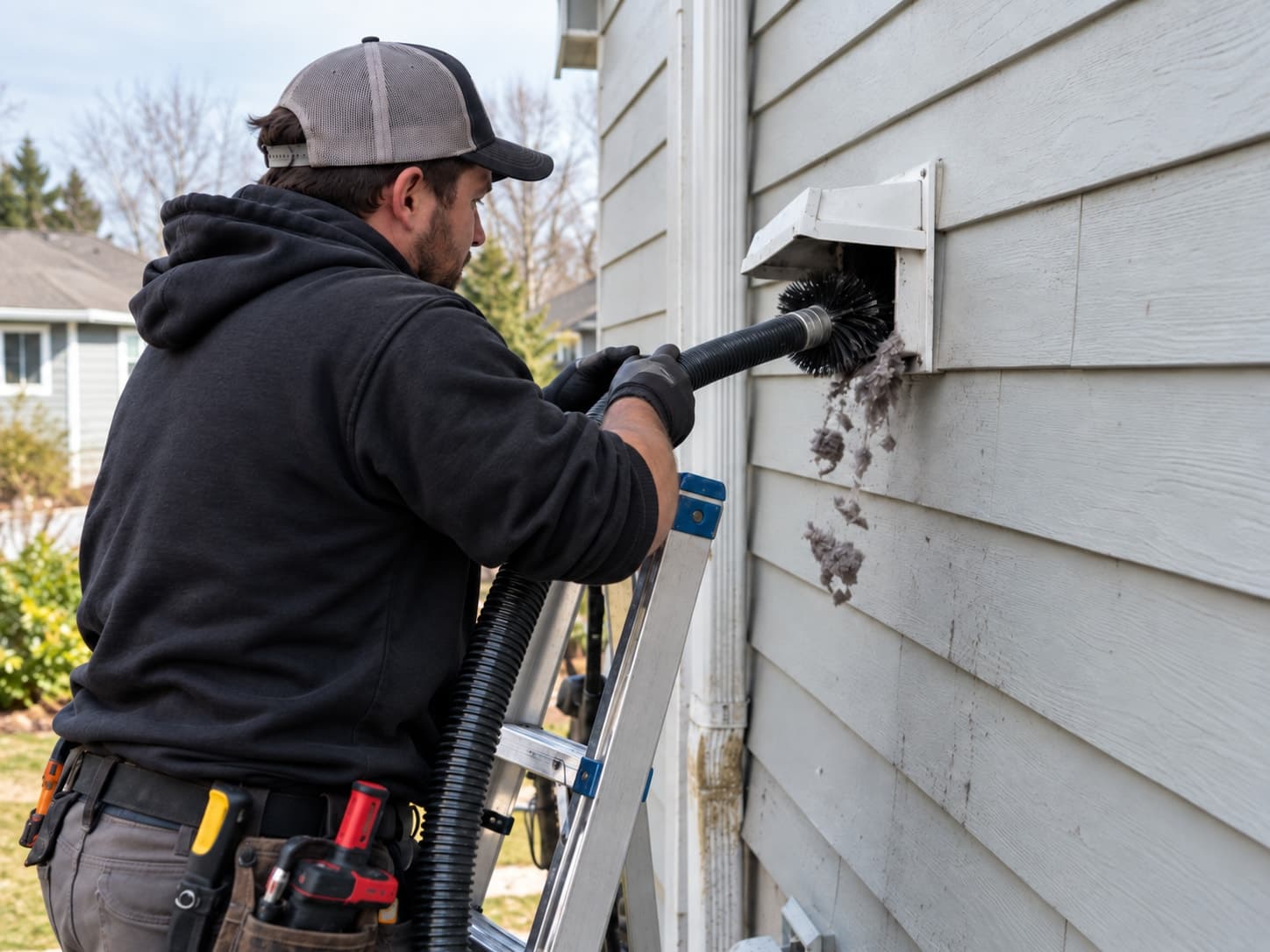
Leesburg has an even split of old and new: 32.0% of homes predate 1970 and 32.0% date from 2000 or later. Owner-occupancy is 62.6%, so rental homes are common too. That’s the backdrop for most dryer vent calls here.
Signs your dryer vent needs cleaning
- Towels or jeans need a second cycle; see slow drying and its causes
- The dryer top or the laundry room gets unusually hot: why the dryer gets so hot
- The outside flap barely moves with the dryer running, or there’s a vent that barely pushes air
- Lint behind the dryer, around the outside hood or on the roof near the cap
- A “check vent” or airflow warning on the dryer
- A burning smell during a cycle: stop the dryer first, then read about a burning smell from the dryer
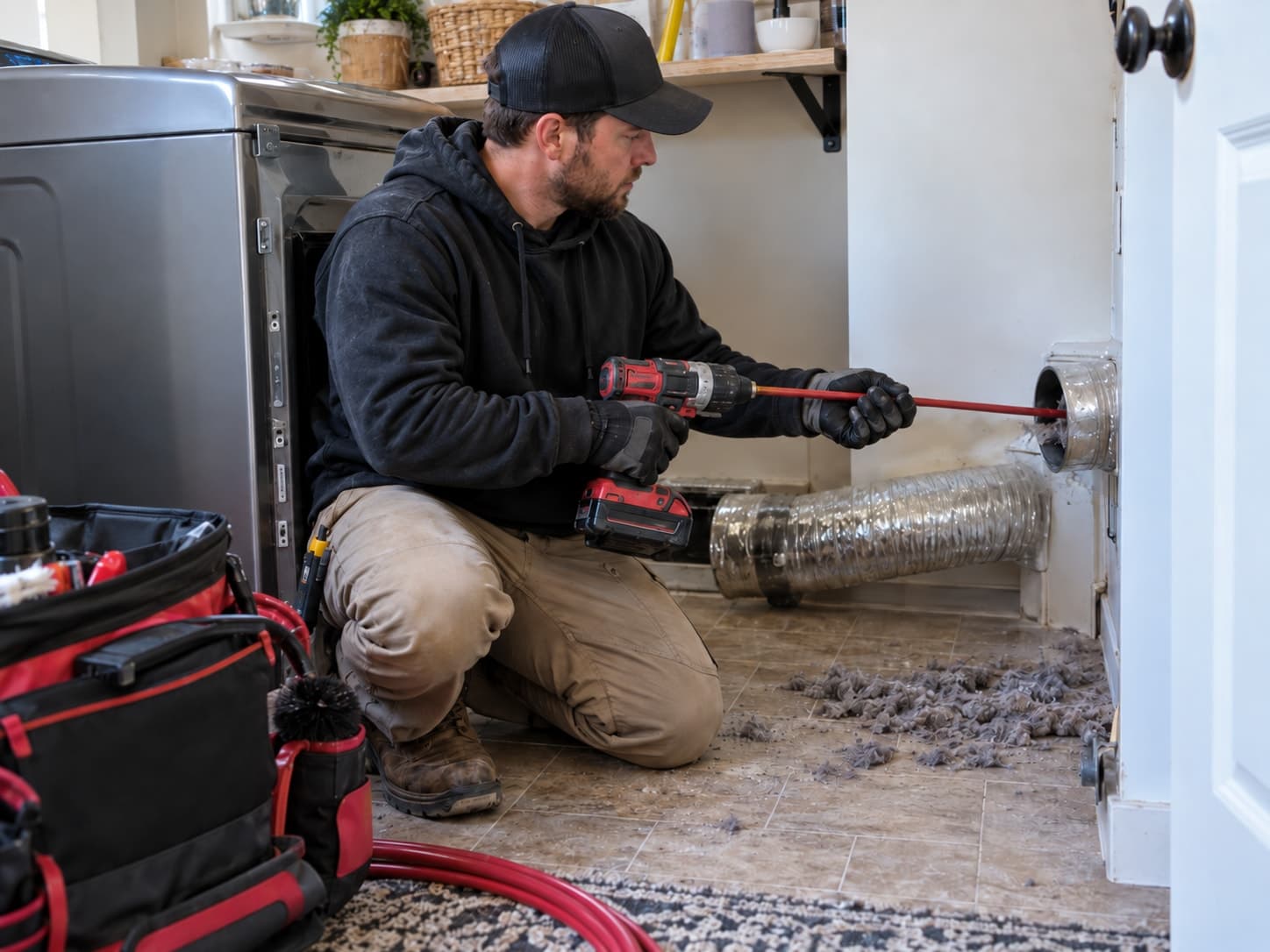
Failure to clean was the leading factor in U.S. home dryer fires in the U.S. Fire Administration’s study (USFA); more on why lint in a vent is a fire risk.
The local picture in Leesburg
In the Leesburg historic district, laundry spaces were often added to older houses, and vent routes through crawlspaces or porch walls can be long. Newer subdivisions within city limits usually have an interior laundry with a wall or roof exit. Rentals add another question: when the vent was last cleaned.
Where this page applies
Several subdivisions with Leesburg addresses are outside city limits; this page follows the City of Leesburg.
From the dryer to the outside
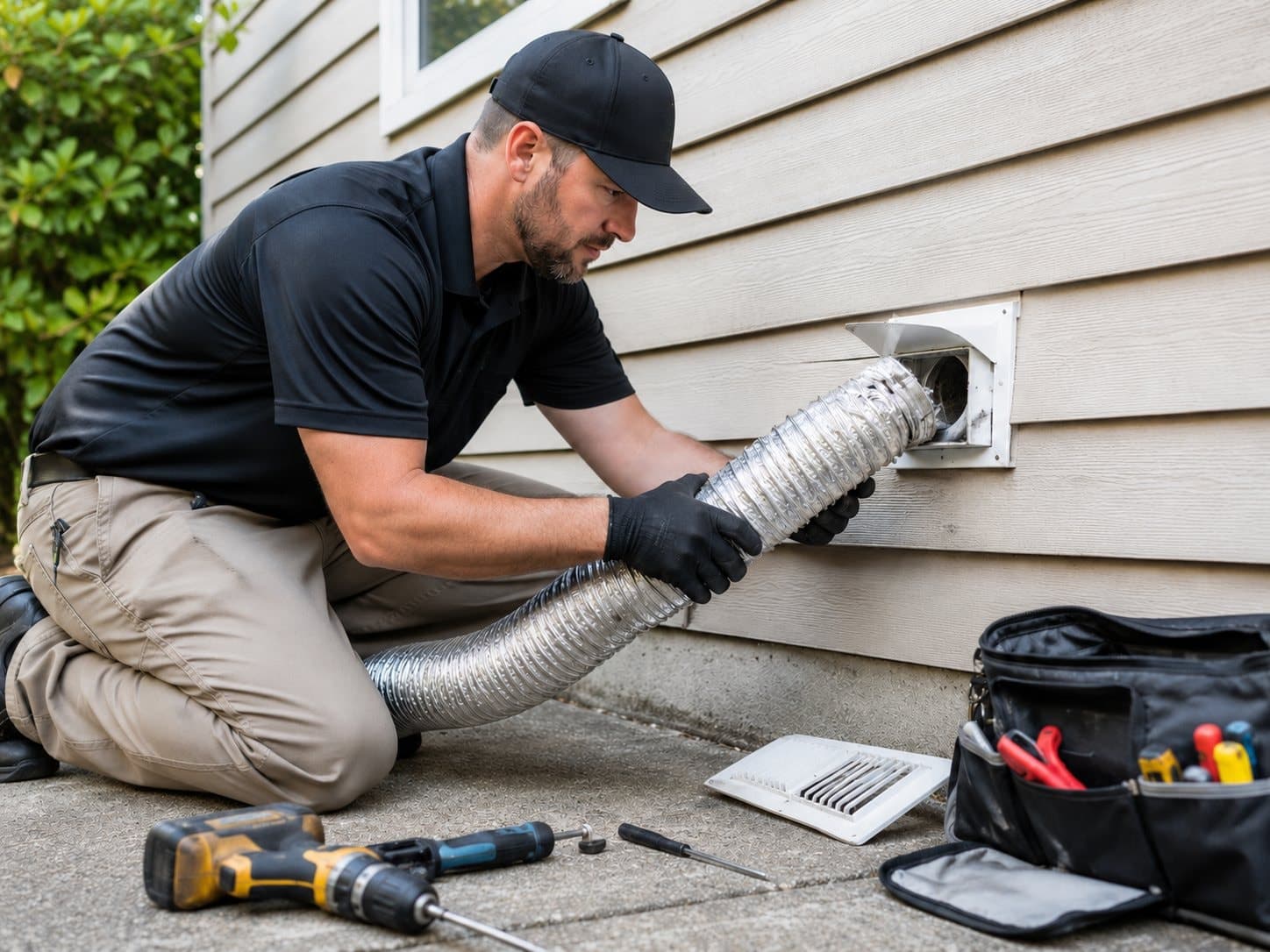
A dryer vent has three parts, and lint collects in all of them. Behind the dryer is the transition duct, the short connector that gets pushed against the wall and crushed. Inside the house is the duct run itself, through a wall, a floor or the attic, with elbows where the air slows and lint drops out. Outside is the termination, a wall hood or roof cap with a backdraft damper that should open with the airflow and close when the dryer stops.
Cleaning covers all three, with airflow read before and after at the same point so the numbers can be compared honestly. Florida’s code also sets limits on the duct itself, summarized in dryer exhaust rules in Florida.
Where your vent ends matters
A first-floor laundry on an outside wall usually has a short run to a wall hood; lint collects behind the flap, and a flap that won’t open is a common result. An upstairs or interior laundry more often climbs through the attic to a roof cap, where lint slows down and packs under the cap. Roof ends are cleared from the roof when it’s safe to get up there, and tile needs care underfoot.
For roof-specific work, see roof-terminated dryer vent cleaning; for a broken, screened or wrong hood, replacing the vent hood.
Cleaning vs. repair, blockage and inspection
| Feature | Dryer vent cleaning | Related services |
|---|---|---|
| Lint | Normal buildup along the duct and at the exit | Packed or escaped lint: removal of packed or escaped lint |
| Airflow | Restricted by lint | Stopped by a nest or plug: clearing a blocked or nested vent |
| The duct | Intact, just dirty | Crushed, loose or foil: dryer duct repair |
| The route | Within the code’s length limit | Too long or too bent: moving the vent to a shorter route |
| The question | “Is it clean?” | “Is it right?”: a dryer vent inspection |
Lint
- Dryer vent cleaning
- Normal buildup along the duct and at the exit
- Related services
- Packed or escaped lint: removal of packed or escaped lint
Airflow
- Dryer vent cleaning
- Restricted by lint
- Related services
- Stopped by a nest or plug: clearing a blocked or nested vent
The duct
- Dryer vent cleaning
- Intact, just dirty
- Related services
- Crushed, loose or foil: dryer duct repair
The route
- Dryer vent cleaning
- Within the code’s length limit
- Related services
- Too long or too bent: moving the vent to a shorter route
The question
- Dryer vent cleaning
- “Is it clean?”
- Related services
- “Is it right?”: a dryer vent inspection
Gas dryers
A gas dryer’s exhaust carries combustion products, including carbon monoxide, so a blocked or disconnected vent matters more. Keep working CO alarms. We work on the exhaust side only; gas-line work is a separate job from appliance service, and we carry that out too.
Homes, rentals and timing
| Household | Typical interval |
|---|---|
| Small household, short wall run | About once a year, or longer if airflow holds |
| Large family, pets or daily loads | More often than once a year |
| Long attic run or roof exit | Sooner than a short wall vent |
| Rental or vacation home | By occupancy, not the calendar (cleaning scheduled around tenants and guests) |
With 62.6% of Leesburg homes owner-occupied, more than a third are rented, and a rental dryer’s vent is easy to lose track of between tenants. The full schedule is in how often a vent needs cleaning, and telling a vent problem from a dryer problem helps when you’re not sure the vent is the cause.
Dryer vent service around Leesburg
- Anywhere in Leesburg, including the Leesburg Historic District: mention where the vent exits and the dryer type
- Nearby: vent cleaning for Fruitland Park homes, dryer vents in Tavares and Lady Lake dryer duct cleaning
- Everything else for the house: services for homes across Leesburg
For the full background, see dryer vent cleaning, step by step and the 35-foot rule and other code limits.
References (3)
Figures for Leesburg and the references used on this page.