Astatula is a small town where 38.3% of homes are manufactured and 80.4% are owner-occupied, with a median home built in 1995. Here’s how that shapes a dryer vent cleaning.
What a restricted dryer vent looks like
| What you notice | What it usually means |
|---|---|
| Loads need two cycles | Lint is restricting airflow somewhere in the duct (what slow drying usually means) |
| Dryer or laundry room runs hot | Heat and moisture can’t leave fast enough (an overheating dryer) |
| Weak air at the outside exit | A packed elbow, a stuck flap or a crushed section (little or no air leaving the vent) |
| Lint around the hood or roof cap | Lint is packing at the termination and escaping around it |
| Burning or scorched smell | Stop the dryer; lint near a heat source is the concern (a burning smell from the dryer) |
Lint is highly flammable, and a clogged duct makes the dryer run hotter. That’s why slow drying is worth acting on, not just living with.
What we see in Astatula
In a manufactured home, the dryer often vents through the floor or a wall to the outside at skirting level. HUD’s manufactured-home standard requires dryer exhaust to go outside and not to end beneath the home. A duct that has come loose under the floor dumps lint and moisture under the house, so the cleaning checks that the duct actually reaches the outside.
How a dryer duct cleaning visit works in Astatula
Find the route
Where the vent ends (wall, soffit area or roof) and roughly how the duct gets there.
Before reading
Airflow at the exit with the dryer on a no-heat setting.
Pull the dryer out
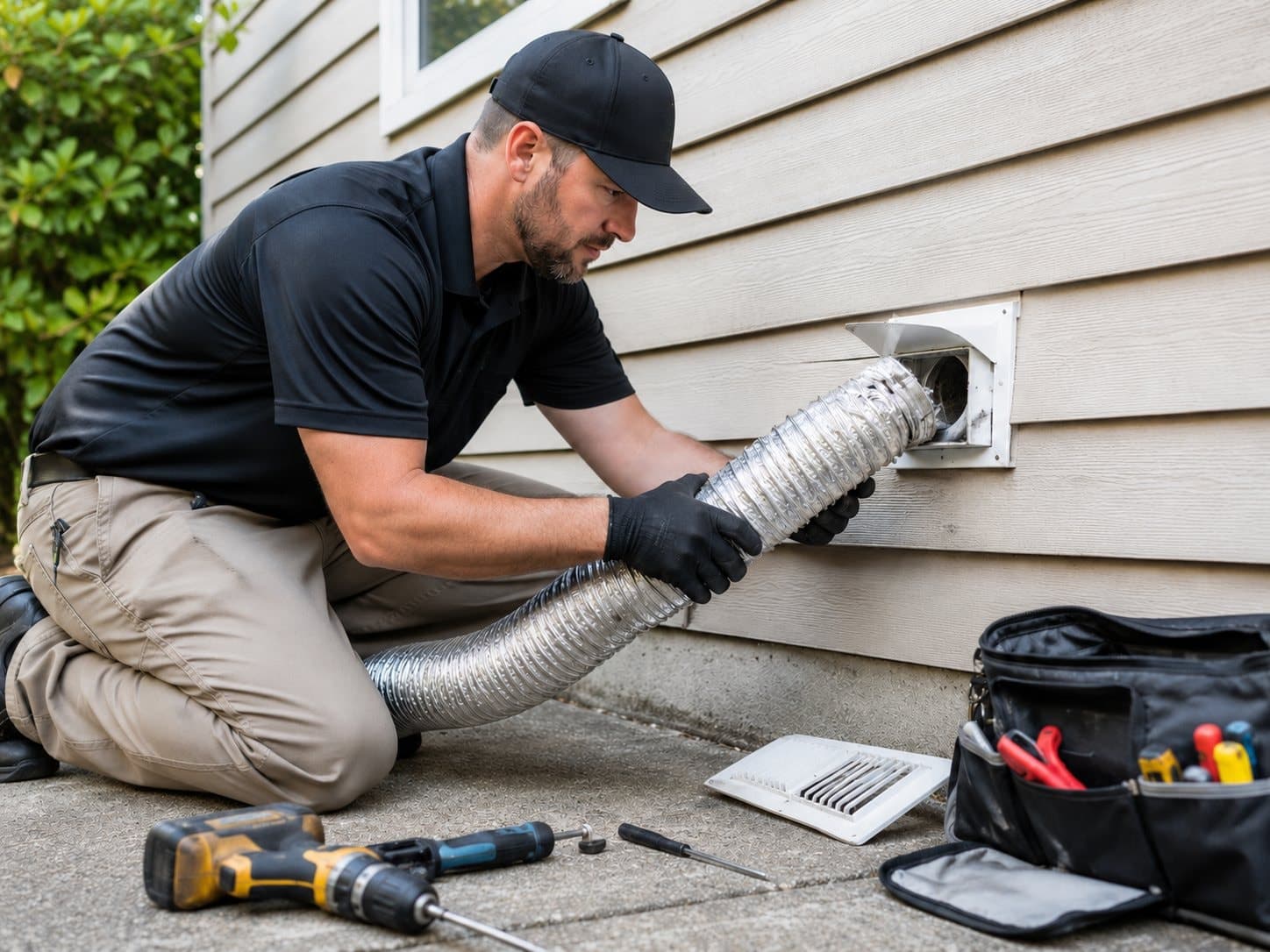
The transition duct is disconnected and checked for crushing; lint is vacuumed from the dryer outlet.
Brush and vacuum the run
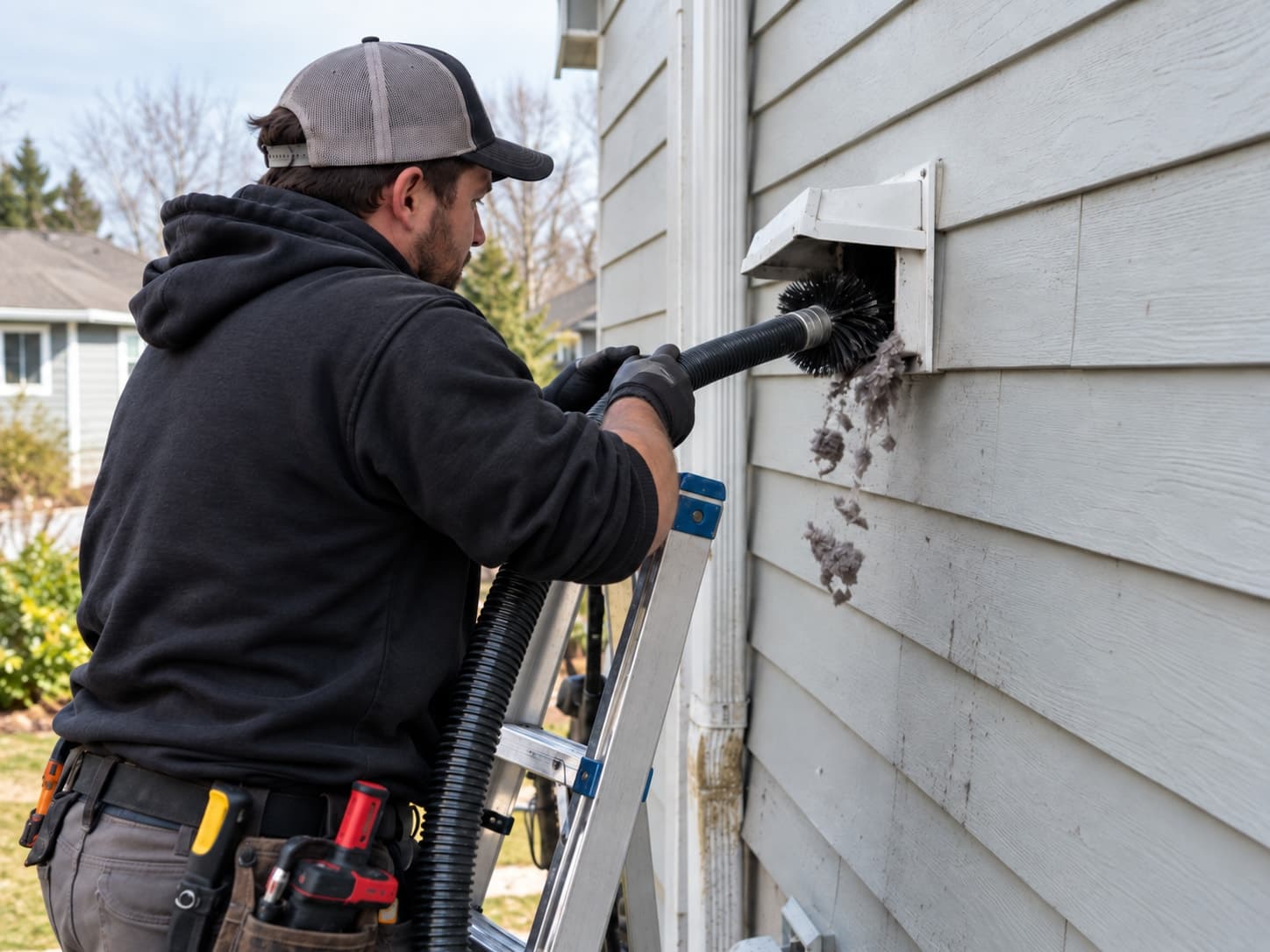
Rotary brushes on flexible rods work through the exhaust duct while a vacuum pulls the lint out.
Clear the exit
Lint behind the flap or under the cap is removed and the damper is checked.
Reconnect and re-test
The dryer goes back without crushing the hose, and airflow is read again.
Where your vent ends matters
A first-floor laundry on an outside wall usually has a short run to a wall hood; lint collects behind the flap, and why the outside flap sticks is a common result. An upstairs or interior laundry more often climbs through the attic to a roof cap, where lint slows down and packs under the cap. Roof ends are cleared from the roof when it’s safe to get up there, and tile needs care underfoot.
For roof-specific work, see cleaning a vent that exits through the roof; for a broken, screened or wrong hood, a new vent cover with a working damper.
Cleaning vs. repair, blockage and inspection
| Feature | Dryer vent cleaning | Related services |
|---|---|---|
| Lint | Normal buildup along the duct and at the exit | Packed or escaped lint: lint removal for badly packed ducts |
| Airflow | Restricted by lint | Stopped by a nest or plug: dryer vent blockage removal |
| The duct | Intact, just dirty | Crushed, loose or foil: fixing the duct itself |
| The route | Within the code’s length limit | Too long or too bent: dryer vent rerouting |
| The question | “Is it clean?” | “Is it right?”: a full vent inspection against the code |
Lint
- Dryer vent cleaning
- Normal buildup along the duct and at the exit
- Related services
- Packed or escaped lint: lint removal for badly packed ducts
Airflow
- Dryer vent cleaning
- Restricted by lint
- Related services
- Stopped by a nest or plug: dryer vent blockage removal
The duct
- Dryer vent cleaning
- Intact, just dirty
- Related services
- Crushed, loose or foil: fixing the duct itself
The route
- Dryer vent cleaning
- Within the code’s length limit
- Related services
- Too long or too bent: dryer vent rerouting
The question
- Dryer vent cleaning
- “Is it clean?”
- Related services
- “Is it right?”: a full vent inspection against the code
Homes, rentals and timing
| Household | Typical interval |
|---|---|
| Small household, short wall run | About once a year, or longer if airflow holds |
| Large family, pets or daily loads | More often than once a year |
| Long attic run or roof exit | Sooner than a short wall vent |
| Rental or vacation home | By occupancy, not the calendar (vent care for landlords and property managers) |
In a manufactured home, the cleaning also confirms the duct reaches the outside, since HUD’s standard doesn’t allow it to end beneath the home (24 CFR 3280.708). The full schedule is in a realistic cleaning schedule, and vent or appliance: how to tell helps when you’re not sure the vent is the cause.
Dryer vent cleaning across Astatula
Cleaning is available throughout Astatula, from Tula Parc to the newest streets. When you book, tell us where the vent seems to end, whether the dryer is gas or electric, and whether it’s stacked or in a closet. For other work on the house, see everything we handle in Astatula. Nearby, the same service covers dryer vents in Tavares, Howey-in-the-Hills dryer duct cleaning and lint and airflow work in Minneola.
The service in depth: dryer vent cleaning, step by step. For vacation homes, see dryer vents in vacation rentals.
References (4)
Figures for Astatula and the references used on this page.
- 1Census Reporter: Astatula, FL (ACS 2024 5-year)
- 2U.S. Fire Administration, Clothes Dryer Fires in Residential Buildings, Topical Fire Report v13i7
- 3Florida Building Code, Residential 2023, Chapter 15 (M1502 Clothes Dryer Exhaust)
- 424 CFR 3280.708: Exhaust duct system for clothes dryers in manufactured homes (eCFR)